Oil roti, dhal puri, metemgee and duff, channa and aloo, salara and pine tarts. Explore familiar Guyanese food first, with clear explanations for visitors and a separate place for the wider collection of kitchen variations.
Roti to tear and share, a favorite snack, a bowl that brings back memories. These are reference photographs of food—not photographs of kitchen-tested results for our recipe adaptations.
Roti, ready to tear and share.
Clapped Guyanese roti, photographed by DJLYX. Explore the recipe →Photo: DJLYX · CC BY 3.0. Displayed in a cropped frame; original license applies.
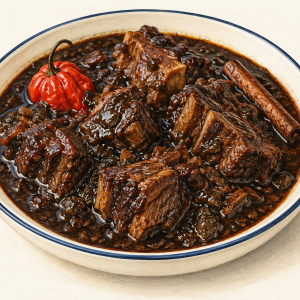
Pepperpot, photographed in Brooklyn. A food reference, not the result of our lamb adaptation. Explore Guyanese food culture →Photo: Simon Abrams · CC BY 2.0. Displayed in a cropped frame; original license applies.
FIND SOMETHING GOOD TO COOK
Guyanese food, by the names we know.
Dhal and rice, fry bora, channa and aloo, black-eye cook-up, oil roti fresh off the tawah. Start with familiar Guyanese dishes, then explore the clearly marked kitchen variations. Local names come first; the kitchen guide helps visitors follow along.
Recipes here are untested home-kitchen adaptations. Names and methods vary by family and community. We do not claim these are heirloom family recipes or professionally tested recipes. Follow ingredient packaging, safe cooking temperatures, and your own taste. A cup is 240 ml, a tablespoon 15 ml, and a teaspoon 5 ml.
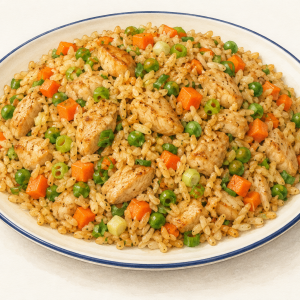
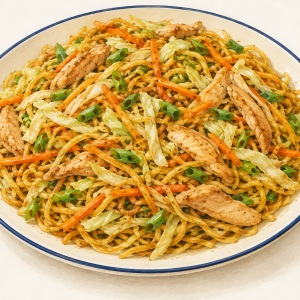
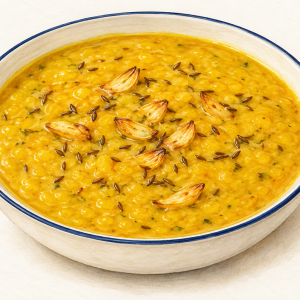
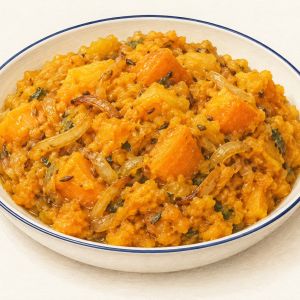
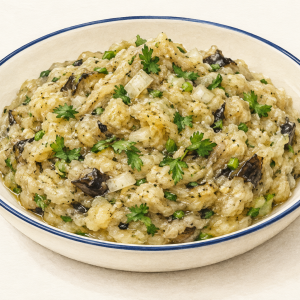
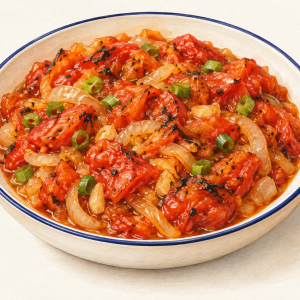
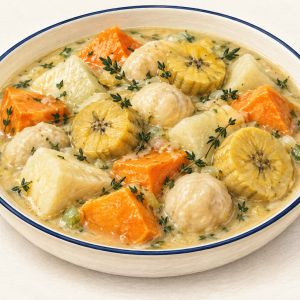
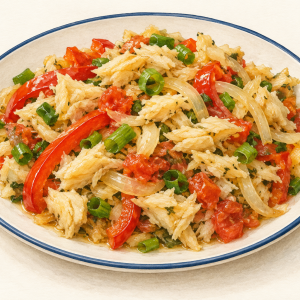
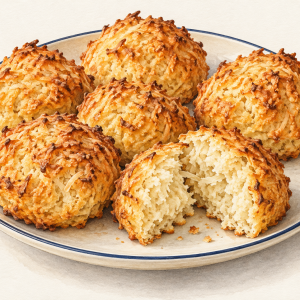
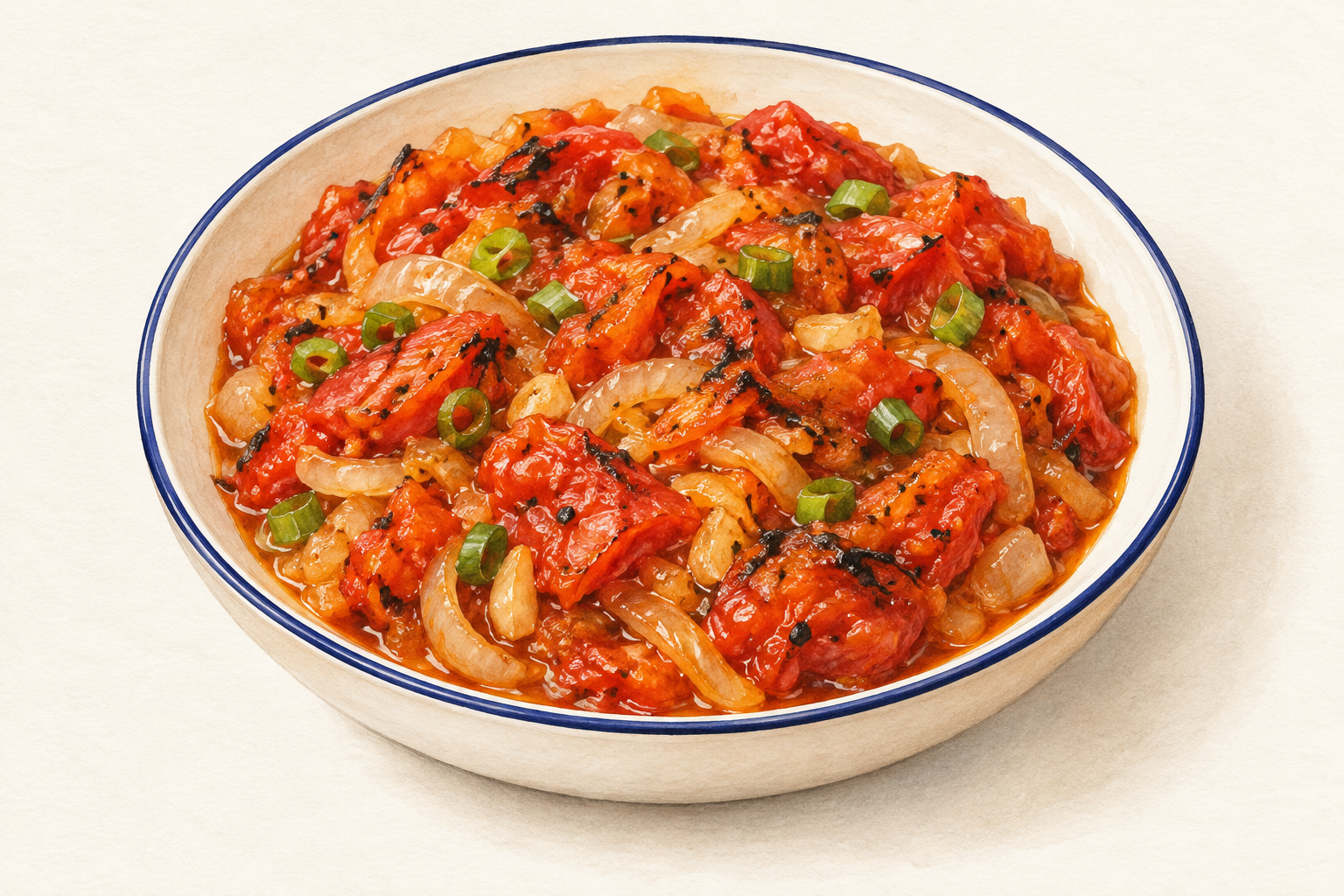
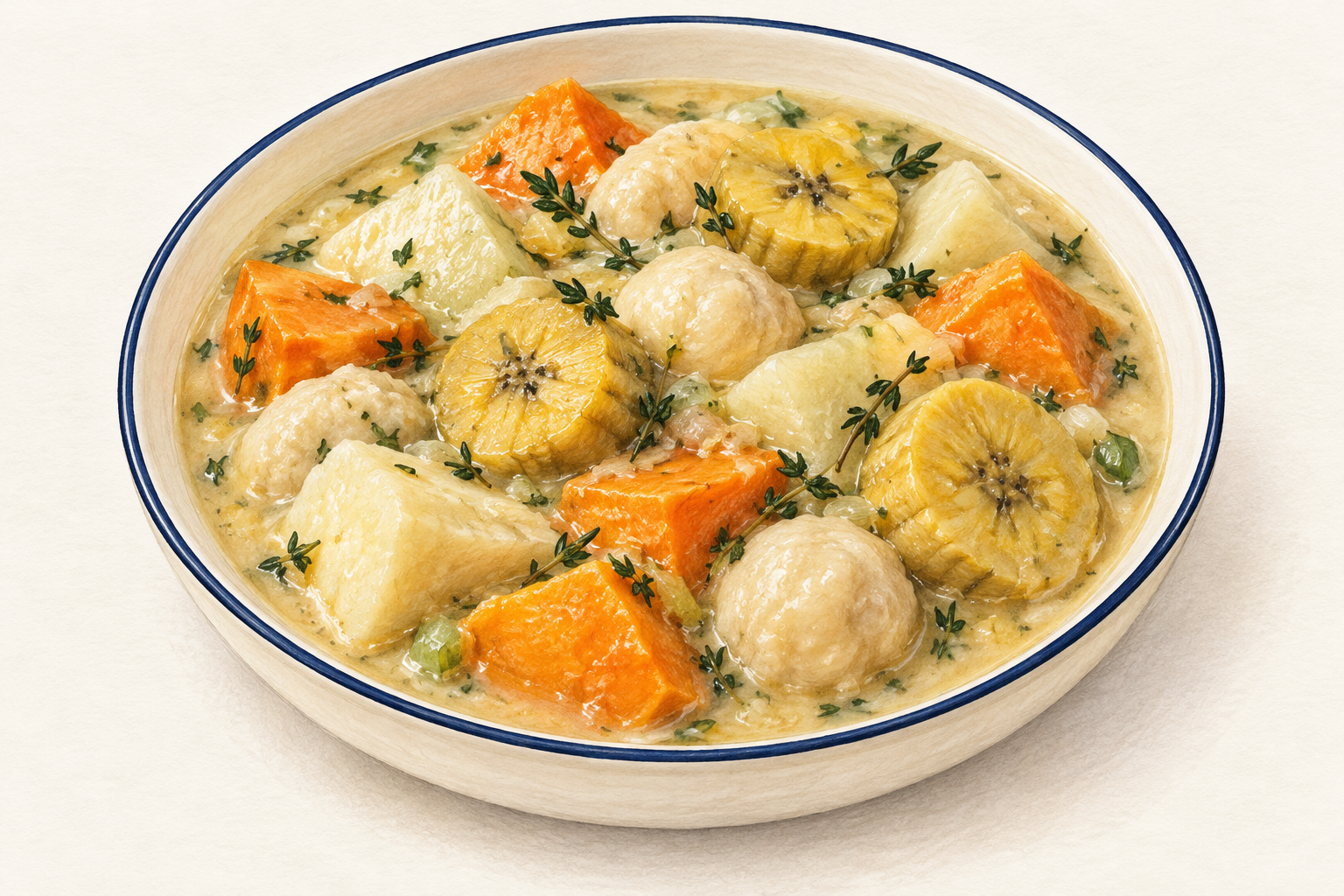
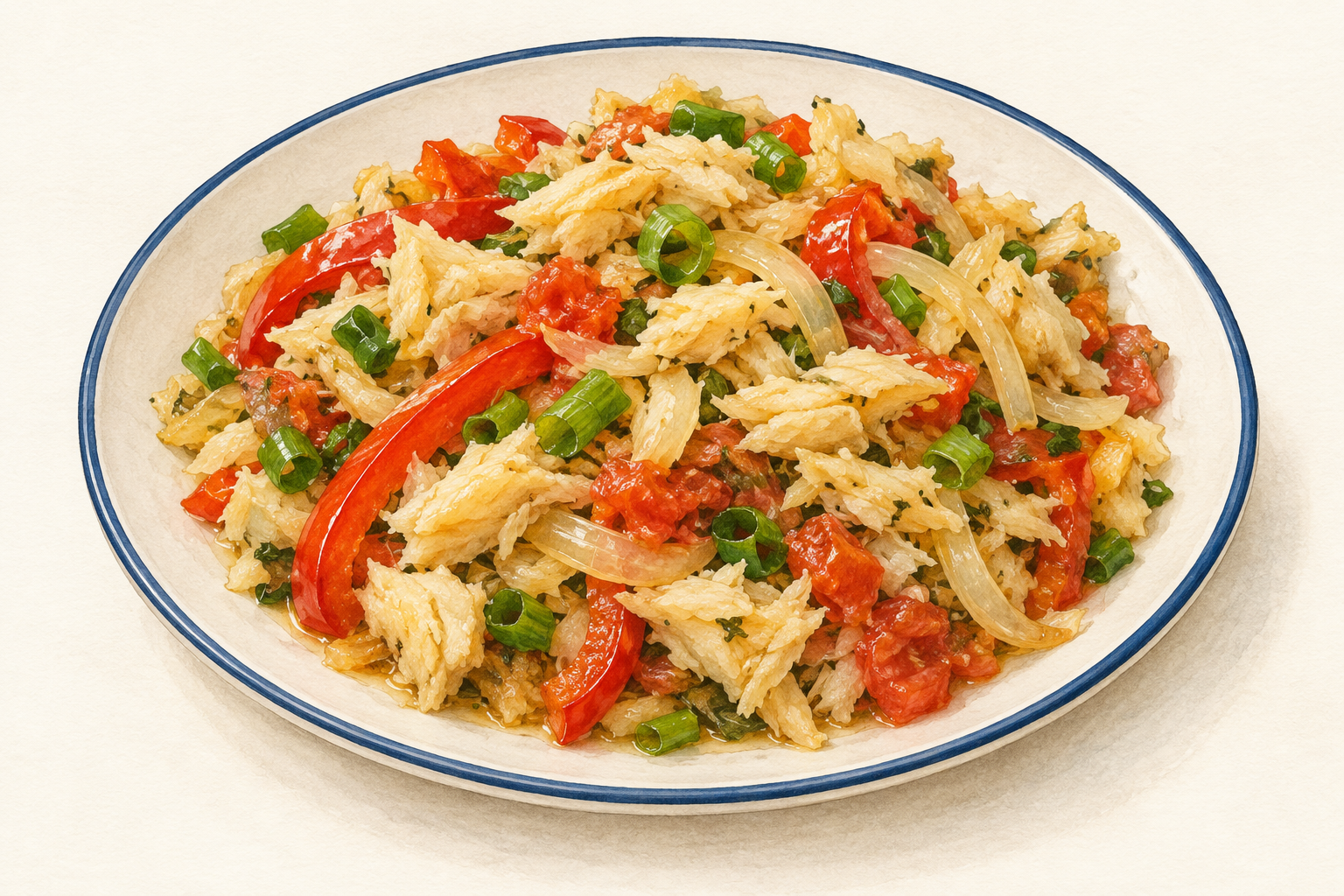
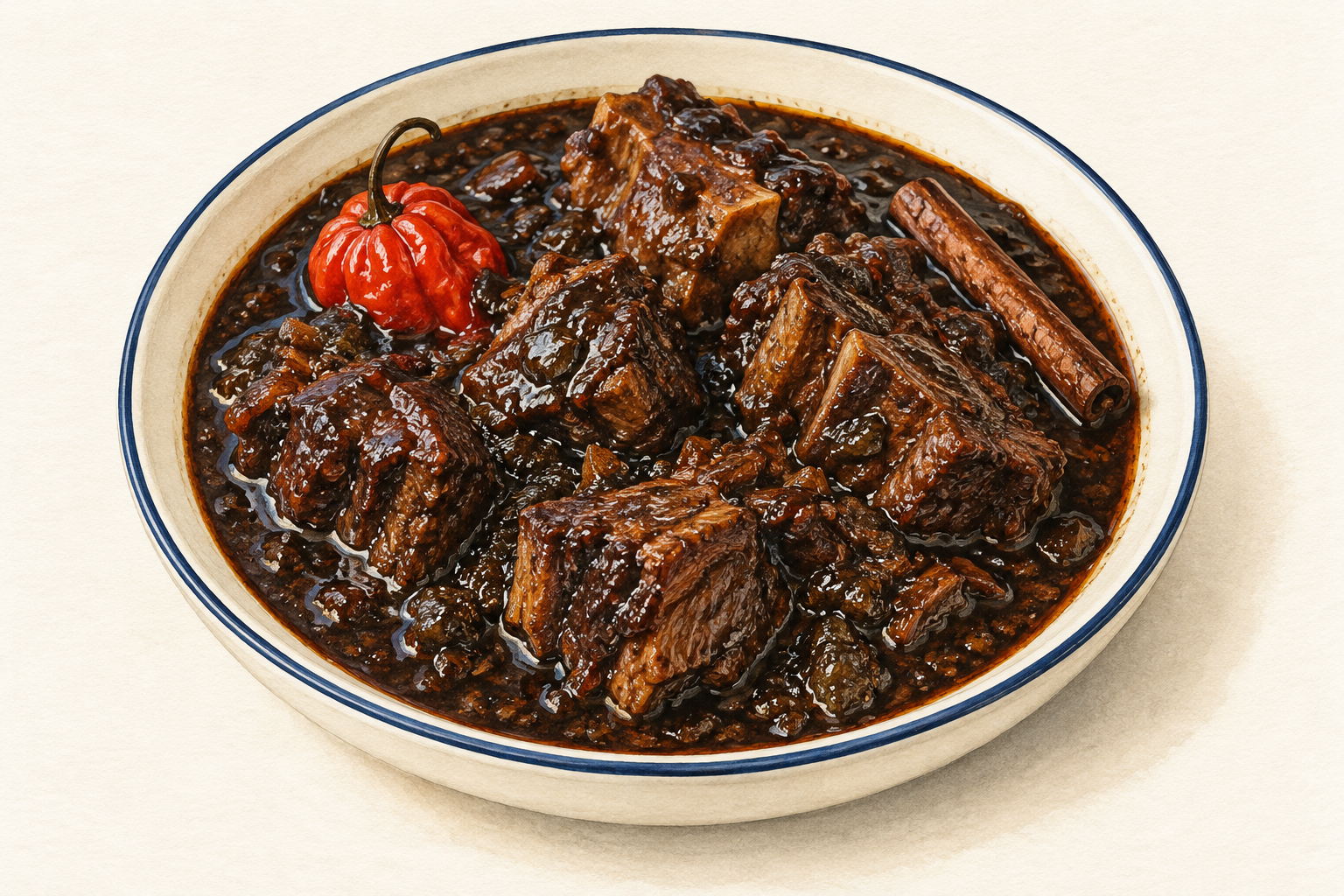
Selected dishes include real reference photographs or clearly labeled AI illustrations. Reference photographs show the food, not kitchen-tested results for these adaptations. Other recipes currently have no food image.
Local names come first. Explore Guyanese staples alongside clearly labeled diaspora, Caribbean and wider-table adaptations. Bakery-counter recipes are original home adaptations; Persaud Travel is not affiliated with or endorsed by Sybil’s.
Guyanese kitchen guide: local names, seasoning & techniques
Names on the plate
Aloo: potato. Sweet potato remains sweet potato; they are not interchangeable.
Channa: chickpeas.
Boulanger / baigan: eggplant. Family usage varies.
Ochro / okro: okra.
Bora: yardlong beans, not a new name for every type of green bean.
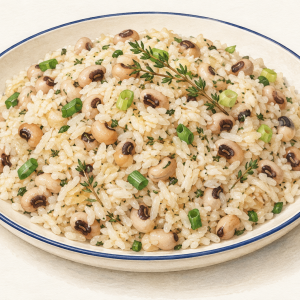
Black-eye peas: black-eyed peas, familiar in cook-up rice.
Shallot: here, the green seasoning onions sold as scallions or spring onions—not the small bulb shallots in a U.S. grocery store.
Names for the method
Geera: cumin. Ground roasted geera and whole seeds used in a chunkay give different finishes.
Chunkay: a finishing of hot oil, garlic, and spices stirred into dhal or kitchri.
Duff: steamed dumplings served with metemgee. Keep the lid on while they steam.
Tawah / tawa: the flat cooking surface for roti.
Bunjal: cooking down in the seasoning for a concentrated finish; not every curry is a bunjal curry.
Wiri wiri: a small, hot pepper. Start with a little and build the heat; a whole pepper can still season the pot.
A simple green seasoning
Blend 4 chopped shallot (scallions), 6 garlic cloves, 1 tablespoon fresh thyme leaves, 2 tablespoons chopped celery leaves, ¼ cup parsley, and 2–3 tablespoons water. Add a little wiri wiri if wanted. Use about 2 tablespoons for 700 g–1 kg meat before cooking. This is a suggested blend; herbs differ by household. Keep covered in the refrigerator and use within 3 days. Keep any seasoning that touched raw meat separate.
Garam masala, curry powder, and geera are different seasonings; those names are not interchangeable ingredients.
PUT A GOOD PLATE TOGETHER
What goes with what?
Making gilbaka curry, a pot of cook-up, or garlic shrimp pasta? Choose your main and get a ready-to-cook meal idea. Mix Guyanese favorites with familiar American sides when that suits your table.
Choose a main, then select “Build my meal” for linked recipe suggestions.
Suggestions are flexible menus, not nutrition plans or allergy checks. “Vegetarian mains” filters the main dish; read every selected recipe for ingredients, egg, dairy, seafood and other allergens. Pairing names describe inspiration, not a claim that every combination is traditional.
Prayer tables, celebrations & something sweet
Explore roat (rote / roth), lapsi with puri, parsad, sirnee, and spiced halwa. These foods belong to different family, faith and life-event traditions; they are not one interchangeable religious menu. Ask your family, pandit or community about preparation, ingredients and offering requirements. These home adaptations do not certify suitability for a ritual.
A NEW WAY TO MAKE THE FAMILIAR
Air fryer days. Guyanese flavors.
From fry-fish-style fillets, egg ball and aloo balls to chicken patties, pine tarts and coconut buns: familiar flavors for small-batch air frying and baking. Browse 30 air fryer adaptations with ingredients, both °F and °C, doneness checks and ideas for what to serve alongside.
Use a single layer and work in batches. Turn or shake when the recipe calls for it; start checking at the early end of the range.
Keep the food names honest.
These are modern adaptations. Bunjal and stew keep their pot-cooked methods; air-roasted boulanger will not taste flame-roasted.
Wet batter needs another method.
Keep raw pholourie and traditional bigannie / byganie wet batter out of the basket. Our bigannie adaptation uses a dry coating. Pastries and buns use a suitable baking tray.
Cooking ranges are starting estimates, not tested guarantees. Poultry and reheated leftovers: 165°F / 74°C; fish and shrimp: 145°F / 63°C. Use a food thermometer. Follow appliance and liner instructions; never preheat with loose paper inside. Official temperature guide ↗ For already-fried snacks or pastries, reheat in a single layer at about 350°F / 175°C, check from 4 minutes and continue until leftovers reach 165°F / 74°C; dense pieces take longer. This reheats cooked food—it does not cook raw wet batter. For pastry and buns, use an appliance-approved ovenproof tray inside the basket, leave airflow around it and check the underside as well as the top. Keep unbaked dough and cooked fillings refrigerated between batches. Baking-dish guidance ↗
580 recipes in 15 categories. Browse 12 recipes at a time, or search by dish or ingredient.
No recipes match those filters. Try a different dish or ingredient, or clear the filters.
63 RECIPES IN THIS CATEGORY
Breads & snacks
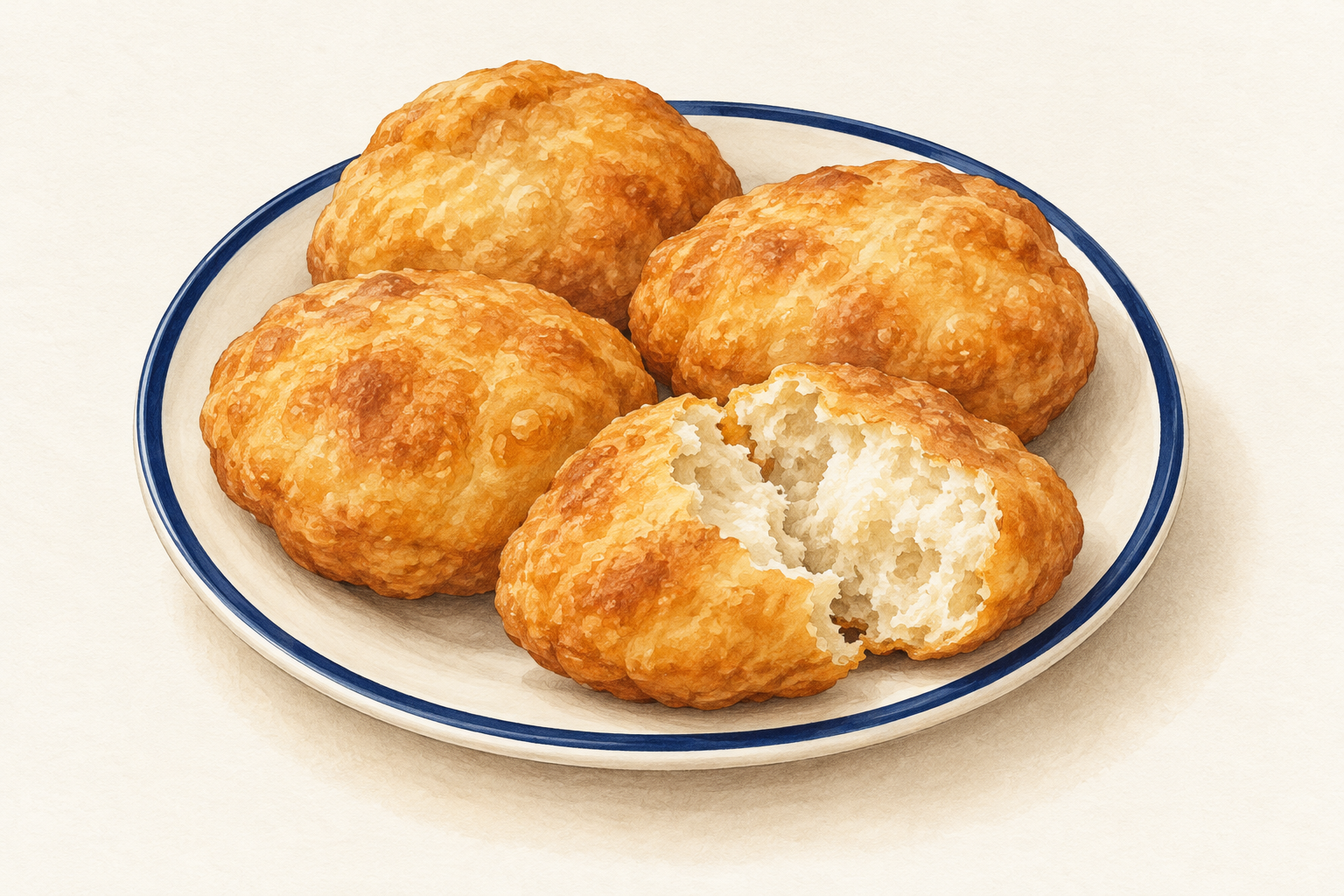
Bake (fry bake)Makes 8 · About 50 minutes · Vegetarian
AI-generated illustration of Fried bake; not a photograph of a tested recipe result.
Golden fried bread for breakfast or a snack. Serve with the saltfish recipe below, or enjoy with butter or a filling you like.
Ingredients
2 cups all-purpose flour (about 250 g), plus a little for shaping
2 teaspoons baking powder; 1 tablespoon sugar; ½ teaspoon salt
1 tablespoon softened butter; about ¾ cup water
Neutral oil for frying, about 3 cm deep in a heavy pan
Method
Mix flour, baking powder, sugar, and salt. Rub in butter. Add water gradually until a soft, slightly tacky dough forms; you may not need every drop.
Knead gently for 2 minutes. Cover and rest for 20 minutes. Divide into 8 balls, then flatten each to a round about 1 cm thick.
Heat oil to 350°F / 175°C in a deep, heavy pan, no more than half full. Fry 2–3 rounds at a time for about 2–3 minutes per side, turning carefully, until puffed and golden with no doughy center.
Drain on a rack or paper towels and serve warm. Let the oil return to temperature between batches.
Contains wheat and milk. Keep water away from hot oil and never leave the pan unattended.
Reference photograph: Clapped Guyanese roti, photographed by DJLYX. Not a photograph of a tested result for this adaptation. Photo: DJLYX · CC BY 3.0. Cropped frame; original license applies.
A home-style layered roti adaptation. The rest periods help the dough stretch without tearing.
Ingredients
3 cups all-purpose flour (about 375 g), plus extra for dusting
1 teaspoon baking powder; ½ teaspoon salt
About 1¼ cups warm water
6 tablespoons neutral oil, divided, plus a little for the pan
Method
Mix flour, baking powder, and salt. Gradually add water to make a soft dough. Knead for 5 minutes, cover, and rest for 20 minutes.
Divide into 6 balls. Roll each into a thin circle about 20 cm across. Brush with 1 tablespoon oil, dust lightly with flour, and cut a single slit from the center to the edge.
Roll from one side of the slit around the circle into a cone. Tuck the tip and loose edge inward to form a rounded parcel. Cover and rest for another 20 minutes.
Roll each parcel gently into a circle about 20 cm across. Cook on a lightly oiled tawa or heavy skillet over medium heat for about 1–2 minutes per side, brushing lightly with oil, until brown spots appear and the dough is cooked.
Fold or gently clap the warm roti inside a clean kitchen towel to loosen the layers. Keep covered while cooking the rest.
Contains wheat. Handle the hot roti through the towel rather than with bare hands.
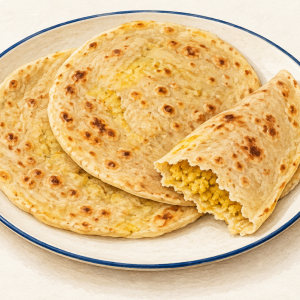
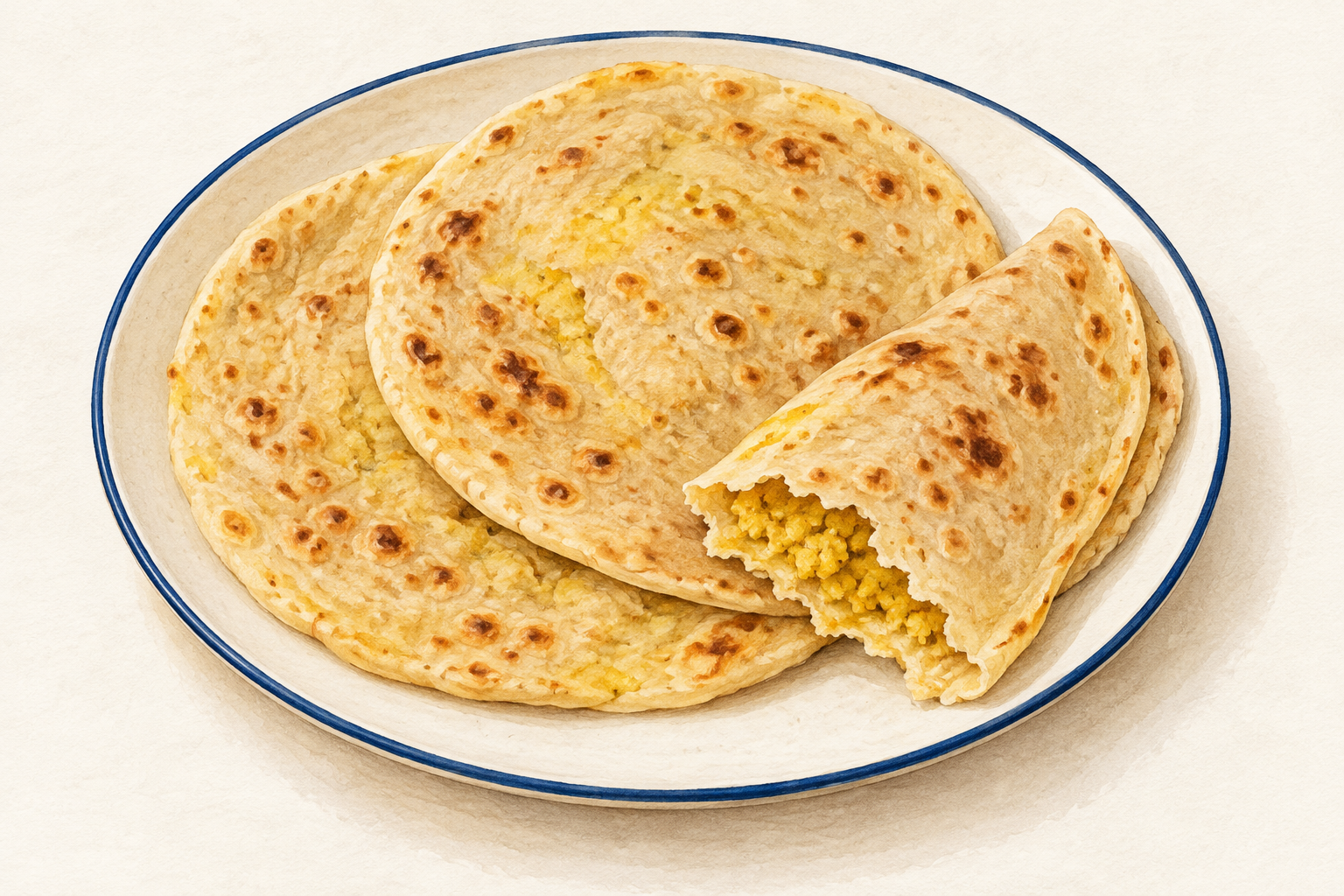
Dhal puriMakes 6 · About 2 hours · Vegetarian
AI-generated illustration of Dhal puri; not a photograph of a tested recipe result.
Thin flatbreads filled with seasoned ground split peas. Aim for a dry, fine filling so the dough rolls without bursting.
Ingredients
¾ cup dried yellow split peas, rinsed; water for boiling
About 1¼ cups warm water; 2 tablespoons neutral oil, plus more for cooking
Method
Cover peas generously with water and boil for 25–40 minutes until tender enough to crush but still holding their shape. Drain very well and let steam-dry.
Pulse cooled peas with garlic, geera, and ¼ teaspoon salt into fine crumbs. If damp, stir in a dry skillet over low heat until loose and dry; cool.
Mix flour, baking powder, and remaining salt. Add water gradually and the oil to make a soft dough. Knead for 5 minutes, cover, and rest for 30 minutes.
Divide dough and filling into 6 portions. Flatten a dough ball, cup it in your hand, add a portion of filling, and pinch the dough closed around it. Rest seam-side down for 10 minutes.
Dust lightly with flour and roll gently to about 20 cm across, keeping the filling enclosed. Cook on a lightly oiled tawa over medium heat for about 1–2 minutes per side, until lightly browned and cooked through. Keep under a clean towel.
Contains wheat. New to filled roti? Roll slightly thicker on your first attempt; an even seal matters more than a perfectly round shape.
PholourieMakes about 24 small fritters · About 45 minutes · Vegetarian
Reference photograph: Pholourie photographed in Trinidad: a shared Caribbean favorite. Not a photograph of a tested result for this adaptation. Photo: Grueslayer @Wikipedia · CC BY-SA 3.0. Cropped frame; original license applies.
A quick split-pea-flour adaptation of the much-loved snack. Serve with a commercially prepared tamarind or mango sauce.
Ingredients
¾ cup split-pea flour; ¾ cup all-purpose flour
1½ teaspoons baking powder; ½ teaspoon turmeric; ½ teaspoon ground geera
½ teaspoon salt; 2 garlic cloves, finely grated
About 1 cup water; optional finely chopped wiri wiri pepper
Neutral oil for deep-frying
Method
Whisk the flours, baking powder, spices, and salt. Stir in garlic, optional pepper, and enough water for a thick, scoopable batter that drops slowly from a spoon. Rest for 15 minutes.
Heat 5 cm of oil in a deep, heavy saucepan to 350°F / 175°C, keeping the pan no more than half full.
Using two teaspoons or a small scoop, carefully drop small portions into the oil. Fry in small batches for about 3–4 minutes, turning, until golden and cooked in the middle.
Drain well. Break open the first fritter to check for a cooked, fluffy center; reduce the heat slightly if it browns before the inside cooks. Serve warm with dipping sauce.
Contains wheat and peas. Batter thickness varies by flour; add water a tablespoon at a time.
¼ cup all-purpose flour for dusting; neutral oil for frying
Method
Prepare the cassava by following the package’s boiling instructions in fresh water until fully cooked and tender; frozen pieces often take 25–35 minutes. Drain and discard all cooking water. Remove any tough central fibers. Never use bitter or unidentified cassava, and never eat cassava raw.
Mash thoroughly while warm with shallot, garlic, salt, and pepper. Let cool enough to handle. If very wet, stir briefly over low heat to dry, then cool.
Divide into 4 portions. Flatten one portion in an oiled hand, place an egg in the center, and bring the cassava around it, sealing completely. Repeat and dust lightly with flour.
Heat 5 cm oil in a deep, heavy pan to 350°F / 175°C, keeping the pan no more than half full. Fry one or two balls at a time, turning carefully, for about 4–6 minutes until golden and hot through. Drain and serve.
Contains egg and wheat. Use cassava only as directed on its food packaging; a cooked-aloo coating is an alternative if suitable cassava is unavailable.
shallot bakeMakes 8 · About 50 minutesKitchen variation
Ingredients
2 cups all-purpose flour (about 250 g)
3 finely sliced shallot
2 teaspoons baking powder; 1 tablespoon sugar; ½ teaspoon salt
1 tablespoon softened butter; about ¾ cup water
Neutral oil for frying, about 3 cm deep
Method
Mix flour, baking powder, sugar, and salt, making the flour replacement if specified. Rub in butter, then fold in the listed addition.
Add water gradually to make a soft, slightly tacky dough; you may not need all of it. Knead gently for 2 minutes, cover, and rest for 20 minutes.
Divide into 8 balls and flatten into rounds about 1 cm thick. Heat oil in a heavy pan to 350°F / 175°C, keeping the pan no more than half full.
Fry in small batches for about 2–3 minutes per side until golden and cooked inside. Check the first bake for a non-doughy center. Drain and serve warm.
Contains wheat and milk. Original fried-bake variation. Oil and water must be kept separate; do not leave frying unattended.
geera bakeMakes 8 · About 50 minutesKitchen variation
Ingredients
2 cups all-purpose flour (about 250 g)
1 teaspoon ground geera
2 teaspoons baking powder; 1 tablespoon sugar; ½ teaspoon salt
1 tablespoon softened butter; about ¾ cup water
Neutral oil for frying, about 3 cm deep
Method
Mix flour, baking powder, sugar, and salt, making the flour replacement if specified. Rub in butter, then fold in the listed addition.
Add water gradually to make a soft, slightly tacky dough; you may not need all of it. Knead gently for 2 minutes, cover, and rest for 20 minutes.
Divide into 8 balls and flatten into rounds about 1 cm thick. Heat oil in a heavy pan to 350°F / 175°C, keeping the pan no more than half full.
Fry in small batches for about 2–3 minutes per side until golden and cooked inside. Check the first bake for a non-doughy center. Drain and serve warm.
Contains wheat and milk. Original fried-bake variation. Oil and water must be kept separate; do not leave frying unattended.
Part-wholewheat bakeMakes 8 · About 50 minutesKitchen variation
Ingredients
2 cups all-purpose flour (about 250 g)
Replace 1 cup of the all-purpose flour with wholewheat flour
2 teaspoons baking powder; 1 tablespoon sugar; ½ teaspoon salt
1 tablespoon softened butter; about ¾ cup plus 1 tablespoon water
Neutral oil for frying, about 3 cm deep
Method
Mix flour, baking powder, sugar, and salt, making the flour replacement if specified. Rub in butter, then fold in the listed addition.
Add water gradually to make a soft, slightly tacky dough; you may not need all of it. Knead gently for 2 minutes, cover, and rest for 20 minutes.
Divide into 8 balls and flatten into rounds about 1 cm thick. Heat oil in a heavy pan to 350°F / 175°C, keeping the pan no more than half full.
Fry in small batches for about 2–3 minutes per side until golden and cooked inside. Check the first bake for a non-doughy center. Drain and serve warm.
Contains wheat and milk. Original fried-bake variation. Oil and water must be kept separate; do not leave frying unattended.
Sweet potato bakeMakes 8 · About 50 minutesKitchen variation
Ingredients
2 cups all-purpose flour (about 250 g)
½ cup smooth cooked sweet-aloo mash
2 teaspoons baking powder; 1 tablespoon sugar; ½ teaspoon salt
1 tablespoon softened butter; about ½ cup water
Neutral oil for frying, about 3 cm deep
Method
Mix flour, baking powder, sugar, and salt, making the flour replacement if specified. Rub in butter, then fold in the listed addition.
Add water gradually to make a soft, slightly tacky dough; you may not need all of it. Knead gently for 2 minutes, cover, and rest for 20 minutes.
Divide into 8 balls and flatten into rounds about 1 cm thick. Heat oil in a heavy pan to 350°F / 175°C, keeping the pan no more than half full.
Fry in small batches for about 2–3 minutes per side until golden and cooked inside. Check the first bake for a non-doughy center. Drain and serve warm.
Contains wheat and milk. Original fried-bake variation. Oil and water must be kept separate; do not leave frying unattended.
Coconut bakeMakes 8 · About 50 minutesKitchen variation
Ingredients
2 cups all-purpose flour (about 250 g)
¼ cup finely shredded unsweetened coconut
2 teaspoons baking powder; 1 tablespoon sugar; ½ teaspoon salt
1 tablespoon softened butter; about ¾ cup plus 1 tablespoon water
Neutral oil for frying, about 3 cm deep
Method
Mix flour, baking powder, sugar, and salt, making the flour replacement if specified. Rub in butter, then fold in the listed addition.
Add water gradually to make a soft, slightly tacky dough; you may not need all of it. Knead gently for 2 minutes, cover, and rest for 20 minutes.
Divide into 8 balls and flatten into rounds about 1 cm thick. Heat oil in a heavy pan to 350°F / 175°C, keeping the pan no more than half full.
Fry in small batches for about 2–3 minutes per side until golden and cooked inside. Check the first bake for a non-doughy center. Drain and serve warm.
Contains wheat and milk. Original fried-bake variation. Oil and water must be kept separate; do not leave frying unattended.
1 teaspoon ground geera (cumin); ½ teaspoon salt; optional a little chopped wiri wiri
Method
Boil aloo until completely tender, about 15–20 minutes. Drain very well and mash until smooth. Stir in the filling seasonings and cool. The mash should be smooth and fairly dry.
Mix dough flour, baking powder, and salt. Add oil and water gradually for a soft dough. Knead for 5 minutes, cover, and rest for 30 minutes.
Divide dough and filling into 6 portions. Flatten a dough ball, cup it in your hand, add filling, and bring dough around it. Pinch closed and rest seam-side down for 10 minutes.
Roll gently on a lightly floured surface to about 20 cm across. Cook on a lightly oiled tawah over medium heat for about 2 minutes per side, brushing sparingly with oil, until cooked through. Keep under a clean towel.
Aloo roti has a potato filling; dhal puri has a split-pea filling. Untested adaptation. Contains wheat.
Sada rotiMakes 6 · About 50 minutesGuyanese favorite · adaptation
Ingredients
2 cups all-purpose flour (about 250 g), plus extra for rolling
2 teaspoons baking powder; ½ teaspoon salt
About ¾ cup warm water, added gradually
Method
Mix flour, baking powder, and salt. Add warm water gradually until the dough is soft but not sticky. Knead gently for 3–4 minutes.
Cover and rest for 25 minutes. Divide into 6 balls and roll each into an even round about 15–18 cm across.
Heat a dry tawah over medium heat. Cook each roti for about 1–2 minutes per side, turning until lightly spotted and cooked through, including the edges. Lower the heat if it scorches before cooking inside.
Keep the warm rotis under a clean towel. Serve with tomato or boulanger choka. This method does not require puffing over an open flame.
Sada roti is not layered oil roti. This is an untested home-kitchen adaptation. Contains wheat.
Garlic flatbreadMakes 6 · About 1 hourKitchen variation
Ingredients
3 cups all-purpose flour (about 375 g)
3 finely grated garlic cloves
1 teaspoon baking powder; ½ teaspoon salt
About 1¼ cups warm water; 3 tablespoons neutral oil, plus a little for the pan
Method
Mix flour, baking powder, and salt, making the flour replacement if specified. Stir in any other listed addition.
Add water gradually and 2 tablespoons oil to make a soft dough. Knead for 5 minutes, cover, and rest for 30 minutes.
Divide into 6 balls. Roll each on a lightly floured surface to a thin round about 20 cm across.
Heat a heavy skillet or tawa over medium heat. Cook each round for about 1–2 minutes per side, brushing lightly with the remaining oil, until brown spots appear and it is cooked through. Keep covered in a clean towel.
Contains wheat. These are simple roti-inspired flatbread variations, not laminated paratha.
Coconut flatbreadMakes 6 · About 1 hourKitchen variation
Ingredients
3 cups all-purpose flour (about 375 g)
¼ cup finely shredded unsweetened coconut
1 teaspoon baking powder; ½ teaspoon salt
About 1¼ cups warm water; 3 tablespoons neutral oil, plus a little for the pan
Method
Mix flour, baking powder, and salt, making the flour replacement if specified. Stir in any other listed addition.
Add water gradually and 2 tablespoons oil to make a soft dough. Knead for 5 minutes, cover, and rest for 30 minutes.
Divide into 6 balls. Roll each on a lightly floured surface to a thin round about 20 cm across.
Heat a heavy skillet or tawa over medium heat. Cook each round for about 1–2 minutes per side, brushing lightly with the remaining oil, until brown spots appear and it is cooked through. Keep covered in a clean towel.
Contains wheat. These are simple roti-inspired flatbread variations, not laminated paratha.
Part-wholewheat flatbreadMakes 6 · About 1 hourKitchen variation
Ingredients
3 cups all-purpose flour (about 375 g)
Replace 1 cup of the all-purpose flour with wholewheat flour
1 teaspoon baking powder; ½ teaspoon salt
About 1¼ cups warm water; 3 tablespoons neutral oil, plus a little for the pan
Method
Mix flour, baking powder, and salt, making the flour replacement if specified. Stir in any other listed addition.
Add water gradually and 2 tablespoons oil to make a soft dough. Knead for 5 minutes, cover, and rest for 30 minutes.
Divide into 6 balls. Roll each on a lightly floured surface to a thin round about 20 cm across.
Heat a heavy skillet or tawa over medium heat. Cook each round for about 1–2 minutes per side, brushing lightly with the remaining oil, until brown spots appear and it is cooked through. Keep covered in a clean towel.
Contains wheat. These are simple roti-inspired flatbread variations, not laminated paratha.
Onion frittersMakes about 16 small fritters · About 35 minutesKitchen variation
Ingredients
1 cup channa flour; ¼ cup all-purpose flour
1 cup very thinly sliced onion
1 teaspoon baking powder; ½ teaspoon ground geera; ½ teaspoon salt
1 grated garlic clove; about ½ cup water; neutral oil for frying
Method
Mix flours, baking powder, geera, and salt. Fold in garlic and the prepared vegetable. Add water gradually to make a thick batter that drops slowly from a spoon. Rest 10 minutes.
Heat 5 cm oil in a deep, heavy pan to 350°F / 175°C, keeping the pan no more than half full.
Carefully lower small spoonfuls into the oil and fry in batches for about 3–4 minutes, turning, until golden and cooked in the center.
Check the first fritter inside. Reduce heat slightly if it browns before cooking through. Drain well and serve warm.
Contains wheat and channa. An original Caribbean-inspired vegetable-fritter variation.
Spinach frittersMakes about 16 small fritters · About 35 minutesKitchen variation
Ingredients
1 cup channa flour; ¼ cup all-purpose flour
1 cup finely chopped spinach, squeezed dry
1 teaspoon baking powder; ½ teaspoon ground geera; ½ teaspoon salt
1 grated garlic clove; about ½ cup water; neutral oil for frying
Method
Mix flours, baking powder, geera, and salt. Fold in garlic and the prepared vegetable. Add water gradually to make a thick batter that drops slowly from a spoon. Rest 10 minutes.
Heat 5 cm oil in a deep, heavy pan to 350°F / 175°C, keeping the pan no more than half full.
Carefully lower small spoonfuls into the oil and fry in batches for about 3–4 minutes, turning, until golden and cooked in the center.
Check the first fritter inside. Reduce heat slightly if it browns before cooking through. Drain well and serve warm.
Contains wheat and channa. An original Caribbean-inspired vegetable-fritter variation.
Corn frittersMakes about 16 small fritters · About 35 minutesKitchen variation
Ingredients
1 cup channa flour; ¼ cup all-purpose flour
1 cup canned corn, drained very well
1 teaspoon baking powder; ½ teaspoon ground geera; ½ teaspoon salt
1 grated garlic clove; about ½ cup water; neutral oil for frying
Method
Mix flours, baking powder, geera, and salt. Fold in garlic and the prepared vegetable. Add water gradually to make a thick batter that drops slowly from a spoon. Rest 10 minutes.
Heat 5 cm oil in a deep, heavy pan to 350°F / 175°C, keeping the pan no more than half full.
Carefully lower small spoonfuls into the oil and fry in batches for about 3–4 minutes, turning, until golden and cooked in the center.
Check the first fritter inside. Reduce heat slightly if it browns before cooking through. Drain well and serve warm.
Contains wheat and channa. An original Caribbean-inspired vegetable-fritter variation.
Carrot frittersMakes about 16 small fritters · About 35 minutesKitchen variation
Ingredients
1 cup channa flour; ¼ cup all-purpose flour
1 cup finely grated carrot
1 teaspoon baking powder; ½ teaspoon ground geera; ½ teaspoon salt
1 grated garlic clove; about ½ cup water; neutral oil for frying
Method
Mix flours, baking powder, geera, and salt. Fold in garlic and the prepared vegetable. Add water gradually to make a thick batter that drops slowly from a spoon. Rest 10 minutes.
Heat 5 cm oil in a deep, heavy pan to 350°F / 175°C, keeping the pan no more than half full.
Carefully lower small spoonfuls into the oil and fry in batches for about 3–4 minutes, turning, until golden and cooked in the center.
Check the first fritter inside. Reduce heat slightly if it browns before cooking through. Drain well and serve warm.
Contains wheat and channa. An original Caribbean-inspired vegetable-fritter variation.
Plantain chipsServes 4 as a snack · About 30 minutesGuyanese favorite · adaptation
Ingredients
2 firm green plantains
Neutral oil for frying, about 5 cm deep
½ teaspoon fine salt, then adjust
Method
Cut off plantain ends, score the peel lengthwise, and remove it. Slice flesh very thinly and evenly, about 1–2 mm, then pat dry.
Heat oil in a deep, heavy pan to about 350°F / 175°C, keeping the pan no more than half full. Keep water away from hot oil.
Fry small batches, separating slices carefully, for about 2–4 minutes until lightly golden and crisp. Lower heat if they darken before crisping; slice the next batch thinner if needed.
Drain on a rack or paper towels and season lightly while warm. Let cool before serving; they crisp further as they cool.
Use green plantain for chips; ripe sweet plantain gives a different result. Never leave frying unattended. Untested adaptation.
aloo & pea turnoversMakes 8 · About 1¼ hours, plus pastry thawingKitchen variation
Ingredients
500 g ready-made puff pastry, thawed as the package directs
1 teaspoon Guyanese-style curry powder; ¼ teaspoon salt; ¼ cup water
1 beaten egg for brushing
Method
Heat oil, soften onion for 4 minutes, and stir in garlic and curry powder for 30 seconds. Add the filling vegetables, salt, and water. Cook covered for 15–20 minutes until tender, adding peas or spinach for the final 3 minutes.
Uncover to remove excess liquid. Cool the filling completely. Heat oven to 400°F / 200°C, or the pastry package temperature if different.
Cut pastry into 8 equal squares. Divide filling between them, leaving a border. Fold into triangles, press edges firmly with a fork, and make a small steam slit in each.
Brush with beaten egg and bake on a lined tray for about 20–25 minutes, following the pastry package guidance, until risen and golden. Let filling cool slightly before eating.
Usually contains wheat, milk, and egg; check pastry labels. These are convenient curry-pastry adaptations, not traditional dhal puri.
Pumpkin turnoversMakes 8 · About 1¼ hours, plus pastry thawingKitchen variation
Ingredients
500 g ready-made puff pastry, thawed as the package directs
1 teaspoon Guyanese-style curry powder; ¼ teaspoon salt; ¼ cup water
1 beaten egg for brushing
Method
Heat oil, soften onion for 4 minutes, and stir in garlic and curry powder for 30 seconds. Add the filling vegetables, salt, and water. Cook covered for 15–20 minutes until tender, adding peas or spinach for the final 3 minutes.
Uncover to remove excess liquid. Cool the filling completely. Heat oven to 400°F / 200°C, or the pastry package temperature if different.
Cut pastry into 8 equal squares. Divide filling between them, leaving a border. Fold into triangles, press edges firmly with a fork, and make a small steam slit in each.
Brush with beaten egg and bake on a lined tray for about 20–25 minutes, following the pastry package guidance, until risen and golden. Let filling cool slightly before eating.
Usually contains wheat, milk, and egg; check pastry labels. These are convenient curry-pastry adaptations, not traditional dhal puri.
Cheese rollsMakes 8 · About 1½ hours including chillingGuyanese favorite · adaptation
Ingredients
Pastry: 2 cups all-purpose flour (250 g); ¼ teaspoon salt; ½ cup cold butter (115 g), cubed
5–7 tablespoons cold water, added gradually
Filling: 200 g firm cheddar, grated; 1 teaspoon prepared mustard; ¼ teaspoon black pepper
1 beaten egg for brushing
Method
Mix flour and salt. Rub in cold butter to coarse crumbs with a few small butter pieces remaining. Add cold water just until dough forms. Do not knead smooth. Wrap and chill 30 minutes.
Mix cheese, mustard, and pepper. Heat oven to 375°F / 190°C and line a tray.
Roll pastry about 3 mm thick and cut 8 rectangles. Divide cheese in a narrow line along each, leaving a border. Fold short ends inward, roll around the filling, and pinch the seam closed. Place seam-side down.
Brush with egg, make a small steam slit, and bake about 25–30 minutes until golden and cooked underneath. Cool a little before eating; the filling is hot.
A cheese roll is a cheese-filled pastry, not a cheese-flavored dinner roll. Untested adaptation. Contains wheat, milk, egg, and mustard.
Cheese strawsMakes about 24 · About 50 minutes including chillingGuyanese favorite · adaptation
Ingredients
1½ cups all-purpose flour (190 g); ¼ teaspoon salt
Mix flour, salt, mustard, and pepper. Rub in butter until crumbly, then work in grated cheese.
Add just enough cold water for a firm dough. Wrap and chill 20 minutes. Heat oven to 350°F / 175°C.
Roll about 5 mm thick and cut narrow strips about 10 cm long. Arrange on a lined tray with space between.
Bake 15–20 minutes until lightly golden and cooked through. Cool on a rack to crisp. If thicker strips remain soft inside, bake a little longer at a slightly lower heat.
1 teaspoon Guyanese-style curry powder; ¼ teaspoon salt; ¼ cup water
1 beaten egg for brushing
Method
Heat oil, soften onion for 4 minutes, and stir in garlic and curry powder for 30 seconds. Add the filling vegetables, salt, and water. Cook covered for 15–20 minutes until tender, adding peas or spinach for the final 3 minutes.
Uncover to remove excess liquid. Cool the filling completely. Heat oven to 400°F / 200°C, or the pastry package temperature if different.
Cut pastry into 8 equal squares. Divide filling between them, leaving a border. Fold into triangles, press edges firmly with a fork, and make a small steam slit in each.
Brush with beaten egg and bake on a lined tray for about 20–25 minutes, following the pastry package guidance, until risen and golden. Let filling cool slightly before eating.
Usually contains wheat, milk, and egg; check pastry labels. These are convenient curry-pastry adaptations, not traditional dhal puri.
Plait breadMakes 1 large loaf · About 3 hoursGuyanese & Caribbean kitchen · adaptation
Ingredients
500 g bread flour; 7 g instant yeast; 2 tablespoons sugar; 1 teaspoon salt
300 ml lukewarm milk; 40 g softened butter
1 tablespoon milk for brushing
Method
Mix flour, yeast, sugar and salt. Add milk and butter; knead 8–10 minutes to a smooth, elastic dough.
Cover and leave until doubled, about 60–90 minutes. Divide into 3 pieces; roll equal ropes and plait, tucking ends underneath.
Place on a lined tray. Cover and rise 35–50 minutes until puffy. Heat oven to 375°F/190°C.
Brush with milk. Bake 30–35 minutes until deeply golden and cooked through; cool on a rack before slicing.
Wheat and milk. Rise times depend on room temperature; look for expansion, not only the clock. Untested home-kitchen adaptation.
Mix flour and salt; work in tablespoon oil, then water gradually to a firm, smooth dough. Knead 5 minutes; cover and rest 20 minutes.
Divide into 12 balls. Roll evenly into thin 10–12 cm rounds, using very little dusting flour.
Heat oil to 350°F/175°C in a heavy pan no more than half full. Lower in one round and gently spoon hot oil over it to help it puff.
Turn once; cook until lightly golden on both sides. Drain and repeat, maintaining the oil temperature.
Wheat. Plain fried puri differs from split-pea-filled dhal puri. Suitable with lapsi; follow your own household rules for prayer food. Untested home-kitchen adaptation.
Pastry: 2 cups flour; ½ teaspoon salt; 100 g cold butter; 5–7 tablespoons cold water
Filling: 350 g peeled raw shrimp, chopped; 1 small chopped onion; 2 minced garlic cloves; 1 tablespoon oil
½ teaspoon curry powder; ½ teaspoon paprika; ¼ teaspoon salt; 1 tablespoon flour; ¼ cup water
Milk for brushing
Method
Rub butter into flour and salt until crumbly. Add cold water for a dough; wrap and refrigerate 30 minutes.
Soften onion in oil; add garlic, curry and paprika for 30 seconds. Add shrimp and cook to 145°F/63°C. Stir in flour and water; cook until thick. Cool fully.
Heat oven to 375°F/190°C. Roll pastry 3 mm thick and cut 10 circles. Add a spoon of cold filling, dampen edges, fold and crimp.
Brush with milk; bake 25–30 minutes until golden and filling reaches 165°F/74°C.
Shellfish, wheat and milk. Filling must be cool before sealing; keep uncooked patties refrigerated until baking. Untested home-kitchen adaptation.
650 g commercially peeled food-grade sweet cassava pieces for boiling
2 chopped shallot stalks; 1 minced garlic clove; ½ teaspoon salt
Batter: ¾ cup flour; ¼ teaspoon baking powder; about ¾ cup water
Oil for frying
Method
Follow all cassava package processing directions. Boil in plenty of fresh water until fully tender, usually 20–30 minutes; drain and discard water. Remove central fibers.
Mash cooked cassava while warm; mix with shallot, garlic and salt. Cool and shape 14 balls.
Whisk flour, baking powder and water into a coating batter. Heat 4 cm oil to 350°F/175°C in a heavy pot no more than half full.
Dip balls and fry in batches 4–5 minutes until golden. Drain; serve with sour.
Wheat. Use only properly processed sweet cassava and never raw or bitter cassava. These have no boiled egg center; egg ball is a separate recipe. Untested home-kitchen adaptation.
Bring water, salt and oil to a boil. Turn heat off, stir in rice flour, cover and rest 5 minutes.
When safe to handle, knead warm dough until smooth, adding water a teaspoon at a time if crumbly.
Divide into 8; roll between baking parchment into thin rounds.
Cook on a medium-hot tawah 1–2 minutes each side until set and lightly spotted. Keep covered to stay soft.
Use certified gluten-free flour and clean equipment if necessary; rice dough is more fragile than wheat dough. Regional home adaptation. Untested home-kitchen adaptation.
7 g instant yeast; 2 tablespoons sugar; 1 teaspoon salt
280 ml lukewarm milk
40 g softened butter in dough; 50 g extra soft butter for folding
Method
Mix flour, yeast, sugar and salt. Add liquid and other dough ingredients; knead 8–10 minutes until elastic.
Cover and rise 60–90 minutes until doubled. Roll into a 25 × 35 cm rectangle. Spread with extra butter, fold in thirds, then roll up to fit a greased 900 g loaf tin.
Cover and rise 35–50 minutes until puffy. Heat oven to 375°F/190°C; brush top with a little milk or water.
Bake 35–40 minutes until deeply golden and cooked through. Cool on a rack before slicing or packing.
Wheat and milk. A rich folded home loaf, not a copy of a bakery formula. Untested home-kitchen adaptation.
Rub butter into flour and salt. Add cold water just until dough holds together; wrap and chill 30 minutes.
Soften onion in oil, add garlic and curry, then chicken and salt. Cook, breaking up, to 165°F/74°C. Stir in crumbs to absorb free moisture. Cool the filling completely.
Heat oven to 375°F/190°C. Roll dough 3 mm thick; cut 10 circles. Add a spoon of filling, dampen edges, fold in half and crimp firmly.
Brush with milk and bake 25–30 minutes until pastry is golden and filling is hot to 165°F/74°C.
Bake with a dry, cooled filling so the bottom stays crisp. Wheat and milk; check filling allergens. Untested home-kitchen adaptation.
Fish patties (baked pastry)Makes 10 · About 1½ hoursGuyanese kitchen · adaptation
Ingredients
Pastry: 2 cups flour; ½ teaspoon salt; 100 g cold butter; 5–7 tablespoons cold water
Filling: 350 g boneless white fish; 1 chopped onion; 2 minced garlic cloves; 1 tablespoon oil; 1 tablespoon green seasoning; ¼ teaspoon salt
Milk for brushing
Method
Rub butter into flour and salt. Add cold water just until dough holds together; wrap and chill 30 minutes.
Soften onion and garlic in oil. Add fish, seasoning and salt; cook gently to 145°F/63°C, flake and cook off excess liquid. Cool the filling completely.
Heat oven to 375°F/190°C. Roll dough 3 mm thick; cut 10 circles. Add a spoon of filling, dampen edges, fold in half and crimp firmly.
Brush with milk and bake 25–30 minutes until pastry is golden and filling is hot to 165°F/74°C.
Fish. Check carefully for bones before filling. Wheat and milk; check filling allergens. Untested home-kitchen adaptation.
Saltfish pattiesMakes 10 · About 1½ hoursGuyanese kitchen · adaptation
Ingredients
Pastry: 2 cups flour; ½ teaspoon salt; 100 g cold butter; 5–7 tablespoons cold water
Rub butter into flour and salt. Add cold water just until dough holds together; wrap and chill 30 minutes.
Desalt cod following its package, refrigerating long soaks. Simmer until cooked, drain and flake. Soften onion and garlic in oil; add tomato and fish and cook until fairly dry. Cool the filling completely.
Heat oven to 375°F/190°C. Roll dough 3 mm thick; cut 10 circles. Add a spoon of filling, dampen edges, fold in half and crimp firmly.
Brush with milk and bake 25–30 minutes until pastry is golden and filling is hot to 165°F/74°C.
Fish. Taste cooked filling before adding salt; cod saltiness varies. Wheat and milk; check filling allergens. Untested home-kitchen adaptation.
Vegetable pattiesMakes 10 · About 1½ hoursGuyanese kitchen · adaptation
Ingredients
Pastry: 2 cups flour; ½ teaspoon salt; 100 g cold butter; 5–7 tablespoons cold water
Filling: 1 cup finely chopped cabbage; 1 grated carrot; ½ cup cooked peas; 1 chopped onion; 1 tablespoon oil; ½ teaspoon curry powder; ¼ teaspoon salt
Milk for brushing
Method
Rub butter into flour and salt. Add cold water just until dough holds together; wrap and chill 30 minutes.
Soften onion in oil, add curry then vegetables and salt. Cook 8–10 minutes until tender and no free liquid remains. Cool the filling completely.
Heat oven to 375°F/190°C. Roll dough 3 mm thick; cut 10 circles. Add a spoon of filling, dampen edges, fold in half and crimp firmly.
Brush with milk and bake 25–30 minutes until pastry is golden and filling is hot to 165°F/74°C.
Use fully cooked green peas or thawed frozen peas. Wheat and milk; check filling allergens. Untested home-kitchen adaptation.
Sauce: ¼ cup ready-made mayonnaise; 1 tablespoon lime juice; hot pepper sauce to taste
Method
Dry fish and check bones. Coat in green seasoning and salt. Mix flour and cornmeal; dredge fish lightly.
Fry in 1½ cm oil at 350°F/175°C about 3–5 minutes each side, depending on thickness, to 145°F/63°C. Drain.
Mix mayonnaise, lime and a little pepper sauce. Split rolls; spread lightly with sauce.
Add fish, cabbage, tomato and onion. Serve immediately so the coating stays crisp.
Fish, wheat and egg in most mayonnaise; bread may contain milk. Inspired by Queens Guyanese bakery-counter sandwiches, including the kind familiar from Sybil’s; this is our original adaptation, not their recipe or an endorsed copy. Untested home-kitchen adaptation.
Reheat cooked fry saltfish in a pan with a splash of water to 165°F/74°C.
Split and lightly warm rolls.
Divide saltfish between rolls; add cucumber, lime and shallot.
Serve hot with pepper sauce on the side.
Fish and wheat; bread may contain milk or egg. Starts with prepared, desalted and cooked saltfish—not raw salted cod. Untested home-kitchen adaptation.
Reheat fully cooked saltfish in a pan with a splash of water to 165°F/74°C.
Warm bakes briefly in a low oven or dry pan; split without cutting all the way through.
Divide filling among bakes and add the fresh toppings.
Serve straight away; keep any leftover perishable filling refrigerated.
Fish. Make the saltfish filling and bake from the linked recipes, or use safely prepared ready-made versions. Wheat; check the bake and filling ingredients for other allergens. Untested home-kitchen adaptation.
Bake and fry fishMakes 4 · About 15 minutes with prepared bakeGuyanese kitchen · adaptation
Ingredients
4 prepared fry bakes, split
4 cooked fried fish portions, about 120 g each; 1 cup shredded cabbage; ¼ cup mango sour
Method
Use freshly fried fish cooked to 145°F/63°C, or reheat previously cooked fish thoroughly to 165°F/74°C.
Warm bakes briefly in a low oven or dry pan; split without cutting all the way through.
Divide filling among bakes and add the fresh toppings.
Serve straight away; keep any leftover perishable filling refrigerated.
Fish. A fish-filled bake rather than shark; no restaurant recipe is claimed. Wheat; check the bake and filling ingredients for other allergens. Untested home-kitchen adaptation.
Bake and cheeseMakes 4 · About 15 minutes with prepared bakeGuyanese kitchen · adaptation
Ingredients
4 prepared fry bakes, split
120 g cheddar in slices; 1 sliced tomato; black pepper
Method
Slice cheese and tomato; season tomato lightly with pepper.
Warm bakes briefly in a low oven or dry pan; split without cutting all the way through.
Divide filling among bakes and add the fresh toppings.
Serve straight away; keep any leftover perishable filling refrigerated.
Milk. A quick breakfast; add cheese to warm bake so it softens slightly. Wheat; check the bake and filling ingredients for other allergens. Untested home-kitchen adaptation.
¼ cup ready-made mayonnaise; 1 teaspoon mustard; 1 tablespoon lime juice
2 tablespoons chopped shallot; ¼ cup finely chopped celery; black pepper
4 soft rolls; lettuce leaves
Method
Mix mayonnaise, mustard, lime and pepper.
Fold in cold cooked chicken, shallot and celery.
Split rolls, add lettuce and divide chicken filling between them.
Serve cold. Keep filling refrigerated and use within 2 days.
Wheat, egg and mustard; bread may contain milk. Use safely cooked chicken, chilled promptly before making salad. Untested home-kitchen adaptation.
Chicken roti wrapMakes 4 · About 20 minutes with prepared fillingGuyanese diaspora kitchen · adaptation
Ingredients
4 prepared oil roti or large wheat flatbreads
2½ cups prepared boneless chicken curry; 1 cup shredded lettuce; ¼ cup mango sour
Method
Reheat cooked chicken curry to 165°F/74°C. Remove all bones; simmer off excess thin gravy so filling will not leak.
Warm roti on a dry tawah or skillet until flexible.
Spoon filling down the middle, leaving the edges clear. Add fresh ingredients, fold the bottom in and roll tightly.
Serve immediately; do not leave perishable fillings at room temperature.
Use the linked chicken curry and oil roti recipes; their cooking time is additional. Wheat; check component recipes for additional allergens. Untested home-kitchen adaptation.
Channa and aloo roti wrapMakes 4 · About 20 minutes with prepared fillingGuyanese diaspora kitchen · adaptation
Ingredients
4 prepared oil roti or large wheat flatbreads
2½ cups prepared channa and aloo curry; ½ cup cucumber strips; ¼ cup mango achar
Method
Reheat cooked channa and aloo until steaming hot; crush a few potatoes and reduce any loose gravy.
Warm roti on a dry tawah or skillet until flexible.
Spoon filling down the middle, leaving the edges clear. Add fresh ingredients, fold the bottom in and roll tightly.
Serve immediately; do not leave perishable fillings at room temperature.
Vegetarian when all components are made without meat stock or animal fat. Wheat; check component recipes for additional allergens. Untested home-kitchen adaptation.
Jerk chicken sandwichMakes 4 · About 20 minutes with prepared fillingGuyanese diaspora kitchen · adaptation
Ingredients
4 soft rolls
2½ cups prepared jerk chicken, boneless
1 cup coleslaw; 4 lettuce leaves; 2 tablespoons ready-made mayonnaise
Method
Reheat the fully cooked meat filling to 165°F/74°C; remove all bones and shred into bite-size pieces.
Split rolls; toast cut sides in a dry pan if liked.
Divide meat among rolls and add the listed fresh toppings or sauce.
Serve immediately; add wet sauce just before eating so bread stays intact.
Jamaican-inspired filling in a bakery-style roll. Prep time excludes making the jerk chicken. Wheat; check the sauce and roll labels for allergens. Untested home-kitchen adaptation.
Barbecue chicken sandwichMakes 4 · About 20 minutes with prepared fillingGuyanese diaspora kitchen · adaptation
Ingredients
4 soft rolls
2½ cups prepared boneless barbecue chicken; ¼ cup barbecue sauce
1 cup shredded cabbage; ¼ thinly sliced onion
Method
Reheat the fully cooked meat filling to 165°F/74°C; remove all bones and shred into bite-size pieces.
Split rolls; toast cut sides in a dry pan if liked.
Divide meat among rolls and add the listed fresh toppings or sauce.
Serve immediately; add wet sauce just before eating so bread stays intact.
Use the linked oven barbecue chicken or a safely prepared ready-made filling. Wheat; check the sauce and roll labels for allergens. Untested home-kitchen adaptation.
¼ cup ready-made mayonnaise; 1 tablespoon lime juice
2 tablespoons finely chopped shallot; black pepper
8 bread slices; ½ cucumber, sliced
Method
Flake drained tuna and mash with mayonnaise, lime, shallot and pepper.
Taste before adding any salt; canned tuna may already be salty.
Spread across 4 bread slices; add cucumber and close with remaining bread.
Serve cold; refrigerate filling immediately and use within 2 days.
Fish, wheat and usually egg in mayonnaise; bread may contain milk. Untested home-kitchen adaptation.
Cheese paste sandwichMakes 6 small sandwiches · About 15 minutesGuyanese kitchen · adaptation
Ingredients
200 g cheddar, finely grated
50 g softened butter; 2 tablespoons ready-made mayonnaise
1 teaspoon mustard; ¼ teaspoon black pepper
12 bread slices; optional few drops food coloring
Method
Beat butter and mayonnaise until smooth.
Mix in cheese, mustard and pepper to a spreadable paste; add a teaspoon of milk only if needed.
If making colored layers, divide and tint lightly with food coloring. Spread on bread and close sandwiches.
Cut neatly and refrigerate until serving. Use within 2 days.
Milk, wheat, mustard and egg in most mayonnaise. Coloring is optional; a familiar party sandwich, not a restaurant formula. Untested home-kitchen adaptation.
¼ cup ready-made mayonnaise; 1 tablespoon lemon juice
¼ cup finely chopped celery; 2 tablespoons shallot; black pepper
4 soft rolls; lettuce leaves
Method
Poach shrimp in gently simmering water 3–5 minutes to 145°F/63°C. Drain and cool promptly, then chill.
Chop large shrimp; mix with mayonnaise, lemon, celery, shallot and pepper.
Split rolls; line with lettuce and add chilled filling.
Serve cold; keep refrigerated and use within 1 day.
Shellfish, wheat and egg; bread may contain milk. Cool cooked shrimp promptly rather than leaving them on the counter. Untested home-kitchen adaptation.
Cheese and tomato toastieMakes 4 · About 20 minutesWider table · adaptation
Ingredients
8 bread slices; 160 g sliced cheddar
1 tomato, thinly sliced and patted dry
2 tablespoons soft butter; black pepper
Method
Butter one side of each bread slice.
Put cheese and tomato between unbuttered sides; season with pepper.
Cook sandwiches in a skillet over medium-low heat 3–4 minutes each side, pressing lightly, until golden and cheese melts.
Rest 1 minute before cutting; hot cheese can burn.
Wheat and milk. A familiar American/British-style lunch addition. Untested home-kitchen adaptation.
Avocado and egg toastServes 4 · About 20 minutesWider table · adaptation
Ingredients
4 eggs; 4 thick bread slices
2 ripe avocados; 1 tablespoon lime juice; ¼ teaspoon salt
1 teaspoon oil; black pepper; 1 sliced tomato
Method
Mash avocado with lime and salt; toast bread.
Cook eggs in a lightly oiled pan until whites and yolks are firm, to 160°F/71°C.
Spread avocado on toast; add tomato and an egg to each.
Season with pepper and serve immediately.
Egg and wheat; check bread for milk. Modern wider-table breakfast. Untested home-kitchen adaptation.
84 RECIPES IN THIS CATEGORY
Curries
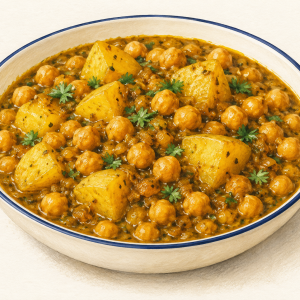
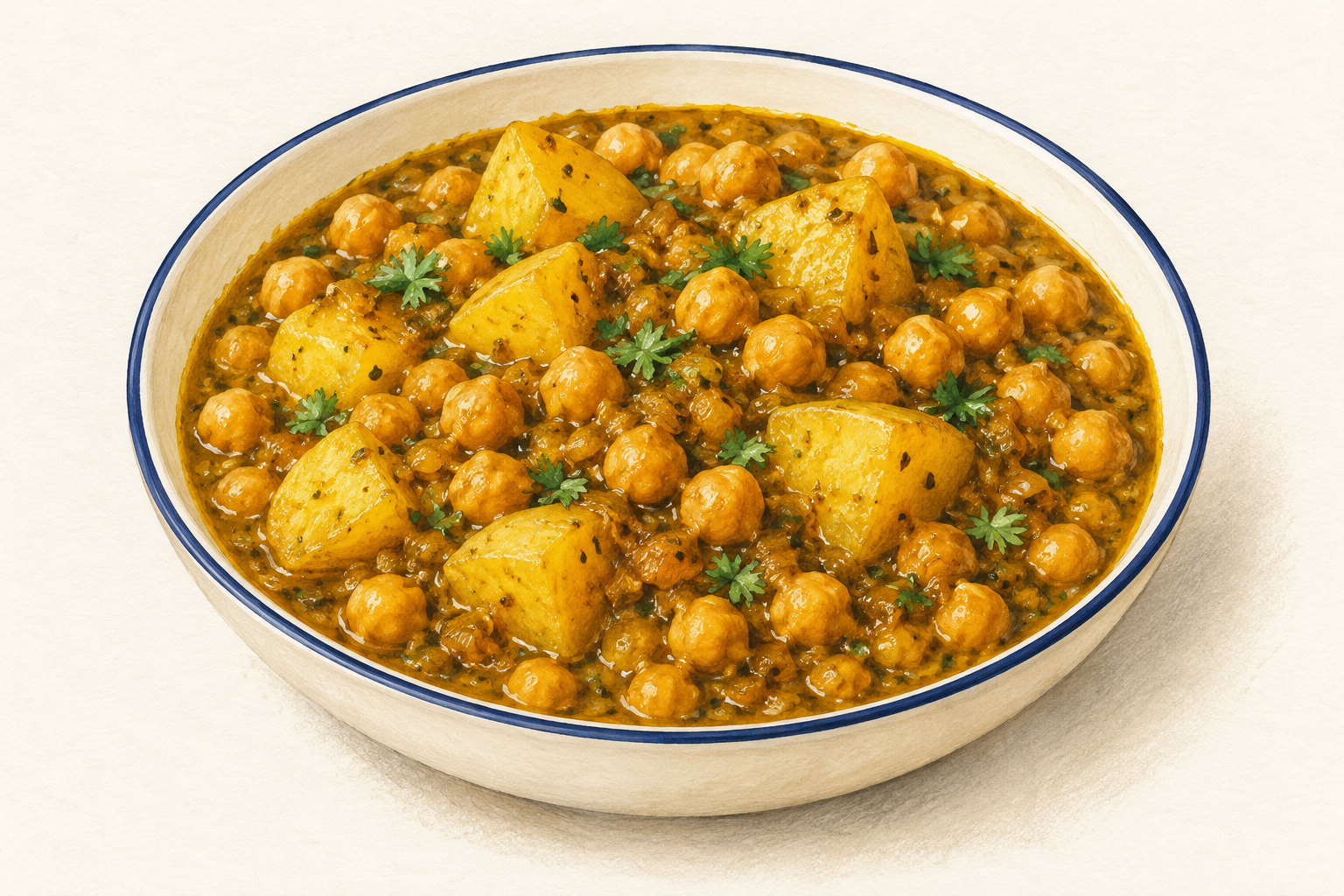
Channa and aloo curryServes 4 · About 40 minutes · Vegetarian
AI-generated illustration of channa & aloo curry; not a photograph of a tested recipe result.
Ingredients
2 tablespoons neutral oil; 1 onion, diced
3 garlic cloves and a 2 cm piece of ginger, finely grated
2 medium aloo (about 400 g), peeled and cut into 2 cm cubes
1 can channa (about 400 g / 14 oz), drained and rinsed
2 cups water; ½ teaspoon salt, then adjust to taste
Optional: chopped coriander and a little lime juice to finish
Method
Mix the curry powder and geera with 3 tablespoons of the measured water to make a paste.
Heat the oil over medium heat. Soften the onion for 5 minutes. Add garlic and ginger; stir for 30 seconds.
Add the spice paste. Cook, stirring, for 1–2 minutes until fragrant, adding a splash of water if it catches.
Add aloo, channa, remaining water, and salt. Bring to a simmer, cover loosely, and cook for 20–25 minutes, stirring occasionally, until the aloo are tender.
Mash a few aloo pieces into the sauce to thicken it. Simmer uncovered to reduce, or add water to loosen. Taste and finish with the optional herbs and lime.
Curry blends differ in heat and salt. Choose a blend that suits your household, and adjust seasoning at the end.
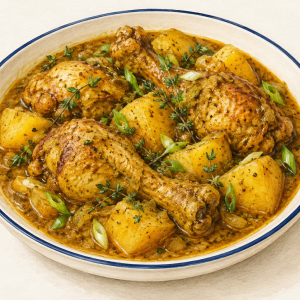
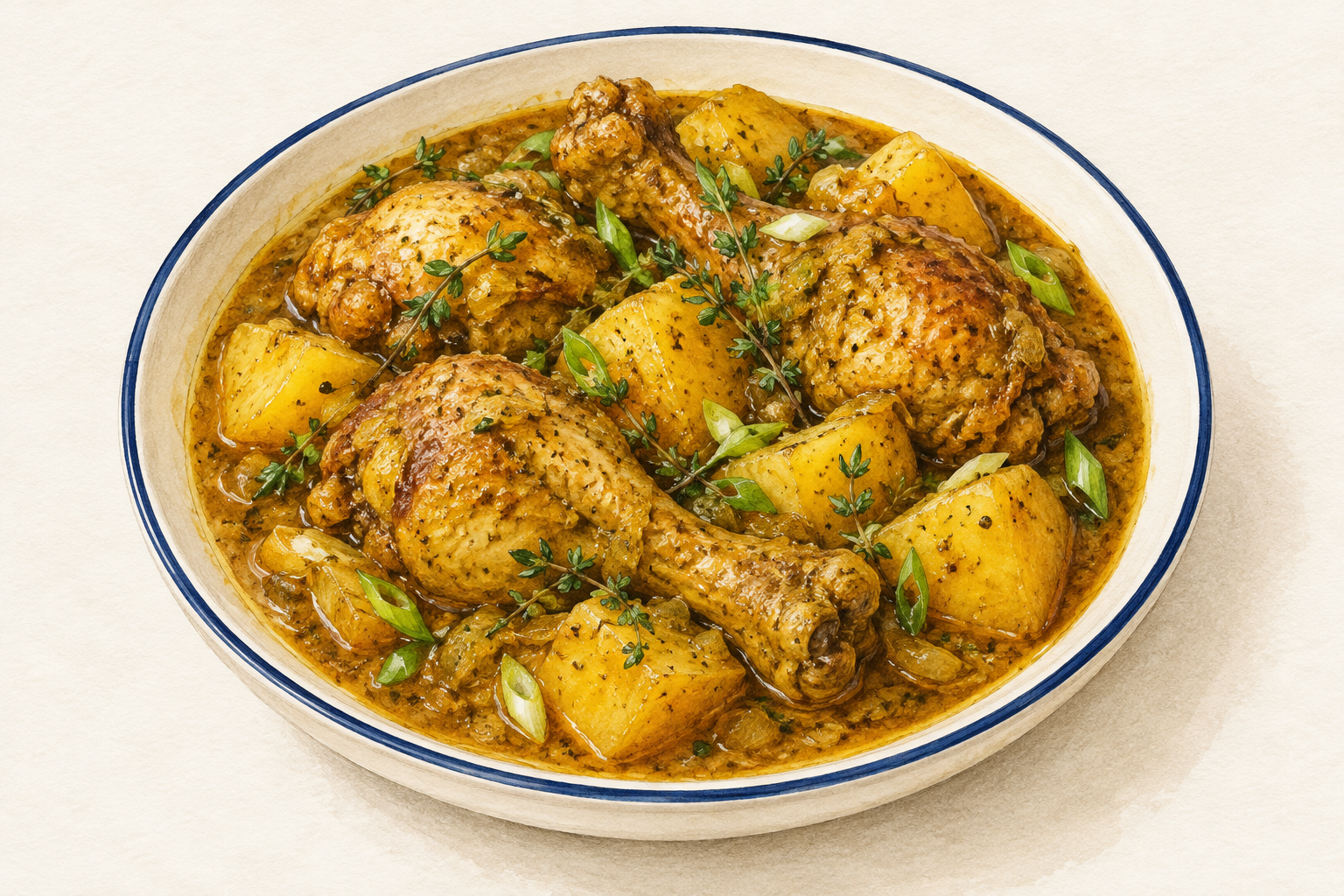
Chicken curryServes 4 · About 1 hour · Contains chicken
AI-generated illustration of chicken curry; not a photograph of a tested recipe result.
A warming curry to pair with roti, dhal puri, or rice. Curry blends and family seasoning methods vary.
Ingredients
900 g / 2 lb bone-in chicken pieces
2 tablespoons neutral oil; 1 onion, chopped
4 garlic cloves and a 2 cm piece of ginger, grated
2 tablespoons freshly made green seasoning (see the kitchen guide above)
Method
Coat the meat with green seasoning and keep refrigerated while preparing the pot. Mix curry powder and geera with 3 tablespoons of the measured water. Keep raw chicken separate from ready-to-eat ingredients; do not wash it.
Heat oil in a heavy pot. Cook onion for 5 minutes. Add garlic and ginger, then the spice paste; stir for 1–2 minutes without burning.
Add chicken and salt. Turn in the seasoning for 5 minutes. Add aloo, thyme, remaining water, and optional hot pepper.
Bring to a simmer, cover loosely, and cook for about 30–40 minutes, stirring occasionally, until the aloo are tender and every chicken piece reaches 165°F / 74°C at its thickest part, away from bone.
Uncover to reduce the gravy if needed. Taste, adjust salt, remove thyme stems, and finish with shallot.
Use a thermometer; cooking time depends on the size of the chicken pieces.
Pumpkin & spinach curryServes 4 · About 33 minutesKitchen variation
Ingredients
500 g peeled pumpkin, in 2 cm cubes
2 cups chopped spinach
2 tablespoons neutral oil; 1 small onion, chopped
3 garlic cloves and a 2 cm piece of ginger, grated
1 tablespoon Guyanese-style curry powder; ½ teaspoon ground geera
1½ cups water; ½ teaspoon salt, then adjust; optional chopped wiri wiri pepper
Method
Mix curry powder and geera with 2 tablespoons of the measured water. Heat oil in a heavy saucepan; soften onion for 5 minutes.
Add garlic, ginger, optional pepper, and the spice paste. Stir over medium-low heat for 1 minute without burning.
Add the main ingredients and remaining water, following any staggered additions below. Bring to a simmer, cover loosely, and cook gently for about 18 minutes, stirring occasionally. Add spinach for the final 3 minutes.
Check that all vegetables are tender. Add a splash of hot water if the pot dries out, or simmer uncovered to thicken. Taste and adjust salt. Serve with rice or roti.
Use commercially canned, fully cooked beans or lentils where specified. This is an original vegetable-curry variation; household seasoning methods differ.
Boulanger & aloo curryServes 4 · About 40 minutesKitchen variation
Ingredients
1 medium boulanger, in 2 cm cubes
300 g aloo, in 2 cm cubes
2 tablespoons neutral oil; 1 small onion, chopped
3 garlic cloves and a 2 cm piece of ginger, grated
1 tablespoon Guyanese-style curry powder; ½ teaspoon ground geera
1½ cups water; ½ teaspoon salt, then adjust; optional chopped wiri wiri pepper
Method
Mix curry powder and geera with 2 tablespoons of the measured water. Heat oil in a heavy saucepan; soften onion for 5 minutes.
Add garlic, ginger, optional pepper, and the spice paste. Stir over medium-low heat for 1 minute without burning.
Add the main ingredients and remaining water, following any staggered additions below. Bring to a simmer, cover loosely, and cook gently for about 25 minutes, stirring occasionally. Add boulanger after the aloo have simmered for 10 minutes.
Check that all vegetables are tender. Add a splash of hot water if the pot dries out, or simmer uncovered to thicken. Taste and adjust salt. Serve with rice or roti.
Use commercially canned, fully cooked beans or lentils where specified. This is an original vegetable-curry variation; household seasoning methods differ.
Bora & aloo curryServes 4 · About 40 minutesKitchen variation
Ingredients
300 g bora / yardlong beans, trimmed and cut into 3 cm lengths
300 g aloo, in 2 cm cubes
2 tablespoons neutral oil; 1 small onion, chopped
3 garlic cloves and a 2 cm piece of ginger, grated
1 tablespoon Guyanese-style curry powder; ½ teaspoon ground geera
1½ cups water; ½ teaspoon salt, then adjust; optional chopped wiri wiri pepper
Method
Mix curry powder and geera with 2 tablespoons of the measured water. Heat oil in a heavy saucepan; soften onion for 5 minutes.
Add garlic, ginger, optional pepper, and the spice paste. Stir over medium-low heat for 1 minute without burning.
Add the main ingredients and remaining water, following any staggered additions below. Bring to a simmer, cover loosely, and cook gently for about 25 minutes, stirring occasionally. Add bora after the aloo have simmered for 10 minutes.
Check that all vegetables are tender. Add a splash of hot water if the pot dries out, or simmer uncovered to thicken. Taste and adjust salt. Serve with rice or roti.
Use commercially canned, fully cooked beans or lentils where specified. This is an original vegetable-curry variation; household seasoning methods differ.
Channa & pumpkin curryServes 4 · About 35 minutesKitchen variation
Ingredients
1 can cooked channa (400 g), drained and rinsed
500 g peeled pumpkin, in 2 cm cubes
2 tablespoons neutral oil; 1 small onion, chopped
3 garlic cloves and a 2 cm piece of ginger, grated
1 tablespoon Guyanese-style curry powder; ½ teaspoon ground geera
1½ cups water; ½ teaspoon salt, then adjust; optional chopped wiri wiri pepper
Method
Mix curry powder and geera with 2 tablespoons of the measured water. Heat oil in a heavy saucepan; soften onion for 5 minutes.
Add garlic, ginger, optional pepper, and the spice paste. Stir over medium-low heat for 1 minute without burning.
Add the main ingredients and remaining water, following any staggered additions below. Bring to a simmer, cover loosely, and cook gently for about 20 minutes, stirring occasionally.
Check that all vegetables are tender. Add a splash of hot water if the pot dries out, or simmer uncovered to thicken. Taste and adjust salt. Serve with rice or roti.
Use commercially canned, fully cooked beans or lentils where specified. This is an original vegetable-curry variation; household seasoning methods differ.
Channa & spinach curryServes 4 · About 27 minutesKitchen variation
Ingredients
2 cans cooked channa (400 g each), drained and rinsed
3 cups chopped spinach
2 tablespoons neutral oil; 1 small onion, chopped
3 garlic cloves and a 2 cm piece of ginger, grated
1 tablespoon Guyanese-style curry powder; ½ teaspoon ground geera
1½ cups water; ½ teaspoon salt, then adjust; optional chopped wiri wiri pepper
Method
Mix curry powder and geera with 2 tablespoons of the measured water. Heat oil in a heavy saucepan; soften onion for 5 minutes.
Add garlic, ginger, optional pepper, and the spice paste. Stir over medium-low heat for 1 minute without burning.
Add the main ingredients and remaining water, following any staggered additions below. Bring to a simmer, cover loosely, and cook gently for about 12 minutes, stirring occasionally. Add spinach for the final 3 minutes.
Check that all vegetables are tender. Add a splash of hot water if the pot dries out, or simmer uncovered to thicken. Taste and adjust salt. Serve with rice or roti.
Use commercially canned, fully cooked beans or lentils where specified. This is an original vegetable-curry variation; household seasoning methods differ.
black-eye pea & sweet potato curryServes 4 · About 35 minutesKitchen variation
Ingredients
1 can cooked black-eye peas (400 g), drained and rinsed
500 g peeled sweet potato, in 2 cm cubes
2 tablespoons neutral oil; 1 small onion, chopped
3 garlic cloves and a 2 cm piece of ginger, grated
1 tablespoon Guyanese-style curry powder; ½ teaspoon ground geera
1½ cups water; ½ teaspoon salt, then adjust; optional chopped wiri wiri pepper
Method
Mix curry powder and geera with 2 tablespoons of the measured water. Heat oil in a heavy saucepan; soften onion for 5 minutes.
Add garlic, ginger, optional pepper, and the spice paste. Stir over medium-low heat for 1 minute without burning.
Add the main ingredients and remaining water, following any staggered additions below. Bring to a simmer, cover loosely, and cook gently for about 20 minutes, stirring occasionally.
Check that all vegetables are tender. Add a splash of hot water if the pot dries out, or simmer uncovered to thicken. Taste and adjust salt. Serve with rice or roti.
Use commercially canned, fully cooked beans or lentils where specified. This is an original vegetable-curry variation; household seasoning methods differ.
2 cans cooked butter beans (400 g each), drained and rinsed
2 chopped ripe tomatoes
2 tablespoons neutral oil; 1 small onion, chopped
3 garlic cloves and a 2 cm piece of ginger, grated
1 tablespoon Guyanese-style curry powder; ½ teaspoon ground geera
1½ cups water; ½ teaspoon salt, then adjust; optional chopped wiri wiri pepper
Method
Mix curry powder and geera with 2 tablespoons of the measured water. Heat oil in a heavy saucepan; soften onion for 5 minutes.
Add garlic, ginger, optional pepper, and the spice paste. Stir over medium-low heat for 1 minute without burning.
Add the main ingredients and remaining water, following any staggered additions below. Bring to a simmer, cover loosely, and cook gently for about 12 minutes, stirring occasionally.
Check that all vegetables are tender. Add a splash of hot water if the pot dries out, or simmer uncovered to thicken. Taste and adjust salt. Serve with rice or roti.
Use commercially canned, fully cooked beans or lentils where specified. This is an original vegetable-curry variation; household seasoning methods differ.
Cauliflower & aloo curryServes 4 · About 40 minutesKitchen variation
Ingredients
300 g cauliflower florets
300 g aloo, in 2 cm cubes
2 tablespoons neutral oil; 1 small onion, chopped
3 garlic cloves and a 2 cm piece of ginger, grated
1 tablespoon Guyanese-style curry powder; ½ teaspoon ground geera
1½ cups water; ½ teaspoon salt, then adjust; optional chopped wiri wiri pepper
Method
Mix curry powder and geera with 2 tablespoons of the measured water. Heat oil in a heavy saucepan; soften onion for 5 minutes.
Add garlic, ginger, optional pepper, and the spice paste. Stir over medium-low heat for 1 minute without burning.
Add the main ingredients and remaining water, following any staggered additions below. Bring to a simmer, cover loosely, and cook gently for about 25 minutes, stirring occasionally. Add cauliflower after the aloo have simmered for 12 minutes.
Check that all vegetables are tender. Add a splash of hot water if the pot dries out, or simmer uncovered to thicken. Taste and adjust salt. Serve with rice or roti.
Use commercially canned, fully cooked beans or lentils where specified. This is an original vegetable-curry variation; household seasoning methods differ.
Green bean & channa curryServes 4 · About 30 minutesKitchen variation
Ingredients
300 g trimmed green beans, cut into 3 cm pieces
1 can cooked channa (400 g), drained and rinsed
2 tablespoons neutral oil; 1 small onion, chopped
3 garlic cloves and a 2 cm piece of ginger, grated
1 tablespoon Guyanese-style curry powder; ½ teaspoon ground geera
1½ cups water; ½ teaspoon salt, then adjust; optional chopped wiri wiri pepper
Method
Mix curry powder and geera with 2 tablespoons of the measured water. Heat oil in a heavy saucepan; soften onion for 5 minutes.
Add garlic, ginger, optional pepper, and the spice paste. Stir over medium-low heat for 1 minute without burning.
Add the main ingredients and remaining water, following any staggered additions below. Bring to a simmer, cover loosely, and cook gently for about 15 minutes, stirring occasionally.
Check that all vegetables are tender. Add a splash of hot water if the pot dries out, or simmer uncovered to thicken. Taste and adjust salt. Serve with rice or roti.
Use commercially canned, fully cooked beans or lentils where specified. This is an original vegetable-curry variation; household seasoning methods differ.
Cabbage & aloo curryServes 4 · About 40 minutesKitchen variation
Ingredients
3 cups shredded cabbage
300 g aloo, in 2 cm cubes
2 tablespoons neutral oil; 1 small onion, chopped
3 garlic cloves and a 2 cm piece of ginger, grated
1 tablespoon Guyanese-style curry powder; ½ teaspoon ground geera
1½ cups water; ½ teaspoon salt, then adjust; optional chopped wiri wiri pepper
Method
Mix curry powder and geera with 2 tablespoons of the measured water. Heat oil in a heavy saucepan; soften onion for 5 minutes.
Add garlic, ginger, optional pepper, and the spice paste. Stir over medium-low heat for 1 minute without burning.
Add the main ingredients and remaining water, following any staggered additions below. Bring to a simmer, cover loosely, and cook gently for about 25 minutes, stirring occasionally. Add cabbage after the aloo have simmered for 12 minutes.
Check that all vegetables are tender. Add a splash of hot water if the pot dries out, or simmer uncovered to thicken. Taste and adjust salt. Serve with rice or roti.
Use commercially canned, fully cooked beans or lentils where specified. This is an original vegetable-curry variation; household seasoning methods differ.
ochro & tomato curryServes 4 · About 30 minutesKitchen variation
Ingredients
350 g ochro, trimmed and sliced
2 chopped ripe tomatoes
2 tablespoons neutral oil; 1 small onion, chopped
3 garlic cloves and a 2 cm piece of ginger, grated
1 tablespoon Guyanese-style curry powder; ½ teaspoon ground geera
1½ cups water; ½ teaspoon salt, then adjust; optional chopped wiri wiri pepper
Method
Mix curry powder and geera with 2 tablespoons of the measured water. Heat oil in a heavy saucepan; soften onion for 5 minutes.
Add garlic, ginger, optional pepper, and the spice paste. Stir over medium-low heat for 1 minute without burning.
Add the main ingredients and remaining water, following any staggered additions below. Bring to a simmer, cover loosely, and cook gently for about 15 minutes, stirring occasionally.
Check that all vegetables are tender. Add a splash of hot water if the pot dries out, or simmer uncovered to thicken. Taste and adjust salt. Serve with rice or roti.
Use commercially canned, fully cooked beans or lentils where specified. This is an original vegetable-curry variation; household seasoning methods differ.
Spinach & aloo curryServes 4 · About 40 minutesKitchen variation
Ingredients
3 cups chopped spinach
400 g aloo, in 2 cm cubes
2 tablespoons neutral oil; 1 small onion, chopped
3 garlic cloves and a 2 cm piece of ginger, grated
1 tablespoon Guyanese-style curry powder; ½ teaspoon ground geera
1½ cups water; ½ teaspoon salt, then adjust; optional chopped wiri wiri pepper
Method
Mix curry powder and geera with 2 tablespoons of the measured water. Heat oil in a heavy saucepan; soften onion for 5 minutes.
Add garlic, ginger, optional pepper, and the spice paste. Stir over medium-low heat for 1 minute without burning.
Add the main ingredients and remaining water, following any staggered additions below. Bring to a simmer, cover loosely, and cook gently for about 25 minutes, stirring occasionally. Add spinach for the final 3 minutes.
Check that all vegetables are tender. Add a splash of hot water if the pot dries out, or simmer uncovered to thicken. Taste and adjust salt. Serve with rice or roti.
Use commercially canned, fully cooked beans or lentils where specified. This is an original vegetable-curry variation; household seasoning methods differ.
Carrot & channa curryServes 4 · About 35 minutesKitchen variation
Ingredients
300 g carrots, in 1 cm slices
1 can cooked channa (400 g), drained and rinsed
2 tablespoons neutral oil; 1 small onion, chopped
3 garlic cloves and a 2 cm piece of ginger, grated
1 tablespoon Guyanese-style curry powder; ½ teaspoon ground geera
1½ cups water; ½ teaspoon salt, then adjust; optional chopped wiri wiri pepper
Method
Mix curry powder and geera with 2 tablespoons of the measured water. Heat oil in a heavy saucepan; soften onion for 5 minutes.
Add garlic, ginger, optional pepper, and the spice paste. Stir over medium-low heat for 1 minute without burning.
Add the main ingredients and remaining water, following any staggered additions below. Bring to a simmer, cover loosely, and cook gently for about 20 minutes, stirring occasionally.
Check that all vegetables are tender. Add a splash of hot water if the pot dries out, or simmer uncovered to thicken. Taste and adjust salt. Serve with rice or roti.
Use commercially canned, fully cooked beans or lentils where specified. This is an original vegetable-curry variation; household seasoning methods differ.
Sweet potato & green pea curryServes 4 · About 35 minutesKitchen variation
Ingredients
500 g peeled sweet potato, in 2 cm cubes
1 cup frozen green peas
2 tablespoons neutral oil; 1 small onion, chopped
3 garlic cloves and a 2 cm piece of ginger, grated
1 tablespoon Guyanese-style curry powder; ½ teaspoon ground geera
1½ cups water; ½ teaspoon salt, then adjust; optional chopped wiri wiri pepper
Method
Mix curry powder and geera with 2 tablespoons of the measured water. Heat oil in a heavy saucepan; soften onion for 5 minutes.
Add garlic, ginger, optional pepper, and the spice paste. Stir over medium-low heat for 1 minute without burning.
Add the main ingredients and remaining water, following any staggered additions below. Bring to a simmer, cover loosely, and cook gently for about 20 minutes, stirring occasionally. Add peas for the final 5 minutes.
Check that all vegetables are tender. Add a splash of hot water if the pot dries out, or simmer uncovered to thicken. Taste and adjust salt. Serve with rice or roti.
Use commercially canned, fully cooked beans or lentils where specified. This is an original vegetable-curry variation; household seasoning methods differ.
Mushroom & aloo curryServes 4 · About 40 minutesKitchen variation
Ingredients
300 g mushrooms, quartered
300 g aloo, in 2 cm cubes
2 tablespoons neutral oil; 1 small onion, chopped
3 garlic cloves and a 2 cm piece of ginger, grated
1 tablespoon Guyanese-style curry powder; ½ teaspoon ground geera
1½ cups water; ½ teaspoon salt, then adjust; optional chopped wiri wiri pepper
Method
Mix curry powder and geera with 2 tablespoons of the measured water. Heat oil in a heavy saucepan; soften onion for 5 minutes.
Add garlic, ginger, optional pepper, and the spice paste. Stir over medium-low heat for 1 minute without burning.
Add the main ingredients and remaining water, following any staggered additions below. Bring to a simmer, cover loosely, and cook gently for about 25 minutes, stirring occasionally.
Check that all vegetables are tender. Add a splash of hot water if the pot dries out, or simmer uncovered to thicken. Taste and adjust salt. Serve with rice or roti.
Use commercially canned, fully cooked beans or lentils where specified. This is an original vegetable-curry variation; household seasoning methods differ.
Lentil & pumpkin curryServes 4 · About 35 minutesKitchen variation
Ingredients
1 can cooked lentils (400 g), drained and rinsed
500 g peeled pumpkin, in 2 cm cubes
2 tablespoons neutral oil; 1 small onion, chopped
3 garlic cloves and a 2 cm piece of ginger, grated
1 tablespoon Guyanese-style curry powder; ½ teaspoon ground geera
1½ cups water; ½ teaspoon salt, then adjust; optional chopped wiri wiri pepper
Method
Mix curry powder and geera with 2 tablespoons of the measured water. Heat oil in a heavy saucepan; soften onion for 5 minutes.
Add garlic, ginger, optional pepper, and the spice paste. Stir over medium-low heat for 1 minute without burning.
Add the main ingredients and remaining water, following any staggered additions below. Bring to a simmer, cover loosely, and cook gently for about 20 minutes, stirring occasionally.
Check that all vegetables are tender. Add a splash of hot water if the pot dries out, or simmer uncovered to thicken. Taste and adjust salt. Serve with rice or roti.
Use commercially canned, fully cooked beans or lentils where specified. This is an original vegetable-curry variation; household seasoning methods differ.
Red bean & boulanger curryServes 4 · About 35 minutesKitchen variation
Ingredients
1 can fully cooked kidney beans (400 g), drained and rinsed
1 medium boulanger, in 2 cm cubes
2 tablespoons neutral oil; 1 small onion, chopped
3 garlic cloves and a 2 cm piece of ginger, grated
1 tablespoon Guyanese-style curry powder; ½ teaspoon ground geera
1½ cups water; ½ teaspoon salt, then adjust; optional chopped wiri wiri pepper
Method
Mix curry powder and geera with 2 tablespoons of the measured water. Heat oil in a heavy saucepan; soften onion for 5 minutes.
Add garlic, ginger, optional pepper, and the spice paste. Stir over medium-low heat for 1 minute without burning.
Add the main ingredients and remaining water, following any staggered additions below. Bring to a simmer, cover loosely, and cook gently for about 20 minutes, stirring occasionally.
Check that all vegetables are tender. Add a splash of hot water if the pot dries out, or simmer uncovered to thicken. Taste and adjust salt. Serve with rice or roti.
Use commercially canned, fully cooked beans or lentils where specified. This is an original vegetable-curry variation; household seasoning methods differ.
1 can cooked butter beans (400 g), drained and rinsed
2 tablespoons neutral oil; 1 small onion, chopped
3 garlic cloves and a 2 cm piece of ginger, grated
1 tablespoon Guyanese-style curry powder; ½ teaspoon ground geera
1½ cups water; ½ teaspoon salt, then adjust; optional chopped wiri wiri pepper
Method
Mix curry powder and geera with 2 tablespoons of the measured water. Heat oil in a heavy saucepan; soften onion for 5 minutes.
Add garlic, ginger, optional pepper, and the spice paste. Stir over medium-low heat for 1 minute without burning.
Add the main ingredients and remaining water, following any staggered additions below. Bring to a simmer, cover loosely, and cook gently for about 20 minutes, stirring occasionally.
Check that all vegetables are tender. Add a splash of hot water if the pot dries out, or simmer uncovered to thicken. Taste and adjust salt. Serve with rice or roti.
Use commercially canned, fully cooked beans or lentils where specified. This is an original vegetable-curry variation; household seasoning methods differ.
Green plantain & channa curryServes 4 · About 40 minutesKitchen variation
Ingredients
2 firm green plantains, peeled and cut into 1 cm half-moons
1 can cooked channa (400 g), drained and rinsed
2 tablespoons neutral oil; 1 small onion, chopped
3 garlic cloves and a 2 cm piece of ginger, grated
1 tablespoon Guyanese-style curry powder; ½ teaspoon ground geera
1½ cups water; ½ teaspoon salt, then adjust; optional chopped wiri wiri pepper
Method
Mix curry powder and geera with 2 tablespoons of the measured water. Heat oil in a heavy saucepan; soften onion for 5 minutes.
Add garlic, ginger, optional pepper, and the spice paste. Stir over medium-low heat for 1 minute without burning.
Add the main ingredients and remaining water, following any staggered additions below. Bring to a simmer, cover loosely, and cook gently for about 25 minutes, stirring occasionally.
Check that all vegetables are tender. Add a splash of hot water if the pot dries out, or simmer uncovered to thicken. Taste and adjust salt. Serve with rice or roti.
Use commercially canned, fully cooked beans or lentils where specified. This is an original vegetable-curry variation; household seasoning methods differ.
Bora & pumpkin curryServes 4 · About 35 minutesKitchen variation
Ingredients
250 g bora / yardlong beans, trimmed and cut into 3 cm lengths
400 g peeled pumpkin, in 2 cm cubes
2 tablespoons neutral oil; 1 small onion, chopped
3 garlic cloves and a 2 cm piece of ginger, grated
1 tablespoon Guyanese-style curry powder; ½ teaspoon ground geera
1½ cups water; ½ teaspoon salt, then adjust; optional chopped wiri wiri pepper
Method
Mix curry powder and geera with 2 tablespoons of the measured water. Heat oil in a heavy saucepan; soften onion for 5 minutes.
Add garlic, ginger, optional pepper, and the spice paste. Stir over medium-low heat for 1 minute without burning.
Add the main ingredients and remaining water, following any staggered additions below. Bring to a simmer, cover loosely, and cook gently for about 20 minutes, stirring occasionally. Add bora after the pumpkin has simmered for 5 minutes.
Check that all vegetables are tender. Add a splash of hot water if the pot dries out, or simmer uncovered to thicken. Taste and adjust salt. Serve with rice or roti.
Use commercially canned, fully cooked beans or lentils where specified. This is an original vegetable-curry variation; household seasoning methods differ.
Chicken & bora curryServes 4 · About 50 minutesKitchen variation
Ingredients
700 g boneless chicken thigh, in 3 cm pieces
250 g trimmed bora, in 3 cm lengths
2 tablespoons neutral oil; 1 onion, chopped
4 garlic cloves and a 2 cm piece of ginger, grated
2½ cups water, plus extra as needed; 3 thyme sprigs; ¾ teaspoon salt
2 tablespoons freshly made green seasoning (see the kitchen guide above)
Method
Coat the meat with green seasoning and keep refrigerated while preparing the pot. Keep raw meat separate from ready-to-eat food; do not wash poultry. Mix curry powder and geera with 3 tablespoons of the water.
Heat oil in a heavy pot. Soften onion for 5 minutes, add garlic and ginger, then stir in the curry paste for 1–2 minutes without burning.
Add meat and turn in the seasoning for 5 minutes. Add remaining water, thyme, and salt. Simmer gently, partly covered, for about 30 minutes. Add bora for the final 12–15 minutes.
Stir occasionally and add hot water if the gravy dries out. Cook all poultry to 165°F / 74°C, measured with a food thermometer. Check the vegetables are tender, remove thyme stems, and adjust salt before serving.
Curry strength varies by blend. This is a named variation rather than a claim of one standard Guyanese family recipe.
Chicken & pumpkin curryServes 4 · About 50 minutesKitchen variation
Ingredients
700 g boneless chicken thigh, in 3 cm pieces
400 g pumpkin, in 3 cm cubes
2 tablespoons neutral oil; 1 onion, chopped
4 garlic cloves and a 2 cm piece of ginger, grated
2½ cups water, plus extra as needed; 3 thyme sprigs; ¾ teaspoon salt
2 tablespoons freshly made green seasoning (see the kitchen guide above)
Method
Coat the meat with green seasoning and keep refrigerated while preparing the pot. Keep raw meat separate from ready-to-eat food; do not wash poultry. Mix curry powder and geera with 3 tablespoons of the water.
Heat oil in a heavy pot. Soften onion for 5 minutes, add garlic and ginger, then stir in the curry paste for 1–2 minutes without burning.
Add meat and turn in the seasoning for 5 minutes. Add remaining water, thyme, and salt. Simmer gently, partly covered, for about 30 minutes. Add pumpkin for the final 15–20 minutes.
Stir occasionally and add hot water if the gravy dries out. Cook all poultry to 165°F / 74°C, measured with a food thermometer. Check the vegetables are tender, remove thyme stems, and adjust salt before serving.
Curry strength varies by blend. This is a named variation rather than a claim of one standard Guyanese family recipe.
Chicken & spinach curryServes 4 · About 50 minutesKitchen variation
Ingredients
700 g boneless chicken thigh, in 3 cm pieces
3 cups chopped spinach
2 tablespoons neutral oil; 1 onion, chopped
4 garlic cloves and a 2 cm piece of ginger, grated
2½ cups water, plus extra as needed; 3 thyme sprigs; ¾ teaspoon salt
2 tablespoons freshly made green seasoning (see the kitchen guide above)
Method
Coat the meat with green seasoning and keep refrigerated while preparing the pot. Keep raw meat separate from ready-to-eat food; do not wash poultry. Mix curry powder and geera with 3 tablespoons of the water.
Heat oil in a heavy pot. Soften onion for 5 minutes, add garlic and ginger, then stir in the curry paste for 1–2 minutes without burning.
Add meat and turn in the seasoning for 5 minutes. Add remaining water, thyme, and salt. Simmer gently, partly covered, for about 30 minutes. Add spinach for the final 3 minutes.
Stir occasionally and add hot water if the gravy dries out. Cook all poultry to 165°F / 74°C, measured with a food thermometer. Check the vegetables are tender, remove thyme stems, and adjust salt before serving.
Curry strength varies by blend. This is a named variation rather than a claim of one standard Guyanese family recipe.
Chicken & channa curryServes 4 · About 50 minutesKitchen variation
Ingredients
700 g boneless chicken thigh, in 3 cm pieces
1 can cooked channa (400 g), drained and rinsed
2 tablespoons neutral oil; 1 onion, chopped
4 garlic cloves and a 2 cm piece of ginger, grated
2½ cups water, plus extra as needed; 3 thyme sprigs; ¾ teaspoon salt
2 tablespoons freshly made green seasoning (see the kitchen guide above)
Method
Coat the meat with green seasoning and keep refrigerated while preparing the pot. Keep raw meat separate from ready-to-eat food; do not wash poultry. Mix curry powder and geera with 3 tablespoons of the water.
Heat oil in a heavy pot. Soften onion for 5 minutes, add garlic and ginger, then stir in the curry paste for 1–2 minutes without burning.
Add meat and turn in the seasoning for 5 minutes. Add remaining water, thyme, and salt. Simmer gently, partly covered, for about 30 minutes. Add channa for the final 10 minutes.
Stir occasionally and add hot water if the gravy dries out. Cook all poultry to 165°F / 74°C, measured with a food thermometer. Check the vegetables are tender, remove thyme stems, and adjust salt before serving.
Curry strength varies by blend. This is a named variation rather than a claim of one standard Guyanese family recipe.
Chicken & coconut curryServes 4 · About 50 minutesKitchen variation
Ingredients
700 g boneless chicken thigh, in 3 cm pieces
½ cup unsweetened coconut milk
2 tablespoons neutral oil; 1 onion, chopped
4 garlic cloves and a 2 cm piece of ginger, grated
2½ cups water, plus extra as needed; 3 thyme sprigs; ¾ teaspoon salt
2 tablespoons freshly made green seasoning (see the kitchen guide above)
Method
Coat the meat with green seasoning and keep refrigerated while preparing the pot. Keep raw meat separate from ready-to-eat food; do not wash poultry. Mix curry powder and geera with 3 tablespoons of the water.
Heat oil in a heavy pot. Soften onion for 5 minutes, add garlic and ginger, then stir in the curry paste for 1–2 minutes without burning.
Add meat and turn in the seasoning for 5 minutes. Add remaining water, thyme, and salt. Simmer gently, partly covered, for about 30 minutes. Stir in coconut milk for the final 10 minutes.
Stir occasionally and add hot water if the gravy dries out. Cook all poultry to 165°F / 74°C, measured with a food thermometer. Check the vegetables are tender, remove thyme stems, and adjust salt before serving.
Curry strength varies by blend. This is a named variation rather than a claim of one standard Guyanese family recipe.
Turkey & aloo curryServes 4 · About 60 minutesKitchen variation
Ingredients
700 g boneless turkey thigh, in 3 cm pieces
300 g aloo, in 2 cm cubes
2 tablespoons neutral oil; 1 onion, chopped
4 garlic cloves and a 2 cm piece of ginger, grated
2½ cups water, plus extra as needed; 3 thyme sprigs; ¾ teaspoon salt
2 tablespoons freshly made green seasoning (see the kitchen guide above)
Method
Coat the meat with green seasoning and keep refrigerated while preparing the pot. Keep raw meat separate from ready-to-eat food; do not wash poultry. Mix curry powder and geera with 3 tablespoons of the water.
Heat oil in a heavy pot. Soften onion for 5 minutes, add garlic and ginger, then stir in the curry paste for 1–2 minutes without burning.
Add meat and turn in the seasoning for 5 minutes. Add remaining water, thyme, and salt. Simmer gently, partly covered, for about 40 minutes. Add aloo for the final 25 minutes.
Stir occasionally and add hot water if the gravy dries out. Cook all poultry to 165°F / 74°C, measured with a food thermometer. Check the vegetables are tender, remove thyme stems, and adjust salt before serving.
Curry strength varies by blend. This is a named variation rather than a claim of one standard Guyanese family recipe.
2½ cups water, plus extra as needed; 3 thyme sprigs; ¾ teaspoon salt
2 tablespoons freshly made green seasoning (see the kitchen guide above)
Method
Coat the meat with green seasoning and keep refrigerated while preparing the pot. Keep raw meat separate from ready-to-eat food; do not wash poultry. Mix curry powder and geera with 3 tablespoons of the water.
Heat oil in a heavy pot. Soften onion for 5 minutes, add garlic and ginger, then stir in the curry paste for 1–2 minutes without burning.
Add meat and turn in the seasoning for 5 minutes. Add remaining water, thyme, and salt. Simmer gently, partly covered, for about 40 minutes. Add beans for the final 10 minutes.
Stir occasionally and add hot water if the gravy dries out. Cook all poultry to 165°F / 74°C, measured with a food thermometer. Check the vegetables are tender, remove thyme stems, and adjust salt before serving.
Curry strength varies by blend. This is a named variation rather than a claim of one standard Guyanese family recipe.
Lamb & aloo curryServes 4 · About 120 minutesKitchen variation
Ingredients
800 g boneless lamb shoulder, in 3 cm cubes
300 g aloo, in 2 cm cubes
2 tablespoons neutral oil; 1 onion, chopped
4 garlic cloves and a 2 cm piece of ginger, grated
2½ cups water, plus extra as needed; 3 thyme sprigs; ¾ teaspoon salt
2 tablespoons freshly made green seasoning (see the kitchen guide above)
Method
Coat the meat with green seasoning and keep refrigerated while preparing the pot. Keep raw meat separate from ready-to-eat food; do not wash poultry. Mix curry powder and geera with 3 tablespoons of the water.
Heat oil in a heavy pot. Soften onion for 5 minutes, add garlic and ginger, then stir in the curry paste for 1–2 minutes without burning.
Add meat and turn in the seasoning for 5 minutes. Add remaining water, thyme, and salt. Simmer gently, partly covered, for about 100 minutes. Add aloo for the final 25 minutes.
Stir occasionally and add hot water if the gravy dries out. Continue simmering until the lamb is fork-tender; time varies with the cut. Check the vegetables are tender, remove thyme stems, and adjust salt before serving.
Curry strength varies by blend. This is a named variation rather than a claim of one standard Guyanese family recipe.
Lamb & channa curryServes 4 · About 120 minutesKitchen variation
Ingredients
800 g boneless lamb shoulder, in 3 cm cubes
1 can cooked channa (400 g), drained and rinsed
2 tablespoons neutral oil; 1 onion, chopped
4 garlic cloves and a 2 cm piece of ginger, grated
2½ cups water, plus extra as needed; 3 thyme sprigs; ¾ teaspoon salt
2 tablespoons freshly made green seasoning (see the kitchen guide above)
Method
Coat the meat with green seasoning and keep refrigerated while preparing the pot. Keep raw meat separate from ready-to-eat food; do not wash poultry. Mix curry powder and geera with 3 tablespoons of the water.
Heat oil in a heavy pot. Soften onion for 5 minutes, add garlic and ginger, then stir in the curry paste for 1–2 minutes without burning.
Add meat and turn in the seasoning for 5 minutes. Add remaining water, thyme, and salt. Simmer gently, partly covered, for about 100 minutes. Add channa for the final 10 minutes.
Stir occasionally and add hot water if the gravy dries out. Continue simmering until the lamb is fork-tender; time varies with the cut. Check the vegetables are tender, remove thyme stems, and adjust salt before serving.
Curry strength varies by blend. This is a named variation rather than a claim of one standard Guyanese family recipe.
Lamb & pumpkin curryServes 4 · About 120 minutesKitchen variation
Ingredients
800 g boneless lamb shoulder, in 3 cm cubes
400 g pumpkin, in 3 cm cubes
2 tablespoons neutral oil; 1 onion, chopped
4 garlic cloves and a 2 cm piece of ginger, grated
2½ cups water, plus extra as needed; 3 thyme sprigs; ¾ teaspoon salt
2 tablespoons freshly made green seasoning (see the kitchen guide above)
Method
Coat the meat with green seasoning and keep refrigerated while preparing the pot. Keep raw meat separate from ready-to-eat food; do not wash poultry. Mix curry powder and geera with 3 tablespoons of the water.
Heat oil in a heavy pot. Soften onion for 5 minutes, add garlic and ginger, then stir in the curry paste for 1–2 minutes without burning.
Add meat and turn in the seasoning for 5 minutes. Add remaining water, thyme, and salt. Simmer gently, partly covered, for about 100 minutes. Add pumpkin for the final 20 minutes.
Stir occasionally and add hot water if the gravy dries out. Continue simmering until the lamb is fork-tender; time varies with the cut. Check the vegetables are tender, remove thyme stems, and adjust salt before serving.
Curry strength varies by blend. This is a named variation rather than a claim of one standard Guyanese family recipe.
White fish & tomato curryServes 4 · About 40 minutesKitchen variation
Mix curry powder and geera with 2 tablespoons water. Heat oil; soften onion for 5 minutes, add garlic, optional pepper, and spice paste, and cook for 1 minute.
Add remaining water, salt, and the tomatoes or ochro, if used. Simmer for 8–10 minutes; add coconut milk or spinach, if used, near the end.
Add seafood gently. Simmer for about 6–10 minutes, depending on thickness. Cook seafood to 145°F / 63°C; shrimp should also be pearly and opaque, and fish should flake easily.
Check that vegetables are tender. Avoid vigorous stirring once fish is added. Taste, adjust salt, and serve immediately.
Contains fish. Thaw frozen seafood in the refrigerator before cooking.
Coconut fish curryServes 4 · About 40 minutesKitchen variation
Mix curry powder and geera with 2 tablespoons water. Heat oil; soften onion for 5 minutes, add garlic, optional pepper, and spice paste, and cook for 1 minute.
Add remaining water, salt, and the tomatoes or ochro, if used. Simmer for 8–10 minutes; add coconut milk or spinach, if used, near the end.
Add seafood gently. Simmer for about 6–10 minutes, depending on thickness. Cook seafood to 145°F / 63°C; shrimp should also be pearly and opaque, and fish should flake easily.
Check that vegetables are tender. Avoid vigorous stirring once fish is added. Taste, adjust salt, and serve immediately.
Contains fish. Thaw frozen seafood in the refrigerator before cooking.
Fish & ochro curryServes 4 · About 40 minutesKitchen variation
Mix curry powder and geera with 2 tablespoons water. Heat oil; soften onion for 5 minutes, add garlic, optional pepper, and spice paste, and cook for 1 minute.
Add remaining water, salt, and the tomatoes or ochro, if used. Simmer for 8–10 minutes; add coconut milk or spinach, if used, near the end.
Add seafood gently. Simmer for about 6–10 minutes, depending on thickness. Cook seafood to 145°F / 63°C; shrimp should also be pearly and opaque, and fish should flake easily.
Check that vegetables are tender. Avoid vigorous stirring once fish is added. Taste, adjust salt, and serve immediately.
Contains fish. Thaw frozen seafood in the refrigerator before cooking.
Shrimp & aloo curryServes 4 · About 40 minutesKitchen variation
Mix curry powder and geera with 2 tablespoons water. Heat oil; soften onion for 5 minutes, add garlic, optional pepper, and spice paste, and cook for 1 minute.
Add remaining water, salt, and the aloo or pumpkin. Simmer for 15–20 minutes until almost tender.
Add seafood gently. Simmer for about 3–5 minutes, depending on size. Cook seafood to 145°F / 63°C; shrimp should also be pearly and opaque, and fish should flake easily.
Check that vegetables are tender. Avoid vigorous stirring once fish is added. Taste, adjust salt, and serve immediately.
Contains shellfish. Thaw frozen seafood in the refrigerator before cooking.
Shrimp & spinach curryServes 4 · About 40 minutesKitchen variation
Mix curry powder and geera with 2 tablespoons water. Heat oil; soften onion for 5 minutes, add garlic, optional pepper, and spice paste, and cook for 1 minute.
Add remaining water, salt, and the tomatoes or ochro, if used. Simmer for 8–10 minutes; add coconut milk or spinach, if used, near the end.
Add seafood gently. Simmer for about 3–5 minutes, depending on size. Cook seafood to 145°F / 63°C; shrimp should also be pearly and opaque, and fish should flake easily.
Check that vegetables are tender. Avoid vigorous stirring once fish is added. Taste, adjust salt, and serve immediately.
Contains shellfish. Thaw frozen seafood in the refrigerator before cooking.
Shrimp & pumpkin curryServes 4 · About 40 minutesKitchen variation
Mix curry powder and geera with 2 tablespoons water. Heat oil; soften onion for 5 minutes, add garlic, optional pepper, and spice paste, and cook for 1 minute.
Add remaining water, salt, and the aloo or pumpkin. Simmer for 15–20 minutes until almost tender.
Add seafood gently. Simmer for about 3–5 minutes, depending on size. Cook seafood to 145°F / 63°C; shrimp should also be pearly and opaque, and fish should flake easily.
Check that vegetables are tender. Avoid vigorous stirring once fish is added. Taste, adjust salt, and serve immediately.
Contains shellfish. Thaw frozen seafood in the refrigerator before cooking.
Egg & tomato curryServes 4 · About 40 minutes, with eggs already boiledKitchen variation
1 small onion, chopped; 4 garlic cloves, minced; 2 tablespoons green seasoning
2 tablespoons neutral oil; 2 tablespoons curry powder; 1 teaspoon ground geera; ½ teaspoon garam masala
1 chopped tomato; ½ teaspoon salt to start; 1 whole wiri wiri pepper, optional
2–3 cups hot water
Method
Pat duck dry; season with half the green seasoning and refrigerate while preparing the pot.
Soften onion in oil for 4 minutes. Stir curry powder, geera and masala with 3 tablespoons water; add with garlic and cook 2 minutes, stirring so the paste does not scorch.
Add tomato and green seasoning; cook until tomato softens. Add duck; turn in the paste 8 minutes. Add 2 cups water and pepper. Cover and simmer 75–100 minutes, adding water as needed, until tender and at least 165°F/74°C. Uncover to reduce the gravy.
Taste the gravy and adjust salt. Keep an optional hot pepper whole and remove before serving. Serve with rice or roti.
Skim excess duck fat; leave enough gravy for roti. Contains no beef or pork. Untested home-kitchen adaptation.
1 small onion, chopped; 4 garlic cloves, minced; 2 tablespoons green seasoning
2 tablespoons neutral oil; 2 tablespoons curry powder; 1 teaspoon ground geera; ½ teaspoon garam masala
1 chopped tomato; ½ teaspoon salt to start; 1 whole wiri wiri pepper, optional
3–4 cups hot water
Method
Pat goat dry and season with half the green seasoning.
Soften onion in oil for 4 minutes. Stir curry powder, geera and masala with 3 tablespoons water; add with garlic and cook 2 minutes, stirring so the paste does not scorch.
Add tomato and green seasoning; cook until tomato softens. Turn goat in the paste 10 minutes; add 3 cups water. Cover and simmer gently 1½–2½ hours until fork-tender, replenishing hot water so the pot does not dry.
Taste the gravy and adjust salt. Keep an optional hot pepper whole and remove before serving. Serve with rice or roti.
Mutton can mean goat in Guyanese usage. This recipe specifically uses goat; lamb has a different cooking time. Untested home-kitchen adaptation.
1 kg commercially cooked, cleaned crab sections, thawed in the refrigerator
1 small onion, chopped; 4 garlic cloves, minced; 2 tablespoons green seasoning
2 tablespoons neutral oil; 2 tablespoons curry powder; 1 teaspoon ground geera; ½ teaspoon garam masala
1 chopped tomato; ½ teaspoon salt to start; 1 whole wiri wiri pepper, optional
1½ cups coconut milk; ½–1 cup water
Method
Use ready-cleaned cooked crab sections; crack the claws lightly with a crab cracker. Keep refrigerated until needed.
Soften onion in oil for 4 minutes. Stir curry powder, geera and masala with 3 tablespoons water; add with garlic and cook 2 minutes, stirring so the paste does not scorch.
Add tomato and green seasoning; cook until tomato softens. Add coconut milk and ½ cup water; simmer 8 minutes. Add crab and simmer, covered, 8–12 minutes or until heated through to 165°F/74°C; spoon gravy over shells.
Taste the gravy and adjust salt. Keep an optional hot pepper whole and remove before serving. Serve with rice or roti.
Shellfish. This convenient adaptation starts with cooked crab; raw crab requires different preparation. Watch for shell fragments. Untested home-kitchen adaptation.
750 g hassa, professionally cleaned, gutted and fins trimmed
1 small onion, chopped; 4 garlic cloves, minced; 2 tablespoons green seasoning
2 tablespoons neutral oil; 2 tablespoons curry powder; 1 teaspoon ground geera; ½ teaspoon garam masala
1 chopped tomato; ½ teaspoon salt to start; 1 whole wiri wiri pepper, optional
1½ cups coconut milk; 1 cup water
½ firm green mango, peeled and sliced away from the stone
Method
Buy food-grade, properly identified hassa from a fishmonger and ask them to clean it completely. Pat dry carefully; the armor and remaining spines can be sharp.
Soften onion in oil for 4 minutes. Stir curry powder, geera and masala with 3 tablespoons water; add with garlic and cook 2 minutes, stirring so the paste does not scorch.
Add tomato and green seasoning; cook until tomato softens. Add coconut milk, water and mango; simmer 8 minutes. Lay in hassa and gently simmer about 20–30 minutes, turning carefully, until flesh reaches 145°F/63°C. Add a little water if needed.
Taste the gravy and adjust salt. Keep an optional hot pepper whole and remove before serving. Serve with rice or roti.
Fish. Hassa is a freshwater armored fish, not a sea fish. Lift flesh away from armor and bones carefully; do not substitute an unidentified aquarium fish. Untested home-kitchen adaptation.
1 small onion, chopped; 4 garlic cloves, minced; 2 tablespoons green seasoning
2 tablespoons neutral oil; 2 tablespoons curry powder; 1 teaspoon ground geera; ½ teaspoon garam masala
1 chopped tomato; ½ teaspoon salt to start; 1 whole wiri wiri pepper, optional
1½–2 cups hot water
½ green mango, peeled and sliced; 6 ochro, trimmed and halved
Method
Have a fishmonger prepare gilbaka steaks and remove sharp fins. Pat dry and season with half the green seasoning.
Soften onion in oil for 4 minutes. Stir curry powder, geera and masala with 3 tablespoons water; add with garlic and cook 2 minutes, stirring so the paste does not scorch.
Add tomato and green seasoning; cook until tomato softens. Add 1½ cups water, mango and ochro. Simmer 8 minutes, then lay in fish. Simmer gently 12–18 minutes, without vigorous stirring, until the thickest flesh reaches 145°F/63°C.
Taste the gravy and adjust salt. Keep an optional hot pepper whole and remove before serving. Serve with rice or roti.
Fish. Gilbaka is a freshwater catfish; local spellings vary. This is a distinct fish curry, not a generic name for any fish. Untested home-kitchen adaptation.
1 small onion, chopped; 4 garlic cloves, minced; 2 tablespoons green seasoning
2 tablespoons neutral oil; 2 tablespoons curry powder; 1 teaspoon ground geera; ½ teaspoon garam masala
1 chopped tomato; ½ teaspoon salt to start; 1 whole wiri wiri pepper, optional
1½ cups hot water
Method
Check fish for bones; pat dry. Ask your fishmonger to identify the fish sold locally as butterfish.
Soften onion in oil for 4 minutes. Stir curry powder, geera and masala with 3 tablespoons water; add with garlic and cook 2 minutes, stirring so the paste does not scorch.
Add tomato and green seasoning; cook until tomato softens. Add water and simmer sauce 8 minutes. Add fish in one layer; simmer gently 8–15 minutes to 145°F/63°C in the thickest piece.
Taste the gravy and adjust salt. Keep an optional hot pepper whole and remove before serving. Serve with rice or roti.
Fish. Butterfish names vary by market; follow advice for the actual species and thickness supplied. Untested home-kitchen adaptation.
1 small onion, chopped; 4 garlic cloves, minced; 2 tablespoons green seasoning
2 tablespoons neutral oil; 2 tablespoons curry powder; 1 teaspoon ground geera; ½ teaspoon garam masala
1 chopped tomato; ½ teaspoon salt to start; 1 whole wiri wiri pepper, optional
1½ cups coconut milk; ½ cup water
Method
Pat steaks dry; season with half the green seasoning.
Soften onion in oil for 4 minutes. Stir curry powder, geera and masala with 3 tablespoons water; add with garlic and cook 2 minutes, stirring so the paste does not scorch.
Add tomato and green seasoning; cook until tomato softens. Simmer coconut milk and water in the curry base 8 minutes. Add snapper and simmer 10–15 minutes to 145°F/63°C; turn once carefully.
Taste the gravy and adjust salt. Keep an optional hot pepper whole and remove before serving. Serve with rice or roti.
Fish; check carefully for small bones. Untested home-kitchen adaptation.
1 small onion, chopped; 4 garlic cloves, minced; 2 tablespoons green seasoning
2 tablespoons neutral oil; 2 tablespoons curry powder; 1 teaspoon ground geera; ½ teaspoon garam masala
1 chopped tomato; ½ teaspoon salt to start; 1 whole wiri wiri pepper, optional
1–3 cups hot water, as needed
Method
Pat meat dry. Soften onion in oil. Mix dry spices with 3 tablespoons water; add with garlic and cook 2 minutes.
Add tomato and green seasoning, then meat. Turn over medium heat 8 minutes until coated in the fragrant paste.
Add 1 cup hot water. Cover and simmer gently about 40 minutes, topping up a little at a time until 165°F/74°C. Goat must be tender enough to pull apart easily.
Uncover and stir regularly to reduce to a thick coating, rather than a pot of gravy. Do not let spices burn. Taste for salt and remove any whole pepper.
Bunjal describes cooking down to concentrated seasoning. Timing depends on the cut; do not dry the pot before the meat is tender. Untested home-kitchen adaptation.
1 small onion, chopped; 4 garlic cloves, minced; 2 tablespoons green seasoning
2 tablespoons neutral oil; 2 tablespoons curry powder; 1 teaspoon ground geera; ½ teaspoon garam masala
1 chopped tomato; ½ teaspoon salt to start; 1 whole wiri wiri pepper, optional
1–3 cups hot water, as needed
Method
Pat meat dry. Soften onion in oil. Mix dry spices with 3 tablespoons water; add with garlic and cook 2 minutes.
Add tomato and green seasoning, then meat. Turn over medium heat 8 minutes until coated in the fragrant paste.
Add 1 cup hot water. Cover and simmer gently about 85 minutes, topping up a little at a time until 165°F/74°C. Goat must be tender enough to pull apart easily.
Uncover and stir regularly to reduce to a thick coating, rather than a pot of gravy. Do not let spices burn. Taste for salt and remove any whole pepper.
Bunjal describes cooking down to concentrated seasoning. Timing depends on the cut; do not dry the pot before the meat is tender. Untested home-kitchen adaptation.
1 small onion, chopped; 4 garlic cloves, minced; 2 tablespoons green seasoning
2 tablespoons neutral oil; 2 tablespoons curry powder; 1 teaspoon ground geera; ½ teaspoon garam masala
1 chopped tomato; ½ teaspoon salt to start; 1 whole wiri wiri pepper, optional
1–3 cups hot water, as needed
Method
Pat meat dry. Soften onion in oil. Mix dry spices with 3 tablespoons water; add with garlic and cook 2 minutes.
Add tomato and green seasoning, then meat. Turn over medium heat 8 minutes until coated in the fragrant paste.
Add 1 cup hot water. Cover and simmer gently about 130 minutes, topping up a little at a time until fork-tender. Goat must be tender enough to pull apart easily.
Uncover and stir regularly to reduce to a thick coating, rather than a pot of gravy. Do not let spices burn. Taste for salt and remove any whole pepper.
Bunjal describes cooking down to concentrated seasoning. Timing depends on the cut; do not dry the pot before the meat is tender. Untested home-kitchen adaptation.
1 small chopped tomato; ¼ teaspoon salt; 3 tablespoons water
Method
Pat shrimp dry and keep chilled. Soften onion in oil for 4 minutes.
Mix curry and geera with water. Add to onion with garlic and stir 2 minutes.
Add tomato and green seasoning; cook down until thick, about 5 minutes.
Add shrimp and salt. Toss over medium heat for 3–5 minutes, until shrimp are opaque and reach 145°F/63°C, with the paste clinging to them. Stop before they toughen.
Shellfish. Serve with dhal, rice and a fresh cucumber side. Untested home-kitchen adaptation.
1 small onion, chopped; 4 garlic cloves, minced; 2 tablespoons green seasoning
2 tablespoons neutral oil; 2 tablespoons curry powder; 1 teaspoon ground geera; ½ teaspoon garam masala
1 chopped tomato; ½ teaspoon salt to start; 1 whole wiri wiri pepper, optional
2 cups hot water
Method
Rinse potato cubes and drain.
Soften onion in oil for 4 minutes. Stir curry powder, geera and masala with 3 tablespoons water; add with garlic and cook 2 minutes, stirring so the paste does not scorch.
Add tomato and green seasoning; cook until tomato softens. Add potatoes and stir 2 minutes. Add water; cover and simmer 18–25 minutes until completely tender. Crush a few cubes into the gravy.
Taste the gravy and adjust salt. Keep an optional hot pepper whole and remove before serving. Serve with rice or roti.
Vegan with a plant-based green seasoning. Untested home-kitchen adaptation.
1 small onion, chopped; 4 garlic cloves, minced; 2 tablespoons green seasoning
2 tablespoons neutral oil; 2 tablespoons curry powder; 1 teaspoon ground geera; ½ teaspoon garam masala
1 chopped tomato; ½ teaspoon salt to start; 1 whole wiri wiri pepper, optional
1½ cups hot water
Method
Drain and rinse the fully cooked channa.
Soften onion in oil for 4 minutes. Stir curry powder, geera and masala with 3 tablespoons water; add with garlic and cook 2 minutes, stirring so the paste does not scorch.
Add tomato and green seasoning; cook until tomato softens. Add channa and water; simmer 20 minutes, crushing a few peas to thicken the gravy.
Taste the gravy and adjust salt. Keep an optional hot pepper whole and remove before serving. Serve with rice or roti.
Channa means chickpeas. This version uses canned, fully cooked peas. Untested home-kitchen adaptation.
600 g eddoes, peeled with gloves and cut into 3 cm pieces
1 small onion, chopped; 4 garlic cloves, minced; 2 tablespoons green seasoning
2 tablespoons neutral oil; 2 tablespoons curry powder; 1 teaspoon ground geera; ½ teaspoon garam masala
1 chopped tomato; ½ teaspoon salt to start; 1 whole wiri wiri pepper, optional
2 cups hot water
Method
Peel eddoes wearing kitchen gloves if their raw juices irritate your skin. Rinse the pieces.
Soften onion in oil for 4 minutes. Stir curry powder, geera and masala with 3 tablespoons water; add with garlic and cook 2 minutes, stirring so the paste does not scorch.
Add tomato and green seasoning; cook until tomato softens. Add eddoes and water; cover and simmer 25–35 minutes until soft all the way through. Do not taste raw or undercooked eddo.
Taste the gravy and adjust salt. Keep an optional hot pepper whole and remove before serving. Serve with rice or roti.
Eddoes must be thoroughly cooked. Serve as a starchy side with dhal and greens. Untested home-kitchen adaptation.
Green mango curryServes 6 as a side · About 40 minutesGuyanese & Caribbean kitchen · adaptation
Ingredients
2 firm green mangoes (about 600 g), peeled and flesh sliced away from stones
1 small onion, chopped; 4 garlic cloves, minced; 2 tablespoons green seasoning
2 tablespoons neutral oil; 2 tablespoons curry powder; 1 teaspoon ground geera; ½ teaspoon garam masala
1 chopped tomato; ½ teaspoon salt to start; 1 whole wiri wiri pepper, optional
1½ cups water; 2–4 tablespoons brown sugar
Method
Use sour, unripe mangoes; cut the flesh from the stones on a stable board.
Soften onion in oil for 4 minutes. Stir curry powder, geera and masala with 3 tablespoons water; add with garlic and cook 2 minutes, stirring so the paste does not scorch.
Add tomato and green seasoning; cook until tomato softens. Add mango, water and 2 tablespoons sugar. Simmer 15–25 minutes until tender but not dissolved. Add more sugar only if needed to balance the sourness.
Taste the gravy and adjust salt. Keep an optional hot pepper whole and remove before serving. Serve with rice or roti.
Sweet-sour side for a curry plate. Mango acidity varies; start with less sugar. Untested home-kitchen adaptation.
Katahar curryServes 5 · About 1½ hours with prepared kataharGuyanese & Caribbean kitchen · adaptation
Ingredients
600 g prepared katahar flesh and peeled seeds, sold ready for cooking
1 small onion, chopped; 4 garlic cloves, minced; 2 tablespoons green seasoning
2 tablespoons neutral oil; 2 tablespoons curry powder; 1 teaspoon ground geera; ½ teaspoon garam masala
1 chopped tomato; ½ teaspoon salt to start; 1 whole wiri wiri pepper, optional
2 cups coconut milk; 1–2 cups water
Method
Use properly identified katahar (breadnut), already peeled and prepared by a knowledgeable seller; follow any package preparation directions.
Soften onion in oil for 4 minutes. Stir curry powder, geera and masala with 3 tablespoons water; add with garlic and cook 2 minutes, stirring so the paste does not scorch.
Add tomato and green seasoning; cook until tomato softens. Add katahar, coconut milk and 1 cup water. Cover and simmer 45–75 minutes, stirring and topping up water, until flesh and seeds are fully soft. Crush some seeds to thicken.
Taste the gravy and adjust salt. Keep an optional hot pepper whole and remove before serving. Serve with rice or roti.
Katahar is breadnut, not ripe jackfruit. Whole-fruit peeling takes extra time; this version starts with prepared flesh and seeds. Untested home-kitchen adaptation.
650 g legally sourced food-grade conch meat, cleaned and tenderized by the seller
1 small onion, chopped; 4 garlic cloves, minced; 2 tablespoons green seasoning
2 tablespoons neutral oil; 2 tablespoons curry powder; 1 teaspoon ground geera; ½ teaspoon garam masala
1 chopped tomato; ½ teaspoon salt to start; 1 whole wiri wiri pepper, optional
2–3 cups hot water
Method
Use prepared conch sold for cooking, not uncleaned whole animals. Cut across the grain into thin bite-size pieces.
Soften onion in oil for 4 minutes. Stir curry powder, geera and masala with 3 tablespoons water; add with garlic and cook 2 minutes, stirring so the paste does not scorch.
Add tomato and green seasoning; cook until tomato softens. Turn conch in the paste 3 minutes. Add 2 cups water and simmer, covered, 45–90 minutes until tender and at least 145°F/63°C, adding water as needed. Reduce gravy only once tender.
Taste the gravy and adjust salt. Keep an optional hot pepper whole and remove before serving. Serve with rice or roti.
Molluscan shellfish. Conch size and tenderizing affect cooking time; this is a wider Caribbean addition, not a claim of one national recipe. Untested home-kitchen adaptation.
650 g cleaned squid tubes and tentacles, sliced into rings or pieces
1 small onion, chopped; 4 garlic cloves, minced; 2 tablespoons green seasoning
2 tablespoons neutral oil; 2 tablespoons curry powder; 1 teaspoon ground geera; ½ teaspoon garam masala
1 chopped tomato; ½ teaspoon salt to start; 1 whole wiri wiri pepper, optional
1 cup coconut milk; ½ cup water
Method
Use squid that has been completely cleaned by the fishmonger. Pat dry.
Soften onion in oil for 4 minutes. Stir curry powder, geera and masala with 3 tablespoons water; add with garlic and cook 2 minutes, stirring so the paste does not scorch.
Add tomato and green seasoning; cook until tomato softens. Add coconut milk and water; simmer the sauce 10 minutes. Add squid and simmer gently 3–5 minutes, just until cooked to 145°F/63°C. Avoid extended cooking that toughens it.
Taste the gravy and adjust salt. Keep an optional hot pepper whole and remove before serving. Serve with rice or roti.
Molluscan shellfish. Prepared squid cooks quickly; this method does not start with whole uncleaned squid. Untested home-kitchen adaptation.
650 g salmon fillet, checked for bones and cut into 4 cm pieces
1 small onion, chopped; 4 garlic cloves, minced; 2 tablespoons green seasoning
2 tablespoons neutral oil; 2 tablespoons curry powder; 1 teaspoon ground geera; ½ teaspoon garam masala
1 chopped tomato; ½ teaspoon salt to start; 1 whole wiri wiri pepper, optional
1 cup coconut milk; ½ cup water
Method
Pat salmon dry; keep pieces large enough to hold together.
Soften onion in oil for 4 minutes. Stir curry powder, geera and masala with 3 tablespoons water; add with garlic and cook 2 minutes, stirring so the paste does not scorch.
Add tomato and green seasoning; cook until tomato softens. Simmer coconut milk and water in the curry base 8 minutes. Lay salmon into sauce and cook gently 7–12 minutes until 145°F/63°C. Turn carefully once.
Taste the gravy and adjust salt. Keep an optional hot pepper whole and remove before serving. Serve with rice or roti.
Fish. A diaspora kitchen adaptation using readily available salmon. Untested home-kitchen adaptation.
1½ tablespoons curry powder; ½ teaspoon geera; 1 chopped tomato
1 cup coconut milk; ¾ cup water; ¼ teaspoon salt
Method
Soften onion in oil. Mix spices with 2 tablespoons water; add with garlic and stir 2 minutes.
Add tomato, coconut milk, water and salt; simmer sauce 10 minutes.
Discard damaged shells and open mussels that do not close when tapped. Add sound mussels to bubbling sauce, cover and steam 5–7 minutes until opened and fully cooked. Discard any remaining shut.
Taste for salt and serve immediately with rice or roti.
Molluscan shellfish. Keep live mussels refrigerated and follow supplier handling guidance. Untested home-kitchen adaptation.
Lobster curryServes 4 · About 40 minutesCaribbean kitchen · adaptation
Ingredients
600 g raw lobster tail meat, commercially prepared, cut in large pieces
1½ tablespoons curry powder; ½ teaspoon geera; 1 chopped tomato
1 cup coconut milk; ¾ cup water; ¼ teaspoon salt
Method
Soften onion in oil. Mix spices with 2 tablespoons water; add with garlic and stir 2 minutes.
Add tomato, coconut milk, water and salt; simmer sauce 10 minutes.
Add lobster meat; simmer gently about 6–10 minutes, depending on size, until thickest pieces reach 145°F/63°C.
Taste for salt and serve immediately with rice or roti.
Shellfish. Keep pieces large so they remain tender; do not substitute unprepared live lobster without a different preparation method. Untested home-kitchen adaptation.
Clam curryServes 4 · About 40 minutesCaribbean kitchen · adaptation
Ingredients
1 kg live clams, cleaned according to seafood supplier instructions
1½ tablespoons curry powder; ½ teaspoon geera; 1 chopped tomato
1 cup coconut milk; ¾ cup water; ¼ teaspoon salt
Method
Soften onion in oil. Mix spices with 2 tablespoons water; add with garlic and stir 2 minutes.
Add tomato, coconut milk, water and salt; simmer sauce 10 minutes.
Discard cracked shells and open clams that do not close when tapped. Add to bubbling sauce, cover and steam 5–10 minutes until opened and fully cooked; discard any that remain shut.
Taste for salt and serve immediately with rice or roti.
Molluscan shellfish. Do not use clams collected from waters closed to harvesting. Untested home-kitchen adaptation.
AI-generated illustration of Coconut & black-eyed-pea cook-up; not a photograph of a tested recipe result.
A simple meat-free adaptation using cooked peas for an easier weeknight pot.
Ingredients
1 tablespoon neutral oil; 1 small onion, diced
3 garlic cloves, minced; 2 shallot, sliced
1 cup long-grain white rice, rinsed and drained
1 can black-eye peas (about 400 g / 14 oz), drained and rinsed
1 cup unsweetened coconut milk; 1¼ cups water
3 fresh thyme sprigs; ½ teaspoon salt, then adjust to taste
Optional: black pepper and chopped parsley to finish
Method
Heat the oil in a heavy pot with a lid. Soften the onion for 4–5 minutes. Stir in the garlic and shallot for 1 minute.
Add the rice, peas, coconut milk, water, thyme, and salt. Stir once and bring to a gentle boil.
Cover, reduce the heat to low, and cook for 18–22 minutes. Check near the end: if the rice is still firm and the pot is dry, add a little hot water and cover for a few more minutes.
When the rice is tender and the liquid absorbed, remove from the heat. Rest covered for 10 minutes, remove thyme stems, and fluff gently. Taste before adding more salt.
Rice brands and pot sizes vary; adjust the liquid to suit your rice. This recipe uses canned, fully cooked peas rather than dried peas.
Break apart cold rice clumps with a clean fork. Do not use rice left sitting at room temperature.
Heat 1 tablespoon oil in a large skillet. Stir-fry chicken until it reaches 165°F / 74°C throughout. Transfer to a clean plate.
Add remaining oil and cook onion and carrot for about 4 minutes. Add garlic, ginger, peas, and thyme; cook for another minute.
Add rice and soy sauce. Stir-fry for 4–6 minutes, breaking up clumps and turning frequently. Return chicken and add shallot and pepper.
Continue until the rice and chicken are thoroughly reheated to 165°F / 74°C. Serve immediately.
Contains soy and usually wheat from soy sauce. Spread freshly cooked rice in shallow containers and refrigerate promptly; never leave it out overnight to dry.
black-eye pea & pumpkin cook-up riceServes 4 · About 45 minutesKitchen variation
Heat oil in a heavy pot with a lid. Soften onion for 4 minutes, then add garlic for 30 seconds. Add any diced root vegetables, sweet pepper, mushrooms, cabbage, or bora and stir for 2 minutes.
Add rice, coconut milk, water, thyme, salt, and the cooked beans or lentils. Bring to a gentle boil, stir once, cover, and lower the heat.
Cook for 18–22 minutes until rice is tender. Add spinach, frozen peas, corn, or cooked chicken, if included, for the final 5 minutes, folding in gently and replacing the lid.
If rice is firm and the pot dry, add a little hot water and cook covered for a few more minutes. Check all vegetables are tender. Rest off heat, covered, for 10 minutes. Remove thyme stems and finish with shallot.
Original cook-up variation. Rice varieties and pots differ; adjust liquid if needed. Refrigerate leftovers promptly.
Red bean & carrot cook-up riceServes 4 · About 45 minutesKitchen variation
Heat oil in a heavy pot with a lid. Soften onion for 4 minutes, then add garlic for 30 seconds. Add any diced root vegetables, sweet pepper, mushrooms, cabbage, or bora and stir for 2 minutes.
Add rice, coconut milk, water, thyme, salt, and the cooked beans or lentils. Bring to a gentle boil, stir once, cover, and lower the heat.
Cook for 18–22 minutes until rice is tender. Add spinach, frozen peas, corn, or cooked chicken, if included, for the final 5 minutes, folding in gently and replacing the lid.
If rice is firm and the pot dry, add a little hot water and cook covered for a few more minutes. Check all vegetables are tender. Rest off heat, covered, for 10 minutes. Remove thyme stems and finish with shallot.
Original cook-up variation. Rice varieties and pots differ; adjust liquid if needed. Refrigerate leftovers promptly.
Green pea & carrot cook-up riceServes 4 · About 45 minutesKitchen variation
Heat oil in a heavy pot with a lid. Soften onion for 4 minutes, then add garlic for 30 seconds. Add any diced root vegetables, sweet pepper, mushrooms, cabbage, or bora and stir for 2 minutes.
Add rice, coconut milk, water, thyme, salt, and the cooked beans or lentils. Bring to a gentle boil, stir once, cover, and lower the heat.
Cook for 18–22 minutes until rice is tender. Add spinach, frozen peas, corn, or cooked chicken, if included, for the final 5 minutes, folding in gently and replacing the lid.
If rice is firm and the pot dry, add a little hot water and cook covered for a few more minutes. Check all vegetables are tender. Rest off heat, covered, for 10 minutes. Remove thyme stems and finish with shallot.
Original cook-up variation. Rice varieties and pots differ; adjust liquid if needed. Refrigerate leftovers promptly.
black-eye pea & bora cook-up riceServes 4 · About 45 minutesKitchen variation
Heat oil in a heavy pot with a lid. Soften onion for 4 minutes, then add garlic for 30 seconds. Add any diced root vegetables, sweet pepper, mushrooms, cabbage, or bora and stir for 2 minutes.
Add rice, coconut milk, water, thyme, salt, and the cooked beans or lentils. Bring to a gentle boil, stir once, cover, and lower the heat.
Cook for 18–22 minutes until rice is tender. Add spinach, frozen peas, corn, or cooked chicken, if included, for the final 5 minutes, folding in gently and replacing the lid.
If rice is firm and the pot dry, add a little hot water and cook covered for a few more minutes. Check all vegetables are tender. Rest off heat, covered, for 10 minutes. Remove thyme stems and finish with shallot.
Original cook-up variation. Rice varieties and pots differ; adjust liquid if needed. Refrigerate leftovers promptly.
Red bean & pumpkin cook-up riceServes 4 · About 45 minutesKitchen variation
Heat oil in a heavy pot with a lid. Soften onion for 4 minutes, then add garlic for 30 seconds. Add any diced root vegetables, sweet pepper, mushrooms, cabbage, or bora and stir for 2 minutes.
Add rice, coconut milk, water, thyme, salt, and the cooked beans or lentils. Bring to a gentle boil, stir once, cover, and lower the heat.
Cook for 18–22 minutes until rice is tender. Add spinach, frozen peas, corn, or cooked chicken, if included, for the final 5 minutes, folding in gently and replacing the lid.
If rice is firm and the pot dry, add a little hot water and cook covered for a few more minutes. Check all vegetables are tender. Rest off heat, covered, for 10 minutes. Remove thyme stems and finish with shallot.
Original cook-up variation. Rice varieties and pots differ; adjust liquid if needed. Refrigerate leftovers promptly.
Chicken & black-eye pea cook-up riceServes 4 · About 45 minutesKitchen variation
Heat oil in a heavy pot with a lid. Soften onion for 4 minutes, then add garlic for 30 seconds. Add any diced root vegetables, sweet pepper, mushrooms, cabbage, or bora and stir for 2 minutes.
Add rice, coconut milk, water, thyme, salt, and the cooked beans or lentils. Bring to a gentle boil, stir once, cover, and lower the heat.
Cook for 18–22 minutes until rice is tender. Add spinach, frozen peas, corn, or cooked chicken, if included, for the final 5 minutes, folding in gently and replacing the lid.
If rice is firm and the pot dry, add a little hot water and cook covered for a few more minutes. Check the chicken and rice reach 165°F / 74°C. Rest off heat, covered, for 10 minutes. Remove thyme stems and finish with shallot.
Original cook-up variation. Rice varieties and pots differ; adjust liquid if needed. Refrigerate leftovers promptly.
Chicken & green pea cook-up riceServes 4 · About 45 minutesKitchen variation
Heat oil in a heavy pot with a lid. Soften onion for 4 minutes, then add garlic for 30 seconds. Add any diced root vegetables, sweet pepper, mushrooms, cabbage, or bora and stir for 2 minutes.
Add rice, coconut milk, water, thyme, salt, and the cooked beans or lentils. Bring to a gentle boil, stir once, cover, and lower the heat.
Cook for 18–22 minutes until rice is tender. Add spinach, frozen peas, corn, or cooked chicken, if included, for the final 5 minutes, folding in gently and replacing the lid.
If rice is firm and the pot dry, add a little hot water and cook covered for a few more minutes. Check the chicken and rice reach 165°F / 74°C. Rest off heat, covered, for 10 minutes. Remove thyme stems and finish with shallot.
Original cook-up variation. Rice varieties and pots differ; adjust liquid if needed. Refrigerate leftovers promptly.
Heat oil in a heavy pot with a lid. Soften onion for 4 minutes, then add garlic for 30 seconds. Add any diced root vegetables, sweet pepper, mushrooms, cabbage, or bora and stir for 2 minutes.
Add rice, coconut milk, water, thyme, salt, and the cooked beans or lentils. Bring to a gentle boil, stir once, cover, and lower the heat.
Cook for 18–22 minutes until rice is tender. Add spinach, frozen peas, corn, or cooked chicken, if included, for the final 5 minutes, folding in gently and replacing the lid.
If rice is firm and the pot dry, add a little hot water and cook covered for a few more minutes. Check all vegetables are tender. Rest off heat, covered, for 10 minutes. Remove thyme stems and finish with shallot.
Original cook-up variation. Rice varieties and pots differ; adjust liquid if needed. Refrigerate leftovers promptly.
Kitchri (rice and split peas)Serves 4 · About 1¼ hoursGuyanese favorite · adaptation
Ingredients
½ cup yellow split peas, picked over and rinsed; ¾ cup white rice, rinsed
4 cups water, plus hot water as needed; ½ teaspoon turmeric; ½ teaspoon salt
Bring split peas, water, turmeric, crushed garlic, and optional pepper to a boil. Skim foam and simmer for 30–45 minutes until peas are tender, adding water if needed.
Add rice and salt. Simmer over low heat for 20–25 minutes, stirring regularly. Add hot water about ½ cup at a time to keep the mixture soft and spoonable, rather than dry like plain rice.
Check both rice and peas are fully tender. Remove the whole pepper carefully, taste, and adjust salt and consistency. A whole pepper can still give heat.
Chunkay with the sliced garlic and whole geera: heat oil in a small pan, add them, and cook until fragrant and lightly golden. Take off the heat and stir carefully into the kitchri; it may splutter.
Also written kichri or kichari. Kitchri is rice and split peas; it is not another name for coconut cook-up. Untested adaptation.
Sweet pepper & black-eye pea cook-up riceServes 4 · About 45 minutesKitchen variation
Heat oil in a heavy pot with a lid. Soften onion for 4 minutes, then add garlic for 30 seconds. Add any diced root vegetables, sweet pepper, mushrooms, cabbage, or bora and stir for 2 minutes.
Add rice, coconut milk, water, thyme, salt, and the cooked beans or lentils. Bring to a gentle boil, stir once, cover, and lower the heat.
Cook for 18–22 minutes until rice is tender. Add spinach, frozen peas, corn, or cooked chicken, if included, for the final 5 minutes, folding in gently and replacing the lid.
If rice is firm and the pot dry, add a little hot water and cook covered for a few more minutes. Check all vegetables are tender. Rest off heat, covered, for 10 minutes. Remove thyme stems and finish with shallot.
Original cook-up variation. Rice varieties and pots differ; adjust liquid if needed. Refrigerate leftovers promptly.
Vegetable & ginger fried riceServes 4 · About 25–30 minutes, with cooked rice readyKitchen variation
Ingredients
4 cups cold cooked long-grain rice, refrigerated promptly after cooking
Break up cold rice clumps with a clean fork. If using tofu, pat it dry and brown in 1 tablespoon of the oil for 5 minutes; set aside.
Heat remaining oil in a large skillet. Cook onion and any firm vegetables for 4–6 minutes; cook bora until tender. Add garlic, the listed seasoning, and any mushrooms or leafy vegetables for another 2–3 minutes.
Add rice, soy sauce, and any cooked beans, chicken, shrimp, corn, peas, or pineapple. Stir-fry in batches if necessary so the pan is not crowded.
Return cooked egg or tofu if included. Fold in shallot and stir until all rice and previously cooked ingredients reach 165°F / 74°C. Serve immediately.
Contains soy and usually wheat from soy sauce; check labels. Additional egg, shellfish, and other allergens depend on the named version. Never use rice left at room temperature overnight.
Chicken & sweet pepper fried riceServes 4 · About 25–30 minutes, with cooked rice readyKitchen variation
Ingredients
4 cups cold cooked long-grain rice, refrigerated promptly after cooking
Break up cold rice clumps with a clean fork. If using tofu, pat it dry and brown in 1 tablespoon of the oil for 5 minutes; set aside.
Heat remaining oil in a large skillet. Cook onion and any firm vegetables for 4–6 minutes; cook bora until tender. Add garlic, the listed seasoning, and any mushrooms or leafy vegetables for another 2–3 minutes.
Add rice, soy sauce, and any cooked beans, chicken, shrimp, corn, peas, or pineapple. Stir-fry in batches if necessary so the pan is not crowded.
Return cooked egg or tofu if included. Fold in shallot and stir until all rice and previously cooked ingredients reach 165°F / 74°C. Serve immediately.
Contains soy and usually wheat from soy sauce; check labels. Additional egg, shellfish, and other allergens depend on the named version. Never use rice left at room temperature overnight.
Chicken & cabbage fried riceServes 4 · About 25–30 minutes, with cooked rice readyKitchen variation
Ingredients
4 cups cold cooked long-grain rice, refrigerated promptly after cooking
Break up cold rice clumps with a clean fork. If using tofu, pat it dry and brown in 1 tablespoon of the oil for 5 minutes; set aside.
Heat remaining oil in a large skillet. Cook onion and any firm vegetables for 4–6 minutes; cook bora until tender. Add garlic, the listed seasoning, and any mushrooms or leafy vegetables for another 2–3 minutes.
Add rice, soy sauce, and any cooked beans, chicken, shrimp, corn, peas, or pineapple. Stir-fry in batches if necessary so the pan is not crowded.
Return cooked egg or tofu if included. Fold in shallot and stir until all rice and previously cooked ingredients reach 165°F / 74°C. Serve immediately.
Contains soy and usually wheat from soy sauce; check labels. Additional egg, shellfish, and other allergens depend on the named version. Never use rice left at room temperature overnight.
Chicken & corn fried riceServes 4 · About 25–30 minutes, with cooked rice readyKitchen variation
Ingredients
4 cups cold cooked long-grain rice, refrigerated promptly after cooking
Break up cold rice clumps with a clean fork. If using tofu, pat it dry and brown in 1 tablespoon of the oil for 5 minutes; set aside.
Heat remaining oil in a large skillet. Cook onion and any firm vegetables for 4–6 minutes; cook bora until tender. Add garlic, the listed seasoning, and any mushrooms or leafy vegetables for another 2–3 minutes.
Add rice, soy sauce, and any cooked beans, chicken, shrimp, corn, peas, or pineapple. Stir-fry in batches if necessary so the pan is not crowded.
Return cooked egg or tofu if included. Fold in shallot and stir until all rice and previously cooked ingredients reach 165°F / 74°C. Serve immediately.
Contains soy and usually wheat from soy sauce; check labels. Additional egg, shellfish, and other allergens depend on the named version. Never use rice left at room temperature overnight.
Shrimp & green pea fried riceServes 4 · About 25–30 minutes, with cooked rice readyKitchen variation
Ingredients
4 cups cold cooked long-grain rice, refrigerated promptly after cooking
Break up cold rice clumps with a clean fork. If using tofu, pat it dry and brown in 1 tablespoon of the oil for 5 minutes; set aside.
Heat remaining oil in a large skillet. Cook onion and any firm vegetables for 4–6 minutes; cook bora until tender. Add garlic, the listed seasoning, and any mushrooms or leafy vegetables for another 2–3 minutes.
Add rice, soy sauce, and any cooked beans, chicken, shrimp, corn, peas, or pineapple. Stir-fry in batches if necessary so the pan is not crowded.
Return cooked egg or tofu if included. Fold in shallot and stir until all rice and previously cooked ingredients reach 165°F / 74°C. Serve immediately.
Contains soy and usually wheat from soy sauce; check labels. Additional egg, shellfish, and other allergens depend on the named version. Never use rice left at room temperature overnight.
Shrimp & sweet pepper fried riceServes 4 · About 25–30 minutes, with cooked rice readyKitchen variation
Ingredients
4 cups cold cooked long-grain rice, refrigerated promptly after cooking
Break up cold rice clumps with a clean fork. If using tofu, pat it dry and brown in 1 tablespoon of the oil for 5 minutes; set aside.
Heat remaining oil in a large skillet. Cook onion and any firm vegetables for 4–6 minutes; cook bora until tender. Add garlic, the listed seasoning, and any mushrooms or leafy vegetables for another 2–3 minutes.
Add rice, soy sauce, and any cooked beans, chicken, shrimp, corn, peas, or pineapple. Stir-fry in batches if necessary so the pan is not crowded.
Return cooked egg or tofu if included. Fold in shallot and stir until all rice and previously cooked ingredients reach 165°F / 74°C. Serve immediately.
Contains soy and usually wheat from soy sauce; check labels. Additional egg, shellfish, and other allergens depend on the named version. Never use rice left at room temperature overnight.
Egg & shallot fried riceServes 4 · About 25–30 minutes, with cooked rice readyKitchen variation
Ingredients
4 cups cold cooked long-grain rice, refrigerated promptly after cooking
Break up cold rice clumps with a clean fork. Heat 1 teaspoon of the measured oil, scramble the eggs until set, and transfer to a clean plate.
Heat remaining oil in a large skillet. Cook onion and any firm vegetables for 4–6 minutes; cook bora until tender. Add garlic, the listed seasoning, and any mushrooms or leafy vegetables for another 2–3 minutes.
Add rice, soy sauce, and any cooked beans, chicken, shrimp, corn, peas, or pineapple. Stir-fry in batches if necessary so the pan is not crowded.
Return cooked egg or tofu if included. Fold in shallot and stir until all rice and previously cooked ingredients reach 165°F / 74°C. Serve immediately.
Contains soy and usually wheat from soy sauce; check labels. Additional egg, shellfish, and other allergens depend on the named version. Never use rice left at room temperature overnight.
Tofu & mushroom fried riceServes 4 · About 25–30 minutes, with cooked rice readyKitchen variation
Ingredients
4 cups cold cooked long-grain rice, refrigerated promptly after cooking
Break up cold rice clumps with a clean fork. If using tofu, pat it dry and brown in 1 tablespoon of the oil for 5 minutes; set aside.
Heat remaining oil in a large skillet. Cook onion and any firm vegetables for 4–6 minutes; cook bora until tender. Add garlic, the listed seasoning, and any mushrooms or leafy vegetables for another 2–3 minutes.
Add rice, soy sauce, and any cooked beans, chicken, shrimp, corn, peas, or pineapple. Stir-fry in batches if necessary so the pan is not crowded.
Return cooked egg or tofu if included. Fold in shallot and stir until all rice and previously cooked ingredients reach 165°F / 74°C. Serve immediately.
Contains soy and usually wheat from soy sauce; check labels. Additional egg, shellfish, and other allergens depend on the named version. Never use rice left at room temperature overnight.
Channa & carrot fried riceServes 4 · About 25–30 minutes, with cooked rice readyKitchen variation
Ingredients
4 cups cold cooked long-grain rice, refrigerated promptly after cooking
Break up cold rice clumps with a clean fork. If using tofu, pat it dry and brown in 1 tablespoon of the oil for 5 minutes; set aside.
Heat remaining oil in a large skillet. Cook onion and any firm vegetables for 4–6 minutes; cook bora until tender. Add garlic, the listed seasoning, and any mushrooms or leafy vegetables for another 2–3 minutes.
Add rice, soy sauce, and any cooked beans, chicken, shrimp, corn, peas, or pineapple. Stir-fry in batches if necessary so the pan is not crowded.
Return cooked egg or tofu if included. Fold in shallot and stir until all rice and previously cooked ingredients reach 165°F / 74°C. Serve immediately.
Contains soy and usually wheat from soy sauce; check labels. Additional egg, shellfish, and other allergens depend on the named version. Never use rice left at room temperature overnight.
black-eye pea & spinach fried riceServes 4 · About 25–30 minutes, with cooked rice readyKitchen variation
Ingredients
4 cups cold cooked long-grain rice, refrigerated promptly after cooking
Break up cold rice clumps with a clean fork. If using tofu, pat it dry and brown in 1 tablespoon of the oil for 5 minutes; set aside.
Heat remaining oil in a large skillet. Cook onion and any firm vegetables for 4–6 minutes; cook bora until tender. Add garlic, the listed seasoning, and any mushrooms or leafy vegetables for another 2–3 minutes.
Add rice, soy sauce, and any cooked beans, chicken, shrimp, corn, peas, or pineapple. Stir-fry in batches if necessary so the pan is not crowded.
Return cooked egg or tofu if included. Fold in shallot and stir until all rice and previously cooked ingredients reach 165°F / 74°C. Serve immediately.
Contains soy and usually wheat from soy sauce; check labels. Additional egg, shellfish, and other allergens depend on the named version. Never use rice left at room temperature overnight.
Mushroom & sweet pepper fried riceServes 4 · About 25–30 minutes, with cooked rice readyKitchen variation
Ingredients
4 cups cold cooked long-grain rice, refrigerated promptly after cooking
Break up cold rice clumps with a clean fork. If using tofu, pat it dry and brown in 1 tablespoon of the oil for 5 minutes; set aside.
Heat remaining oil in a large skillet. Cook onion and any firm vegetables for 4–6 minutes; cook bora until tender. Add garlic, the listed seasoning, and any mushrooms or leafy vegetables for another 2–3 minutes.
Add rice, soy sauce, and any cooked beans, chicken, shrimp, corn, peas, or pineapple. Stir-fry in batches if necessary so the pan is not crowded.
Return cooked egg or tofu if included. Fold in shallot and stir until all rice and previously cooked ingredients reach 165°F / 74°C. Serve immediately.
Contains soy and usually wheat from soy sauce; check labels. Additional egg, shellfish, and other allergens depend on the named version. Never use rice left at room temperature overnight.
Bora & carrot fried riceServes 4 · About 25–30 minutes, with cooked rice readyKitchen variation
Ingredients
4 cups cold cooked long-grain rice, refrigerated promptly after cooking
Break up cold rice clumps with a clean fork. If using tofu, pat it dry and brown in 1 tablespoon of the oil for 5 minutes; set aside.
Heat remaining oil in a large skillet. Cook onion and any firm vegetables for 4–6 minutes; cook bora until tender. Add garlic, the listed seasoning, and any mushrooms or leafy vegetables for another 2–3 minutes.
Add rice, soy sauce, and any cooked beans, chicken, shrimp, corn, peas, or pineapple. Stir-fry in batches if necessary so the pan is not crowded.
Return cooked egg or tofu if included. Fold in shallot and stir until all rice and previously cooked ingredients reach 165°F / 74°C. Serve immediately.
Contains soy and usually wheat from soy sauce; check labels. Additional egg, shellfish, and other allergens depend on the named version. Never use rice left at room temperature overnight.
Corn & green pea fried riceServes 4 · About 25–30 minutes, with cooked rice readyKitchen variation
Ingredients
4 cups cold cooked long-grain rice, refrigerated promptly after cooking
Break up cold rice clumps with a clean fork. If using tofu, pat it dry and brown in 1 tablespoon of the oil for 5 minutes; set aside.
Heat remaining oil in a large skillet. Cook onion and any firm vegetables for 4–6 minutes; cook bora until tender. Add garlic, the listed seasoning, and any mushrooms or leafy vegetables for another 2–3 minutes.
Add rice, soy sauce, and any cooked beans, chicken, shrimp, corn, peas, or pineapple. Stir-fry in batches if necessary so the pan is not crowded.
Return cooked egg or tofu if included. Fold in shallot and stir until all rice and previously cooked ingredients reach 165°F / 74°C. Serve immediately.
Contains soy and usually wheat from soy sauce; check labels. Additional egg, shellfish, and other allergens depend on the named version. Never use rice left at room temperature overnight.
Pineapple & chicken fried riceServes 4 · About 25–30 minutes, with cooked rice readyKitchen variation
Ingredients
4 cups cold cooked long-grain rice, refrigerated promptly after cooking
Break up cold rice clumps with a clean fork. If using tofu, pat it dry and brown in 1 tablespoon of the oil for 5 minutes; set aside.
Heat remaining oil in a large skillet. Cook onion and any firm vegetables for 4–6 minutes; cook bora until tender. Add garlic, the listed seasoning, and any mushrooms or leafy vegetables for another 2–3 minutes.
Add rice, soy sauce, and any cooked beans, chicken, shrimp, corn, peas, or pineapple. Stir-fry in batches if necessary so the pan is not crowded.
Return cooked egg or tofu if included. Fold in shallot and stir until all rice and previously cooked ingredients reach 165°F / 74°C. Serve immediately.
Contains soy and usually wheat from soy sauce; check labels. Additional egg, shellfish, and other allergens depend on the named version. Never use rice left at room temperature overnight.
Pineapple & tofu fried riceServes 4 · About 25–30 minutes, with cooked rice readyKitchen variation
Ingredients
4 cups cold cooked long-grain rice, refrigerated promptly after cooking
Break up cold rice clumps with a clean fork. If using tofu, pat it dry and brown in 1 tablespoon of the oil for 5 minutes; set aside.
Heat remaining oil in a large skillet. Cook onion and any firm vegetables for 4–6 minutes; cook bora until tender. Add garlic, the listed seasoning, and any mushrooms or leafy vegetables for another 2–3 minutes.
Add rice, soy sauce, and any cooked beans, chicken, shrimp, corn, peas, or pineapple. Stir-fry in batches if necessary so the pan is not crowded.
Return cooked egg or tofu if included. Fold in shallot and stir until all rice and previously cooked ingredients reach 165°F / 74°C. Serve immediately.
Contains soy and usually wheat from soy sauce; check labels. Additional egg, shellfish, and other allergens depend on the named version. Never use rice left at room temperature overnight.
Simmer split peas in 3 cups water for 25–35 minutes until nearly tender, adding water as needed. Drain, reserving liquid.
Soften onion and garlic in oil in a heavy pot. Add rice, drained peas, thyme, shallot, salt and pepper.
Measure reserved pea liquid and water together to 2 cups; add with coconut milk. Bring to a simmer; cover and cook on low 18–22 minutes until rice and peas are tender.
Rest covered off heat 10 minutes. Remove thyme stems and fluff gently; add a little boiling water and cook longer if peas are still firm.
Vegan. Split peas need a head start; cooking them raw alongside rice can leave them hard. Untested home-kitchen adaptation.
Saltfish and black-eye cook-upServes 5 · About 1 hour plus desaltingGuyanese & Caribbean kitchen · adaptation
Soften onion in oil 4 minutes; add garlic for 30 seconds.
Add spinach and stir until wilted. Add rice, black-eye peas, coconut milk, water, salt and thyme.
Bring to a simmer, cover and cook on low 18–22 minutes until rice is tender and liquid absorbed.
Rest covered 10 minutes, remove thyme stems and fluff gently.
Vegan. Callaloo can refer to different greens; this accessible version specifically uses spinach, never raw or unidentified dasheen leaves. Untested home-kitchen adaptation.
½ teaspoon salt, or less for salted fish; black pepper
Method
Prepare herring according to label for desalting and cooking; drain, remove skin and bones and flake. Keep any long soak refrigerated.
Soften onion in oil 4 minutes; add garlic for 30 seconds. Add rice, peas, prepared protein, thyme, shallot, coconut milk and water.
Bring to a simmer, add salt cautiously, cover and cook over low heat 18–22 minutes until rice is tender and the cooked protein has reheated to 165°F/74°C.
Rest off heat 10 minutes, remove thyme stems and fluff gently. Add a little boiling water and cook longer if rice is still firm.
Fish. Prep time excludes extended desalting; taste fish before deciding how much salt to use. Untested home-kitchen adaptation.
Crab cook-up riceServes 5 · About 50 minutes with prepared proteinGuyanese kitchen · adaptation
½ teaspoon salt, or less for salted fish; black pepper
Method
Check cooked crabmeat carefully for shell fragments; keep chilled until adding to the pot.
Soften onion in oil 4 minutes; add garlic for 30 seconds. Add rice, peas, prepared protein, thyme, shallot, coconut milk and water.
Bring to a simmer, add salt cautiously, cover and cook over low heat 18–22 minutes until rice is tender and the cooked protein has reheated to 165°F/74°C.
Rest off heat 10 minutes, remove thyme stems and fluff gently. Add a little boiling water and cook longer if rice is still firm.
Shellfish. Picked cooked crab keeps the rice pot easier to serve than shell-on crab. Untested home-kitchen adaptation.
1 cup coconut milk; 2 cups water; 2 thyme sprigs; ½ teaspoon salt
2 chopped shallot stalks; black pepper
Method
Soften onion in oil, then add garlic. Add rice, peas, coconut milk, water, thyme and salt.
Bring to a simmer, cover and cook on low 15 minutes.
Lay shrimp over rice, cover and cook another 6–10 minutes until rice is tender and shrimp reach 145°F/63°C. Add a little boiling water if the pot dries before rice cooks.
Rest off heat 5 minutes. Remove thyme stems, fold in shallot and pepper, and fluff gently.
Shellfish. Adding shrimp near the end avoids cooking them for the full rice time. Untested home-kitchen adaptation.
Duck cook-up riceServes 5 · About 50 minutes with prepared proteinGuyanese kitchen · adaptation
½ teaspoon salt, or less for salted fish; black pepper
Method
Use duck cooked to 165°F/74°C and kept safely chilled; remove bones and excess skin. Cooking the duck is additional preparation.
Soften onion in oil 4 minutes; add garlic for 30 seconds. Add rice, peas, prepared protein, thyme, shallot, coconut milk and water.
Bring to a simmer, add salt cautiously, cover and cook over low heat 18–22 minutes until rice is tender and the cooked protein has reheated to 165°F/74°C.
Rest off heat 10 minutes, remove thyme stems and fluff gently. Add a little boiling water and cook longer if rice is still firm.
Use leftover stew or roast duck with excess gravy drained; reduce salt if it is already well seasoned. Untested home-kitchen adaptation.
Goat cook-up riceServes 5 · About 50 minutes with prepared proteinGuyanese kitchen · adaptation
½ teaspoon salt, or less for salted fish; black pepper
Method
Use tender fully cooked goat, safely chilled; remove every bone. Cooking the goat is additional preparation.
Soften onion in oil 4 minutes; add garlic for 30 seconds. Add rice, peas, prepared protein, thyme, shallot, coconut milk and water.
Bring to a simmer, add salt cautiously, cover and cook over low heat 18–22 minutes until rice is tender and the cooked protein has reheated to 165°F/74°C.
Rest off heat 10 minutes, remove thyme stems and fluff gently. Add a little boiling water and cook longer if rice is still firm.
Prepared stew goat works well with excess gravy drained; this recipe does not cook raw tough goat alongside rice. Untested home-kitchen adaptation.
1 tablespoon green seasoning; 2 thyme sprigs; ¾ teaspoon salt; black pepper
Method
Cut pumpkin and beans evenly so they cook with the rice.
Soften onion and carrot in oil; add garlic and green seasoning for 1 minute.
Add protein, rice, peas, coconut milk, water, browning, thyme and salt. Simmer covered on low 25–30 minutes, adding a splash of water if needed, until rice is tender.
Rest off heat 10 minutes; remove thyme stems and fluff.
Use fully cooked canned pigeon peas; no meat stock is needed. Trinidad-inspired adaptation using prepared browning rather than caramelizing sugar. Untested home-kitchen adaptation.
Chicken pelauServes 5 · About 1 hourCaribbean kitchen · adaptation
1 tablespoon green seasoning; 2 thyme sprigs; ¾ teaspoon salt; black pepper
Method
Pat chicken dry; keep chilled until the pot is ready.
Soften onion and carrot in oil; add garlic and green seasoning for 1 minute.
Add protein, rice, peas, coconut milk, water, browning, thyme and salt. Simmer covered on low 25–30 minutes, adding a splash of water if needed, until rice is tender and chicken reaches 165°F/74°C.
Rest off heat 10 minutes; remove thyme stems and fluff.
Use a thermometer; raw chicken is fully cooked in the covered pot. Trinidad-inspired adaptation using prepared browning rather than caramelizing sugar. Untested home-kitchen adaptation.
Arroz con pollo (chicken and rice)Serves 5 · About 1 hourCaribbean kitchen · adaptation
1 teaspoon paprika; ½ teaspoon geera; ¾ teaspoon salt; black pepper
Method
Brown chicken in oil 5 minutes; remove to a clean plate.
Soften onion and pepper 4 minutes; add garlic, paprika and geera for 30 seconds.
Return chicken with rice, tomatoes, water, salt and pepper. Bring to a simmer, cover and cook on low 20–25 minutes to tender rice and 165°F/74°C in chicken.
Add peas for the last 5 minutes. Rest covered 10 minutes and fluff.
Latin-Caribbean-inspired one-pot meal; not presented as a uniquely Guyanese recipe. Untested home-kitchen adaptation.
1 small onion, sliced; 2 carrots, cut into matchsticks
3 cups shredded cabbage; 3 shallot, sliced
3 tablespoons reduced-sodium soy sauce; 1 tablespoon water; black pepper to taste
Method
Cook noodles according to the package, drain well, and set aside. Mix soy sauce and water in a small bowl.
Heat 1 tablespoon oil in a large skillet over medium-high heat. Cook chicken in batches until every piece reaches 165°F / 74°C; transfer to a clean plate.
Add remaining oil. Stir-fry onion and carrot for 3 minutes, then garlic and ginger for 30 seconds. Add cabbage and cook for 2–3 minutes until just tender.
Add noodles, cooked chicken, sauce, shallot, and pepper. Toss over the heat until everything is piping hot and evenly coated. Taste before adding any salt.
Contains soy and usually wheat; some noodles also contain egg. Check labels. Cook in batches if the pan is crowded.
2 tablespoons reduced-sodium soy sauce mixed with 2 tablespoons water
Method
Cook noodles according to the package, drain well, and set aside. If using tofu, pat dry and brown in a little of the measured oil first.
Heat oil in a large skillet. Cook onion and firm vegetables for 4–6 minutes, allowing bora enough time to become tender. Add mushrooms, if used, for another 3 minutes.
Stir in garlic and ginger for 30 seconds. Add noodles, sauce, and any cooked protein, corn, peas, cabbage, or spinach. Toss gently over the heat.
Cook until vegetables are tender and the dish is piping hot; bring reheated chicken, shrimp, egg, and other leftovers to 165°F / 74°C. Finish with shallot.
A Guyanese-Chinese-inspired variation, not a restaurant’s recipe. Contains soy and usually wheat; noodles may contain egg.
Bora & sweet pepper chow meinServes 4 · About 30 minutesKitchen variation
2 tablespoons reduced-sodium soy sauce mixed with 2 tablespoons water
Method
Cook noodles according to the package, drain well, and set aside. If using tofu, pat dry and brown in a little of the measured oil first.
Heat oil in a large skillet. Cook onion and firm vegetables for 4–6 minutes, allowing bora enough time to become tender. Add mushrooms, if used, for another 3 minutes.
Stir in garlic and ginger for 30 seconds. Add noodles, sauce, and any cooked protein, corn, peas, cabbage, or spinach. Toss gently over the heat.
Cook until vegetables are tender and the dish is piping hot; bring reheated chicken, shrimp, egg, and other leftovers to 165°F / 74°C. Finish with shallot.
A Guyanese-Chinese-inspired variation, not a restaurant’s recipe. Contains soy and usually wheat; noodles may contain egg.
Egg & green pea chow meinServes 4 · About 30 minutesKitchen variation
2 tablespoons reduced-sodium soy sauce mixed with 2 tablespoons water
Method
Cook noodles according to the package, drain well, and set aside. If using tofu, pat dry and brown in a little of the measured oil first.
Heat oil in a large skillet. Cook onion and firm vegetables for 4–6 minutes, allowing bora enough time to become tender. Add mushrooms, if used, for another 3 minutes.
Stir in garlic and ginger for 30 seconds. Add noodles, sauce, and any cooked protein, corn, peas, cabbage, or spinach. Toss gently over the heat.
Cook until vegetables are tender and the dish is piping hot; bring reheated chicken, shrimp, egg, and other leftovers to 165°F / 74°C. Finish with shallot.
A Guyanese-Chinese-inspired variation, not a restaurant’s recipe. Contains soy and usually wheat; noodles may contain egg.
2 tablespoons reduced-sodium soy sauce; 3 tablespoons water
Method
Soak or cook vermicelli exactly as its package directs, then drain. Cut long strands once with clean kitchen scissors if easier to toss.
Heat oil in a large skillet. Brown tofu first if used, then set it aside. Soften onion and carrot or pepper for 4–5 minutes; add mushrooms if used and cook for another 3 minutes.
Add garlic and ginger, stir for 30 seconds, then add noodles, soy sauce, water, and remaining ingredients. Toss over medium-high heat; add a little water if noodles stick.
Cook until vegetables are tender and any cooked chicken or shrimp is reheated to 165°F / 74°C. Finish with shallot.
Caribbean-inspired noodle variation. Rice noodles do not make the whole dish gluten-free if the soy sauce contains wheat.
Green pea & corn rice-noodle chow mein (variation)Serves 4 · About 30 minutesKitchen variation
2 tablespoons reduced-sodium soy sauce; 3 tablespoons water
Method
Soak or cook vermicelli exactly as its package directs, then drain. Cut long strands once with clean kitchen scissors if easier to toss.
Heat oil in a large skillet. Brown tofu first if used, then set it aside. Soften onion and carrot or pepper for 4–5 minutes; add mushrooms if used and cook for another 3 minutes.
Add garlic and ginger, stir for 30 seconds, then add noodles, soy sauce, water, and remaining ingredients. Toss over medium-high heat; add a little water if noodles stick.
Cook until vegetables are tender and any cooked chicken or shrimp is reheated to 165°F / 74°C. Finish with shallot.
Caribbean-inspired noodle variation. Rice noodles do not make the whole dish gluten-free if the soy sauce contains wheat.
Mixed chow mein (chicken and shrimp)Serves 5 · About 40 minutesGuyanese & Caribbean kitchen · adaptation
Ingredients
300 g dried chow mein noodles
300 g boneless chicken, thinly sliced; 250 g raw peeled shrimp
1 teaspoon mustard; ½ teaspoon paprika; ¼ teaspoon black pepper
1 tablespoon butter for the dish; salt for pasta water
Method
Heat oven to 350°F/175°C; butter a 20 cm square dish. Boil macaroni in salted water until just tender; drain and cool 5 minutes.
Whisk eggs, evaporated milk, mustard, paprika and pepper. Stir in macaroni and 1½ cups cheese.
Spread into dish; top with remaining cheese.
Bake 30–40 minutes until set, golden and center reaches 160°F/71°C. Rest 10 minutes before slicing.
Wheat, milk, egg and mustard. A baked macaroni side found around the Caribbean; this version uses an egg-and-milk custard. Untested home-kitchen adaptation.
Baked mac and cheese (American-style)Serves 6 · About 55 minutesWider table · adaptation
Tomato and basil pastaServes 4 · About 35 minutesWider table · adaptation
Ingredients
300 g pasta
1 can crushed tomatoes (400 g); 2 tablespoons olive oil
1 small chopped onion; 3 minced garlic cloves
½ teaspoon salt; black pepper; ½ cup torn fresh basil
¼ cup reserved pasta water, as needed
Method
Soften onion in oil for 5 minutes; add garlic for 30 seconds.
Stir in tomatoes, salt and pepper; simmer 15–20 minutes.
Meanwhile cook pasta according to package. Reserve water, then drain.
Toss pasta with sauce and basil, loosening with a little pasta water. Taste and serve.
Wheat; check pasta for egg. Vegan when made with egg-free pasta. A flexible American/Italian-inspired weeknight option. Untested home-kitchen adaptation.
Optional: a little chopped fresh hot pepper, to taste
Method
Bring the split peas, water, turmeric, crushed garlic, and optional pepper to a boil in a large saucepan. Skim any foam, then lower to a gentle simmer.
Cook partly covered for 45–65 minutes, stirring occasionally, until the peas break down. Add hot water if needed so the pot does not dry out. Older peas may take longer.
Stir in the salt. Whisk or mash for a smoother texture.
Chunkay the dhal: In a small pan, heat the oil over medium heat. Add the geera and sliced garlic; stir until fragrant and lightly golden, about 30–60 seconds. Remove from the heat before the garlic darkens.
Carefully stir the seasoned oil into the dhal—it may splutter. Simmer for 2 minutes, taste, and adjust the salt and water.
Pumpkin talkariServes 4 as a side · About 35 minutes · Vegetarian
AI-generated illustration of Pumpkin curry / pumpkin talkari; not a photograph of a tested recipe result.
A soft pumpkin side for roti or rice. Squash variety changes both sweetness and cooking time.
Ingredients
700 g peeled pumpkin or kabocha squash, cut into 2 cm cubes
2 tablespoons neutral oil; 1 small onion, chopped
3 garlic cloves, minced; 1 teaspoon ground geera
1 teaspoon Guyanese-style curry powder; ½ teaspoon salt
¼ cup water, plus more if needed; optional chopped wiri wiri pepper
Method
Heat oil in a heavy skillet or saucepan. Soften onion for 4 minutes, add garlic, geera, curry powder, and optional pepper, and stir for 30 seconds.
Add pumpkin, salt, and water. Toss to coat, cover, and cook over medium-low heat for 15–20 minutes, stirring occasionally. Add a splash of water if the pan catches.
When the pumpkin is tender, uncover and cook for another 5–10 minutes, stirring and mashing gently, until soft and thick rather than watery.
Taste and adjust salt. Serve warm with dhal puri, oil roti, or rice.
This adaptation includes curry powder; some families season pumpkin differently or leave it out.
Boulanger (baigan) chokaServes 4 as a side · About 1 hour · Vegetarian
AI-generated illustration of Boulanger choka; not a photograph of a tested recipe result.
A roasted-boulanger adaptation of choka. Boulanger is a Guyanese name for boulanger.
Ingredients
2 medium boulanger, about 800 g total
3 garlic cloves, finely grated; ½ small onion, very finely chopped
2 tablespoons neutral oil; ½ teaspoon salt, then adjust
Optional chopped wiri wiri pepper and 1 tablespoon chopped coriander
Method
Heat the oven to 425°F / 220°C. Prick boulanger several times, place on a lined tray, and roast for 35–50 minutes, turning once, until collapsed and very soft.
Let cool enough to handle. Scoop the flesh into a bowl, discard skins, and mash. Drain off excess watery liquid if necessary.
Heat oil in a small skillet over medium heat. Soften onion for 3–4 minutes, add garlic and optional pepper, and cook for 30–60 seconds without burning.
Fold the seasoned oil into the boulanger, add salt, and return briefly to the skillet if you prefer it hotter and thicker. Finish with optional coriander.
Oven-roasting gives a gentler flavor than open-fire roasting; this method does not require cooking over a naked flame.
Tomato chokaServes 4 as a side · About 35 minutes · Vegetarian
AI-generated illustration of Tomato choka; not a photograph of a tested recipe result.
Roasted tomatoes, garlic, and onion make a bright accompaniment to roti.
Ingredients
6 ripe medium tomatoes, about 750 g
½ small onion, finely chopped; 3 garlic cloves, minced
2 tablespoons neutral oil; ½ teaspoon salt, then adjust
Heat oil in a covered skillet. Soften onion for 4 minutes, then stir in garlic and the listed ginger, geera, thyme, or shallot for 30 seconds.
Add fresh vegetables, salt, pepper, and water, reserving any canned beans, frozen peas, corn, or coconut milk. Cover and cook over medium-low heat for about 15 minutes, stirring occasionally. Add the reserved ingredients for the final 5 minutes.
Check all vegetables are tender, adding a little hot water if the pan catches. Uncover for the final few minutes to evaporate excess liquid. Remove thyme stems if used, taste, and adjust seasoning.
Original vegetable-side variation inspired by home-style Guyanese meals. Wash produce and drain canned ingredients before using.
Fry bora and carrotServes 4 · About 28 minutesKitchen variation
Ingredients
250 g bora in 3 cm lengths plus 150 g thinly sliced carrots
Heat oil in a covered skillet. Soften onion for 4 minutes, then stir in garlic and the listed ginger, geera, thyme, or shallot for 30 seconds.
Add fresh vegetables, salt, pepper, and water, reserving any canned beans, frozen peas, corn, or coconut milk. Cover and cook over medium-low heat for about 18 minutes, stirring occasionally. Add the reserved ingredients for the final 5 minutes.
Check all vegetables are tender, adding a little hot water if the pan catches. Uncover for the final few minutes to evaporate excess liquid. Remove thyme stems if used, taste, and adjust seasoning.
Original vegetable-side variation inspired by home-style Guyanese meals. Wash produce and drain canned ingredients before using.
Fry bora and cabbageServes 4 · About 28 minutesKitchen variation
Ingredients
250 g bora in 3 cm lengths plus 2 cups shredded cabbage
Heat oil in a covered skillet. Soften onion for 4 minutes, then stir in garlic and the listed ginger, geera, thyme, or shallot for 30 seconds.
Add fresh vegetables, salt, pepper, and water, reserving any canned beans, frozen peas, corn, or coconut milk. Cover and cook over medium-low heat for about 18 minutes, stirring occasionally. Add the reserved ingredients for the final 5 minutes.
Check all vegetables are tender, adding a little hot water if the pan catches. Uncover for the final few minutes to evaporate excess liquid. Remove thyme stems if used, taste, and adjust seasoning.
Original vegetable-side variation inspired by home-style Guyanese meals. Wash produce and drain canned ingredients before using.
Fry cabbage and carrotServes 4 · About 20 minutesGuyanese favorite · adaptation
Heat oil in a covered skillet. Soften onion for 4 minutes, then stir in garlic and the listed ginger, geera, thyme, or shallot for 30 seconds.
Add fresh vegetables, salt, pepper, and water, reserving any canned beans, frozen peas, corn, or coconut milk. Cover and cook over medium-low heat for about 10 minutes, stirring occasionally. Add the reserved ingredients for the final 5 minutes.
Check all vegetables are tender, adding a little hot water if the pan catches. Uncover for the final few minutes to evaporate excess liquid. Remove thyme stems if used, taste, and adjust seasoning.
Original vegetable-side variation inspired by home-style Guyanese meals. Wash produce and drain canned ingredients before using.
Fry cabbage and sweet pepperServes 4 · About 20 minutesKitchen variation
Ingredients
4 cups shredded cabbage plus 1 sliced sweet pepper
Heat oil in a covered skillet. Soften onion for 4 minutes, then stir in garlic and the listed ginger, geera, thyme, or shallot for 30 seconds.
Add fresh vegetables, salt, pepper, and water, reserving any canned beans, frozen peas, corn, or coconut milk. Cover and cook over medium-low heat for about 10 minutes, stirring occasionally. Add the reserved ingredients for the final 5 minutes.
Check all vegetables are tender, adding a little hot water if the pan catches. Uncover for the final few minutes to evaporate excess liquid. Remove thyme stems if used, taste, and adjust seasoning.
Original vegetable-side variation inspired by home-style Guyanese meals. Wash produce and drain canned ingredients before using.
Fry cabbage and green peaServes 4 · About 20 minutesKitchen variation
Ingredients
4 cups shredded cabbage plus 1 cup frozen green peas
Heat oil in a covered skillet. Soften onion for 4 minutes, then stir in garlic and the listed ginger, geera, thyme, or shallot for 30 seconds.
Add fresh vegetables, salt, pepper, and water, reserving any canned beans, frozen peas, corn, or coconut milk. Cover and cook over medium-low heat for about 10 minutes, stirring occasionally. Add the reserved ingredients for the final 5 minutes.
Check all vegetables are tender, adding a little hot water if the pan catches. Uncover for the final few minutes to evaporate excess liquid. Remove thyme stems if used, taste, and adjust seasoning.
Original vegetable-side variation inspired by home-style Guyanese meals. Wash produce and drain canned ingredients before using.
Fry spinach and garlicServes 4 · About 15 minutesKitchen variation
Heat oil in a covered skillet. Soften onion for 4 minutes, then stir in garlic and the listed ginger, geera, thyme, or shallot for 30 seconds.
Add fresh vegetables, salt, pepper, and water, reserving any canned beans, frozen peas, corn, or coconut milk. Cover and cook over medium-low heat for about 5 minutes, stirring occasionally. Add the reserved ingredients for the final 5 minutes.
Check all vegetables are tender, adding a little hot water if the pan catches. Uncover for the final few minutes to evaporate excess liquid. Remove thyme stems if used, taste, and adjust seasoning.
Original vegetable-side variation inspired by home-style Guyanese meals. Wash produce and drain canned ingredients before using.
Fry spinach and channaServes 4 · About 17 minutesKitchen variation
Ingredients
300 g chopped spinach plus 1 can cooked channa (400 g), drained
Heat oil in a covered skillet. Soften onion for 4 minutes, then stir in garlic and the listed ginger, geera, thyme, or shallot for 30 seconds.
Add fresh vegetables, salt, pepper, and water, reserving any canned beans, frozen peas, corn, or coconut milk. Cover and cook over medium-low heat for about 7 minutes, stirring occasionally. Add the reserved ingredients for the final 5 minutes.
Check all vegetables are tender, adding a little hot water if the pan catches. Uncover for the final few minutes to evaporate excess liquid. Remove thyme stems if used, taste, and adjust seasoning.
Original vegetable-side variation inspired by home-style Guyanese meals. Wash produce and drain canned ingredients before using.
Fry spinach and tomatoServes 4 · About 18 minutesKitchen variation
Heat oil in a covered skillet. Soften onion for 4 minutes, then stir in garlic and the listed ginger, geera, thyme, or shallot for 30 seconds.
Add fresh vegetables, salt, pepper, and water, reserving any canned beans, frozen peas, corn, or coconut milk. Cover and cook over medium-low heat for about 8 minutes, stirring occasionally. Add the reserved ingredients for the final 5 minutes.
Check all vegetables are tender, adding a little hot water if the pan catches. Uncover for the final few minutes to evaporate excess liquid. Remove thyme stems if used, taste, and adjust seasoning.
Original vegetable-side variation inspired by home-style Guyanese meals. Wash produce and drain canned ingredients before using.
Wash the ochro, dry thoroughly, and slice thinly. Do not add cooking water for this fry-ochro method.
Heat the listed oil in a wide skillet over medium heat. Soften onion for 3–4 minutes, then add garlic and other seasoning for 30 seconds. Add sweet pepper now if included.
Add ochro in a fairly thin layer. Cook uncovered for about 15–25 minutes, turning occasionally, until tender and excess moisture has cooked away. Work in batches if crowded and lower the heat if it catches. Add drained corn, if used, for the final 3–4 minutes.
Season to taste, remove thyme stems if used, and serve with dhal and rice or roti. This is pan-fried ochro, not battered deep-fried okra.
Original vegetable-side variation inspired by home-style Guyanese meals. Wash produce and drain canned ingredients before using.
Fry ochro and sweet pepperServes 4 · About 25 minutesKitchen variation
Wash the ochro, dry thoroughly, and slice thinly. Do not add cooking water for this fry-ochro method.
Heat the listed oil in a wide skillet over medium heat. Soften onion for 3–4 minutes, then add garlic and other seasoning for 30 seconds. Add sweet pepper now if included.
Add ochro in a fairly thin layer. Cook uncovered for about 15–25 minutes, turning occasionally, until tender and excess moisture has cooked away. Work in batches if crowded and lower the heat if it catches. Add drained corn, if used, for the final 3–4 minutes.
Season to taste, remove thyme stems if used, and serve with dhal and rice or roti. This is pan-fried ochro, not battered deep-fried okra.
Original vegetable-side variation inspired by home-style Guyanese meals. Wash produce and drain canned ingredients before using.
Fry ochro and cornServes 4 · About 25 minutesKitchen variation
Wash the ochro, dry thoroughly, and slice thinly. Do not add cooking water for this fry-ochro method.
Heat the listed oil in a wide skillet over medium heat. Soften onion for 3–4 minutes, then add garlic and other seasoning for 30 seconds. Add sweet pepper now if included.
Add ochro in a fairly thin layer. Cook uncovered for about 15–25 minutes, turning occasionally, until tender and excess moisture has cooked away. Work in batches if crowded and lower the heat if it catches. Add drained corn, if used, for the final 3–4 minutes.
Season to taste, remove thyme stems if used, and serve with dhal and rice or roti. This is pan-fried ochro, not battered deep-fried okra.
Original vegetable-side variation inspired by home-style Guyanese meals. Wash produce and drain canned ingredients before using.
Fry pumpkin and garlicServes 4 · About 30 minutesKitchen variation
Heat oil in a covered skillet. Soften onion for 4 minutes, then stir in garlic and the listed ginger, geera, thyme, or shallot for 30 seconds.
Add fresh vegetables, salt, pepper, and water, reserving any canned beans, frozen peas, corn, or coconut milk. Cover and cook over medium-low heat for about 20 minutes, stirring occasionally. Add the reserved ingredients for the final 5 minutes.
Check all vegetables are tender, adding a little hot water if the pan catches. Uncover for the final few minutes to evaporate excess liquid. Remove thyme stems if used, taste, and adjust seasoning.
Original vegetable-side variation inspired by home-style Guyanese meals. Wash produce and drain canned ingredients before using.
Fry pumpkin and green peaServes 4 · About 30 minutesKitchen variation
Ingredients
500 g pumpkin in 2 cm cubes plus 1 cup frozen green peas
Heat oil in a covered skillet. Soften onion for 4 minutes, then stir in garlic and the listed ginger, geera, thyme, or shallot for 30 seconds.
Add fresh vegetables, salt, pepper, and water, reserving any canned beans, frozen peas, corn, or coconut milk. Cover and cook over medium-low heat for about 20 minutes, stirring occasionally. Add the reserved ingredients for the final 5 minutes.
Check all vegetables are tender, adding a little hot water if the pan catches. Uncover for the final few minutes to evaporate excess liquid. Remove thyme stems if used, taste, and adjust seasoning.
Original vegetable-side variation inspired by home-style Guyanese meals. Wash produce and drain canned ingredients before using.
Pumpkin cooked in coconut milkServes 4 · About 30 minutesKitchen variation
Ingredients
600 g pumpkin in 2 cm cubes plus ¼ cup unsweetened coconut milk
Heat oil in a covered skillet. Soften onion for 4 minutes, then stir in garlic and the listed ginger, geera, thyme, or shallot for 30 seconds.
Add fresh vegetables, salt, pepper, and water, reserving any canned beans, frozen peas, corn, or coconut milk. Cover and cook over medium-low heat for about 20 minutes, stirring occasionally. Add the reserved ingredients for the final 5 minutes.
Check all vegetables are tender, adding a little hot water if the pan catches. Uncover for the final few minutes to evaporate excess liquid. Remove thyme stems if used, taste, and adjust seasoning.
Original vegetable-side variation inspired by home-style Guyanese meals. Wash produce and drain canned ingredients before using.
Fry boulanger and tomatoServes 4 · About 30 minutesKitchen variation
Ingredients
2 medium boulanger, in 2 cm cubes, plus 2 chopped tomatoes
Heat oil in a covered skillet. Soften onion for 4 minutes, then stir in garlic and the listed ginger, geera, thyme, or shallot for 30 seconds.
Add fresh vegetables, salt, pepper, and water, reserving any canned beans, frozen peas, corn, or coconut milk. Cover and cook over medium-low heat for about 20 minutes, stirring occasionally. Add the reserved ingredients for the final 5 minutes.
Check all vegetables are tender, adding a little hot water if the pan catches. Uncover for the final few minutes to evaporate excess liquid. Remove thyme stems if used, taste, and adjust seasoning.
Original vegetable-side variation inspired by home-style Guyanese meals. Wash produce and drain canned ingredients before using.
Fry boulanger and sweet pepperServes 4 · About 30 minutesKitchen variation
Ingredients
2 medium boulanger, in 2 cm cubes, plus 1 sliced sweet pepper
Heat oil in a covered skillet. Soften onion for 4 minutes, then stir in garlic and the listed ginger, geera, thyme, or shallot for 30 seconds.
Add fresh vegetables, salt, pepper, and water, reserving any canned beans, frozen peas, corn, or coconut milk. Cover and cook over medium-low heat for about 20 minutes, stirring occasionally. Add the reserved ingredients for the final 5 minutes.
Check all vegetables are tender, adding a little hot water if the pan catches. Uncover for the final few minutes to evaporate excess liquid. Remove thyme stems if used, taste, and adjust seasoning.
Original vegetable-side variation inspired by home-style Guyanese meals. Wash produce and drain canned ingredients before using.
Fry boulanger and channaServes 4 · About 30 minutesKitchen variation
Ingredients
1 large boulanger, in 2 cm cubes, plus 1 can cooked channa (400 g), drained
Heat oil in a covered skillet. Soften onion for 4 minutes, then stir in garlic and the listed ginger, geera, thyme, or shallot for 30 seconds.
Add fresh vegetables, salt, pepper, and water, reserving any canned beans, frozen peas, corn, or coconut milk. Cover and cook over medium-low heat for about 20 minutes, stirring occasionally. Add the reserved ingredients for the final 5 minutes.
Check all vegetables are tender, adding a little hot water if the pan catches. Uncover for the final few minutes to evaporate excess liquid. Remove thyme stems if used, taste, and adjust seasoning.
Original vegetable-side variation inspired by home-style Guyanese meals. Wash produce and drain canned ingredients before using.
Green beans with gingerServes 4 · About 25 minutesKitchen variation
Heat oil in a covered skillet. Soften onion for 4 minutes, then stir in garlic and the listed ginger, geera, thyme, or shallot for 30 seconds.
Add fresh vegetables, salt, pepper, and water, reserving any canned beans, frozen peas, corn, or coconut milk. Cover and cook over medium-low heat for about 15 minutes, stirring occasionally. Add the reserved ingredients for the final 5 minutes.
Check all vegetables are tender, adding a little hot water if the pan catches. Uncover for the final few minutes to evaporate excess liquid. Remove thyme stems if used, taste, and adjust seasoning.
Original vegetable-side variation inspired by home-style Guyanese meals. Wash produce and drain canned ingredients before using.
Carrot with geeraServes 4 · About 30 minutesKitchen variation
Heat oil in a covered skillet. Soften onion for 4 minutes, then stir in garlic and the listed ginger, geera, thyme, or shallot for 30 seconds.
Add fresh vegetables, salt, pepper, and water, reserving any canned beans, frozen peas, corn, or coconut milk. Cover and cook over medium-low heat for about 20 minutes, stirring occasionally. Add the reserved ingredients for the final 5 minutes.
Check all vegetables are tender, adding a little hot water if the pan catches. Uncover for the final few minutes to evaporate excess liquid. Remove thyme stems if used, taste, and adjust seasoning.
Original vegetable-side variation inspired by home-style Guyanese meals. Wash produce and drain canned ingredients before using.
Fry sweet potato and thymeServes 4 · About 30 minutesKitchen variation
Heat oil in a covered skillet. Soften onion for 4 minutes, then stir in garlic and the listed ginger, geera, thyme, or shallot for 30 seconds.
Add fresh vegetables, salt, pepper, and water, reserving any canned beans, frozen peas, corn, or coconut milk. Cover and cook over medium-low heat for about 20 minutes, stirring occasionally. Add the reserved ingredients for the final 5 minutes.
Check all vegetables are tender, adding a little hot water if the pan catches. Uncover for the final few minutes to evaporate excess liquid. Remove thyme stems if used, taste, and adjust seasoning.
Original vegetable-side variation inspired by home-style Guyanese meals. Wash produce and drain canned ingredients before using.
Fry aloo and shallotServes 4 · About 35 minutesKitchen variation
Heat oil in a covered skillet. Soften onion for 4 minutes, then stir in garlic and the listed ginger, geera, thyme, or shallot for 30 seconds.
Add fresh vegetables, salt, pepper, and water, reserving any canned beans, frozen peas, corn, or coconut milk. Cover and cook over medium-low heat for about 25 minutes, stirring occasionally. Add the reserved ingredients for the final 5 minutes.
Check all vegetables are tender, adding a little hot water if the pan catches. Uncover for the final few minutes to evaporate excess liquid. Remove thyme stems if used, taste, and adjust seasoning.
Original vegetable-side variation inspired by home-style Guyanese meals. Wash produce and drain canned ingredients before using.
Cauliflower with geeraServes 4 · About 25 minutesKitchen variation
Heat oil in a covered skillet. Soften onion for 4 minutes, then stir in garlic and the listed ginger, geera, thyme, or shallot for 30 seconds.
Add fresh vegetables, salt, pepper, and water, reserving any canned beans, frozen peas, corn, or coconut milk. Cover and cook over medium-low heat for about 15 minutes, stirring occasionally. Add the reserved ingredients for the final 5 minutes.
Check all vegetables are tender, adding a little hot water if the pan catches. Uncover for the final few minutes to evaporate excess liquid. Remove thyme stems if used, taste, and adjust seasoning.
Original vegetable-side variation inspired by home-style Guyanese meals. Wash produce and drain canned ingredients before using.
Cabbage cooked in coconut milkServes 4 · About 20 minutesKitchen variation
Ingredients
5 cups shredded cabbage plus ¼ cup unsweetened coconut milk
Heat oil in a covered skillet. Soften onion for 4 minutes, then stir in garlic and the listed ginger, geera, thyme, or shallot for 30 seconds.
Add fresh vegetables, salt, pepper, and water, reserving any canned beans, frozen peas, corn, or coconut milk. Cover and cook over medium-low heat for about 10 minutes, stirring occasionally. Add the reserved ingredients for the final 5 minutes.
Check all vegetables are tender, adding a little hot water if the pan catches. Uncover for the final few minutes to evaporate excess liquid. Remove thyme stems if used, taste, and adjust seasoning.
Original vegetable-side variation inspired by home-style Guyanese meals. Wash produce and drain canned ingredients before using.
Fry tomato and butter beanServes 4 · About 22 minutesKitchen variation
Ingredients
3 chopped tomatoes plus 1 can cooked butter beans (400 g), drained
Heat oil in a covered skillet. Soften onion for 4 minutes, then stir in garlic and the listed ginger, geera, thyme, or shallot for 30 seconds.
Add fresh vegetables, salt, pepper, and water, reserving any canned beans, frozen peas, corn, or coconut milk. Cover and cook over medium-low heat for about 12 minutes, stirring occasionally. Add the reserved ingredients for the final 5 minutes.
Check all vegetables are tender, adding a little hot water if the pan catches. Uncover for the final few minutes to evaporate excess liquid. Remove thyme stems if used, taste, and adjust seasoning.
Original vegetable-side variation inspired by home-style Guyanese meals. Wash produce and drain canned ingredients before using.
500 g spinach or food-grade edible amaranth leaves, washed and chopped
1 sliced onion; 3 minced garlic cloves
2 tablespoons oil; ½ teaspoon salt; ¼ teaspoon black pepper
Method
Dry washed greens well; discard tough stems.
Soften onion in oil over medium heat for 4 minutes. Add garlic for 30 seconds.
Add greens in handfuls, tossing until wilted. Cook uncovered 5–10 minutes, until tender and excess water has evaporated.
Season and serve with dhal and rice or roti.
Vegan. Bhaji can mean different greens. Use spinach or identified edible amaranth here; dasheen/taro leaves require different preparation. Untested home-kitchen adaptation.
Boil and fry channaServes 4 · About 25 minutes with canned peasGuyanese & Caribbean kitchen · adaptation
½ teaspoon salt; 2 tablespoons chopped shallot; hot pepper, optional
Method
Drain channa well and pat off excess moisture. These canned peas are already boiled.
Soften onion in oil for 4 minutes. Add garlic and optional hot pepper for 30 seconds.
Add channa, geera and salt; fry over medium heat 8–10 minutes, stirring, until coated and lightly browned.
Fold in shallot and serve warm.
Vegan. For dried channa, soak and boil separately until completely tender before starting; that time is not included. Untested home-kitchen adaptation.
Soften onion in oil 4 minutes; add garlic briefly.
Add washed greens in handfuls and stir until wilted.
Add coconut milk, salt and pepper; simmer uncovered 10–15 minutes until tender and creamy rather than watery.
Taste and serve with rice or roti.
Use spinach or edible amaranth. Dasheen/taro leaves require different processing and must not be substituted casually. Untested home-kitchen adaptation.
Dhal with saijanServes 5 · About 1¼ hoursGuyanese kitchen · adaptation
Ingredients
1 cup yellow split peas, sorted and rinsed
300 g young edible moringa pods, trimmed in 5 cm lengths
5 cups water; ½ teaspoon turmeric; ¾ teaspoon salt
Simmer split peas in water with turmeric and 2 crushed garlic cloves 35 minutes.
Add pods and simmer another 25–35 minutes until peas break down and pod pulp is tender; add water as needed.
Add salt and whisk dhal gently around the pods. In a small pan, heat oil and fry sliced remaining garlic with geera just until fragrant and pale golden.
Pour the chunkay carefully into dhal; hot oil may splash. Scrape pod pulp when eating and discard fibrous shells.
Use identified food-grade moringa pods; this is not a medicinal preparation. Untested home-kitchen adaptation.
Stuffed boulanger (channa and tomato)Serves 4 · About 1 hourGuyanese diaspora kitchen · adaptation
Wash and dry leaves thoroughly; slice cucumber and tomatoes and grate carrot.
Mix dressing ingredients in a large bowl.
Fold in prepared salad ingredients gently. Taste and adjust seasoning.
Serve promptly or refrigerate in a covered container; use within 2 days. Keep chilled until serving.
Dress only the amount being served; store leftover undressed leaves separately. Untested home-kitchen adaptation.
20 RECIPES IN THIS CATEGORY
Sour, achar & condiments
Mango sour (mango souree)Makes about 1½ cups · About 35 minutesGuyanese & Caribbean kitchen · adaptation
Ingredients
2 green mangoes, peeled and flesh chopped (about 350 g)
¾ cup water; 2 minced garlic cloves; ½ teaspoon salt
1–2 teaspoons sugar, optional; a little finely chopped wiri wiri pepper
Method
Put mango, water and garlic in a small pan. Bring to a simmer.
Cover loosely and cook 15–20 minutes until mango is very soft, adding water if the pan gets dry.
Mash or cool slightly and blend. Stir in salt and a little hot pepper; balance with optional sugar.
Cool promptly, refrigerate in a clean covered container and use within 3 days. Spoon out only what you need.
A fresh sour for pholourie, potato balls, fish or bake. Sour/souree spellings and sweetness vary; this is not a canning recipe. Untested home-kitchen adaptation.
Tamarind sourMakes about 1½ cups · About 30 minutesGuyanese & Caribbean kitchen · adaptation
Ingredients
100 g seedless tamarind pulp, food-grade
1½ cups hot water; 2 tablespoons brown sugar, to taste
1 minced garlic clove; ¼ teaspoon salt; hot pepper to taste
Method
Soak tamarind in hot water 10 minutes, then work it loose with a spoon.
Press through a sieve into a pan; discard all fibers and any seeds.
Add sugar, garlic, salt and a little pepper. Simmer 8–10 minutes until spoonable, adding water if overly thick.
Cool promptly and refrigerate; use within 3 days.
Check for hard seed fragments even when pulp is labeled seedless. A fresh dipping sauce, not a shelf-stable preserve. Untested home-kitchen adaptation.
Coconut chutneyMakes 1 cup · About 15 minutesGuyanese & Caribbean kitchen · adaptation
Ingredients
1 cup unsweetened grated coconut
1 small garlic clove; 2 tablespoons lime juice; ¼ teaspoon salt
¼ cup cooled boiled water, plus a little if needed
2 tablespoons chopped coriander; a little hot pepper, optional
Method
Put coconut, garlic, lime, salt and water in a blender.
Pulse until finely textured, adding a spoon of water at a time to loosen.
Stir in coriander and optional pepper; taste and adjust salt.
Refrigerate immediately and use within 2 days. Serve a small spoonful alongside curry and roti.
Use unsweetened coconut, not sweetened baking flakes. This fresh chutney is not suitable for storing at room temperature. Untested home-kitchen adaptation.
Wiri wiri pepper sauce (fresh refrigerated)Makes about ¾ cup · About 15 minutesGuyanese & Caribbean kitchen · adaptation
Ingredients
6–10 wiri wiri peppers, stems removed
½ small carrot, chopped; 2 garlic cloves
⅓ cup vinegar; 2 tablespoons lime juice; ½ teaspoon salt
1 tablespoon water if needed
Method
Wear kitchen gloves; avoid touching your face. Start with fewer peppers if unsure of their heat.
Blend peppers, carrot, garlic, vinegar, lime and salt into a sauce, using only a little water if needed.
Transfer to a clean covered container, label and refrigerate immediately.
Use a clean spoon and consume within 3 days. Serve in small amounts.
Fresh refrigerated sauce only: acidity has not been tested for canning or shelf storage. Do not leave garlic sauce at room temperature. Untested home-kitchen adaptation.
Mango achar (fresh refrigerator version)Makes about 2 cups · About 30 minutesGuyanese & Caribbean kitchen · adaptation
Ingredients
2 firm green mangoes, peeled and coarsely grated away from stones
½ teaspoon turmeric; ½ teaspoon salt; 2 tablespoons vinegar; hot pepper to taste
Method
Squeeze excess moisture from grated mango with clean hands.
Warm oil over medium-low heat; add mustard seeds for 30 seconds, then garlic, geera and turmeric for 30 seconds without burning.
Add mango, salt, vinegar and optional pepper. Cook, stirring, 5–8 minutes until softened but still textured.
Cool promptly and refrigerate in a clean covered container. Use within 3 days.
Mustard. A quick adaptation for the home fridge; traditional dried/preserved achar has a different process. This recipe is not shelf-stable. Untested home-kitchen adaptation.
Green mango chutney (fresh, uncooked)Makes about 1 cup · About 15 minutesGuyanese & Caribbean kitchen · adaptation
Ingredients
1 green mango, peeled and finely grated (about 1 cup)
1 small garlic clove, grated; 1 tablespoon lime juice
¼ teaspoon salt; 1 teaspoon sugar, optional
2 tablespoons chopped coriander; a little hot pepper
Method
Grate mango into a bowl, keeping the stone and fibers out.
Mix in garlic, lime, salt and coriander.
Add pepper a little at a time and optional sugar if very sour.
Serve with curry, or refrigerate immediately and use within 2 days.
This fresh grated chutney differs from cooked mango sour and oil-seasoned achar; names overlap in some households. Untested home-kitchen adaptation.
1 small garlic clove, finely grated; 2 tablespoons lime juice
2 tablespoons chopped coriander; ¼ teaspoon salt
A little minced wiri wiri pepper, optional
Method
Put pineapple in a bowl, removing any remaining hard eyes.
Mix garlic, lime, coriander and salt; toss with fruit.
Add hot pepper cautiously. Leave 5 minutes for flavors to mingle.
Serve chilled; refrigerate leftovers and use within 1 day.
A regional Caribbean fruit chow. Use ripe pineapple; this is a side or snack, not a preserved pickle. Untested home-kitchen adaptation.
Lime pickle (quick cooked refrigerator adaptation)Makes about 1 cup · About 45 minutesGuyanese & Caribbean kitchen · adaptation
Ingredients
3 thin-skinned limes, scrubbed
½ cup water; 2 tablespoons vinegar; 1 tablespoon sugar
1 tablespoon oil; 1 minced garlic clove; ½ teaspoon geera
¼ teaspoon turmeric; ½ teaspoon salt; a little hot pepper
Method
Quarter limes, remove seeds and slice very thinly.
Simmer with water, covered, 20–30 minutes until peel is tender; add water if needed.
Warm oil in a separate pan; add garlic, geera and turmeric for 30 seconds. Stir into limes with vinegar, sugar, salt and pepper; simmer 5 minutes.
Cool promptly and refrigerate; use within 3 days.
A quick small-batch substitute for long-cured lime achar, not a traditional preserved version. Never store at room temperature. Untested home-kitchen adaptation.
Quick pickled onionMakes about 1 cup · About 30 minutesWider table · adaptation
Ingredients
1 medium red onion, thinly sliced
½ cup vinegar; ½ cup water
1 tablespoon sugar; ½ teaspoon salt
4 black peppercorns, optional
Method
Pack onion loosely into a clean heatproof bowl.
Bring vinegar, water, sugar, salt and optional peppercorns to a boil in a small pan.
Pour over onion; leave 20 minutes, then cool promptly.
Cover, refrigerate and use within 3 days. Drain a spoonful for fish, sandwiches or a curry plate.
A modern quick pickle, not a shelf-stable canned product. Remove whole peppercorns before eating. Untested home-kitchen adaptation.
Green seasoningMakes about 1½ cups · About 30 minutesGuyanese kitchen · adaptation
Ingredients
4 shallot stalks; 6 garlic cloves; ½ small onion
1 cup coriander leaves or ½ cup culantro; 1 tablespoon thyme leaves
2 tablespoons lime juice; 2 tablespoons oil; ¼ teaspoon salt
2–4 tablespoons drinking water
Method
Wash and dry herbs; peel garlic and onion.
Roughly chop everything and blend with lime, oil and salt.
Add water a spoon at a time for a thick spoonable paste.
Cool promptly if cooked. Store in a clean covered container in the refrigerator and use within 3 days; always use a clean spoon.
Use to season raw meat, fish or vegetables before cooking; keep a clean portion separate from anything that touches raw meat. Freeze small portions if not using within 3 days. Fresh refrigerator recipe only; acidity has not been tested for canning or room-temperature storage. Untested home-kitchen adaptation.
Garlic sauce (mayonnaise base)Makes about 1½ cups · About 30 minutesGuyanese diaspora kitchen · adaptation
Ingredients
½ cup ready-made mayonnaise; ¼ cup plain yogurt
2 small garlic cloves, finely grated; 1 tablespoon lime juice
1 tablespoon chopped parsley; black pepper
Method
Combine mayonnaise and yogurt in a clean bowl.
Stir in garlic, lime, parsley and pepper.
Taste; use a thin layer in fish sandwiches or serve a small portion alongside fried food.
Cool promptly if cooked. Store in a clean covered container in the refrigerator and use within 3 days; always use a clean spoon.
Egg and milk. This version uses ready-made mayonnaise, not raw egg. Fresh refrigerator recipe only; acidity has not been tested for canning or room-temperature storage. Untested home-kitchen adaptation.
Curry ketchupMakes about 1½ cups · About 30 minutesGuyanese diaspora kitchen · adaptation
Ingredients
1 cup ketchup; 1 tablespoon vinegar; 2 tablespoons water
1 teaspoon curry powder; ½ teaspoon geera; 1 teaspoon oil
Method
Warm oil in a small pan; stir in spices for 20 seconds without burning.
Add ketchup, vinegar and water; simmer 3–5 minutes.
Cool and taste; add a little water if too thick for dipping.
Cool promptly if cooked. Store in a clean covered container in the refrigerator and use within 3 days; always use a clean spoon.
A quick takeaway-style dipping sauce; check ketchup ingredients for allergens. Fresh refrigerator recipe only; acidity has not been tested for canning or room-temperature storage. Untested home-kitchen adaptation.
Pineapple chutneyMakes about 1½ cups · About 30 minutesCaribbean kitchen · adaptation
Ingredients
2 cups finely chopped fresh pineapple
¼ cup sugar; ¼ cup vinegar; ¼ cup water
1 tablespoon grated ginger; ¼ teaspoon salt; hot pepper to taste
Method
Put pineapple, sugar, vinegar, water, ginger and salt in a small saucepan.
Simmer 15–20 minutes, stirring, until fruit softens and mixture thickens.
Add pepper cautiously and adjust sweetness for the fruit.
Cool promptly if cooked. Store in a clean covered container in the refrigerator and use within 3 days; always use a clean spoon.
Serve in small amounts with curry, roast chicken or fish. Fresh refrigerator recipe only; acidity has not been tested for canning or room-temperature storage. Untested home-kitchen adaptation.
Green papaya chutneyMakes about 1½ cups · About 30 minutesCaribbean kitchen · adaptation
Ingredients
2 cups peeled, deseeded green papaya, grated
¼ cup sugar; ¼ cup vinegar; ½ cup water
1 teaspoon ginger; ¼ teaspoon salt; hot pepper, optional
Method
Put papaya, sugar, vinegar, water, ginger and salt in a pan.
Simmer 20–25 minutes, stirring and adding a little water if needed, until papaya is tender.
Cook down to a relish; add optional pepper and taste.
Cool promptly if cooked. Store in a clean covered container in the refrigerator and use within 3 days; always use a clean spoon.
Use food-grade green papaya, not ripe fruit in this preparation. Fresh refrigerator recipe only; acidity has not been tested for canning or room-temperature storage. Untested home-kitchen adaptation.
Gooseberry achar (amla, quick version)Makes about 1½ cups · About 30 minutesGuyanese diaspora kitchen · adaptation
Ingredients
400 g food-grade Indian gooseberries/amla, washed
2 tablespoons oil; 2 minced garlic cloves
½ teaspoon mustard seeds, lightly crushed; ½ teaspoon geera; ¼ teaspoon turmeric
2 tablespoons vinegar; ½ teaspoon salt; hot pepper to taste
Method
Steam amla 8–12 minutes until tender enough to separate into segments; discard stones.
Warm oil; add mustard, geera, turmeric and garlic for 30 seconds.
Add amla, vinegar, salt and pepper; stir gently over low heat 3–5 minutes.
Cool promptly if cooked. Store in a clean covered container in the refrigerator and use within 3 days; always use a clean spoon.
Mustard. Use identified edible amla, not unidentified berries. A quick refrigerated adaptation, not a cured preserved achar. Fresh refrigerator recipe only; acidity has not been tested for canning or room-temperature storage. Untested home-kitchen adaptation.
Golden apple achar (quick version)Makes about 1½ cups · About 30 minutesCaribbean kitchen · adaptation
Ingredients
2 firm green golden apples/ambarella, about 350 g
2 tablespoons oil; 2 minced garlic cloves
½ teaspoon geera; ½ teaspoon crushed mustard seed; ¼ teaspoon turmeric
2 tablespoons vinegar; ¼ teaspoon salt; hot pepper to taste
Method
Peel golden apples and grate flesh away from fibrous stones; discard stones and hard fibers.
Warm oil; add garlic, geera, mustard and turmeric for 30 seconds.
Add grated fruit, vinegar, salt and optional pepper; cook 5–8 minutes until softened.
Cool promptly if cooked. Store in a clean covered container in the refrigerator and use within 3 days; always use a clean spoon.
Mustard. Golden apple here means ambarella/Spondias fruit, not a supermarket apple. Fresh refrigerator recipe only; acidity has not been tested for canning or room-temperature storage. Untested home-kitchen adaptation.
Pomerac chow (Malay apple)Makes about 1½ cups · About 30 minutesCaribbean kitchen · adaptation
Ingredients
3 cups washed pomerac/Malay apple pieces, cores removed
1 small garlic clove, finely grated; 2 tablespoons lime juice
2 tablespoons chopped coriander; ¼ teaspoon salt; hot pepper, optional
Method
Use ripe food-grade pomerac; remove seeds and any damaged flesh.
Cut into bite-size pieces.
Toss with garlic, lime, coriander, salt and a little optional pepper.
Cool promptly if cooked. Store in a clean covered container in the refrigerator and use within 3 days; always use a clean spoon.
A regional Caribbean fruit chow; best eaten fresh, with refrigerated leftovers used within 1 day. Fresh refrigerator recipe only; acidity has not been tested for canning or room-temperature storage. Untested home-kitchen adaptation.
Green sweet pepper chutneyMakes about 1½ cups · About 30 minutesWider table · adaptation
Ingredients
2 green bell peppers, deseeded and chopped
½ cup coriander; 1 garlic clove; 2 tablespoons lime juice
1 tablespoon oil; ¼ teaspoon salt; small piece hot pepper, optional
Method
Wash and dry peppers and herbs.
Pulse all ingredients in a blender to a coarse spoonable chutney.
Taste and add optional hot pepper gradually.
Cool promptly if cooked. Store in a clean covered container in the refrigerator and use within 3 days; always use a clean spoon.
Bell pepper is the base; this is a fresh modern chutney, not a claim to one traditional family method. Fresh refrigerator recipe only; acidity has not been tested for canning or room-temperature storage. Untested home-kitchen adaptation.
Tamarind barbecue sauceMakes about 1½ cups · About 30 minutesGuyanese diaspora kitchen · adaptation
Ingredients
¼ cup seedless tamarind pulp; ½ cup hot water
½ cup ketchup; 2 tablespoons brown sugar; 1 tablespoon vinegar
1 minced garlic clove; ½ teaspoon paprika; 1 teaspoon mustard
Method
Soak tamarind in hot water 10 minutes; press through a sieve and discard seeds and fibers.
Put strained liquid in a small pan with remaining ingredients.
Simmer 8–10 minutes until spoonable. Keep a clean portion separate for serving before brushing any onto raw meat.
Cool promptly if cooked. Store in a clean covered container in the refrigerator and use within 3 days; always use a clean spoon.
Mustard. Barbecue sauce, distinct from the simpler sour served with street snacks. Fresh refrigerator recipe only; acidity has not been tested for canning or room-temperature storage. Untested home-kitchen adaptation.
37 RECIPES IN THIS CATEGORY
Soups & provisions
Metemgee with duffServes 4 · About 1 hour · Vegetarian adaptation
AI-generated illustration of Metemgee with duff; not a photograph of a tested recipe result.
A hearty coconut-milk pot of ground provisions, with simple flour duff. This meat-free version uses sweet potato, yam, and plantain.
Ingredients
300 g peeled sweet potato; 300 g peeled yam, each in 4 cm chunks
1 firm green plantain, peeled and cut into thick slices
1 can unsweetened coconut milk (400 ml); 2 cups water
¾ teaspoon salt, divided; black pepper to taste
duff: 1 cup all-purpose flour, 1 teaspoon baking powder, about ⅓ cup water
Method
Combine onion, garlic, thyme, coconut milk, water, and ½ teaspoon salt in a large pot. Bring to a gentle simmer.
Add yam and simmer for 10 minutes. Add sweet potato and plantain; simmer for another 10 minutes. Stir gently so the pieces hold their shape.
Mix flour, baking powder, and remaining salt. Add enough water for a firm dough. Divide into 8 small pieces and flatten each slightly.
Place duff on top of the simmering provisions, add a little hot water if needed, cover, and cook gently for 12–15 minutes without lifting the lid early.
Check that the vegetables are tender and a cut-open piece of duff is cooked through. Remove thyme stems and adjust seasoning.
Contains wheat. Ground provisions vary in cooking time; cut evenly and check tenderness before serving.
5 cups low-sodium chicken stock; 3 thyme sprigs; ½ teaspoon salt
Method
Heat oil in a large pot and soften onion for 5 minutes. Add garlic and stir for 30 seconds.
Add chicken, stock, thyme, salt, and any firm root vegetables, plantain, or carrot. Bring to a simmer, cover loosely, and cook gently for 25–35 minutes.
Add canned channa, cabbage, or peas, if included, for the final 5–8 minutes. Check all vegetables are tender and chicken reaches 165°F / 74°C at its thickest part.
Remove thyme stems, taste before adding more salt, and add a little hot water if you prefer a lighter broth.
Contains chicken. Do not wash raw poultry; use a clean board and utensils for cooked food.
Chicken & pumpkin soupServes 4 · About 50 minutesKitchen variation
5 cups low-sodium chicken stock; 3 thyme sprigs; ½ teaspoon salt
Method
Heat oil in a large pot and soften onion for 5 minutes. Add garlic and stir for 30 seconds.
Add chicken, stock, thyme, salt, and any firm root vegetables, plantain, or carrot. Bring to a simmer, cover loosely, and cook gently for 25–35 minutes.
Add canned channa, cabbage, or peas, if included, for the final 5–8 minutes. Check all vegetables are tender and chicken reaches 165°F / 74°C at its thickest part.
Remove thyme stems, taste before adding more salt, and add a little hot water if you prefer a lighter broth.
Contains chicken. Do not wash raw poultry; use a clean board and utensils for cooked food.
Chicken & plantain soupServes 4 · About 50 minutesKitchen variation
5 cups low-sodium chicken stock; 3 thyme sprigs; ½ teaspoon salt
Method
Heat oil in a large pot and soften onion for 5 minutes. Add garlic and stir for 30 seconds.
Add chicken, stock, thyme, salt, and any firm root vegetables, plantain, or carrot. Bring to a simmer, cover loosely, and cook gently for 25–35 minutes.
Add canned channa, cabbage, or peas, if included, for the final 5–8 minutes. Check all vegetables are tender and chicken reaches 165°F / 74°C at its thickest part.
Remove thyme stems, taste before adding more salt, and add a little hot water if you prefer a lighter broth.
Contains chicken. Do not wash raw poultry; use a clean board and utensils for cooked food.
Chicken & channa soupServes 4 · About 50 minutesKitchen variation
5 cups low-sodium chicken stock; 3 thyme sprigs; ½ teaspoon salt
Method
Heat oil in a large pot and soften onion for 5 minutes. Add garlic and stir for 30 seconds.
Add chicken, stock, thyme, salt, and any firm root vegetables, plantain, or carrot. Bring to a simmer, cover loosely, and cook gently for 25–35 minutes.
Add canned channa, cabbage, or peas, if included, for the final 5–8 minutes. Check all vegetables are tender and chicken reaches 165°F / 74°C at its thickest part.
Remove thyme stems, taste before adding more salt, and add a little hot water if you prefer a lighter broth.
Contains chicken. Do not wash raw poultry; use a clean board and utensils for cooked food.
Fish & yam soupServes 4 · About 45–50 minutesKitchen variation
2 cups flour; 2 teaspoons baking powder; ½ teaspoon salt
1 tablespoon butter or oil; about ¾ cup water
Water for a steamer
Method
Mix flour, baking powder and salt; rub in butter or add oil. Add water gradually for a soft dough.
Knead briefly; divide into 8 and roll into short logs. Leave room for expansion.
Place on a lightly greased heatproof plate or steamer liner above simmering water. Cover tightly and steam 15–20 minutes without lifting the lid early.
Check one center is fluffy and cooked, not sticky raw dough. Serve with metemgee, fish broth or stew.
Wheat; milk if using butter. Standalone steaming method; when cooking on top of soup, maintain enough broth and a tightly closed lid. Untested home-kitchen adaptation.
Boil and fry cassavaServes 4 · About 45 minutesGuyanese & Caribbean kitchen · adaptation
Ingredients
700 g commercially peeled food-grade sweet cassava pieces, fresh or frozen
Use a sweet cassava product sold for boiling; follow all package processing directions. Never use bitter or unidentified cassava.
Put pieces in plenty of fresh water and boil until fully tender, usually 20–30 minutes or as directed. Drain and discard all cooking water; remove tough central fibers.
Break into chunks. Warm oil in a skillet; soften onion 4 minutes and add garlic for 30 seconds.
Add cooked cassava and salt; fry 8–10 minutes, turning gently, until edges brown. Finish with shallot.
Vegan. Cassava must be properly processed and thoroughly boiled before frying. Do not reuse the boiling liquid. Untested home-kitchen adaptation.
Chicken soup with provisions and dumplingsServes 6 · About 1½ hoursGuyanese & Caribbean kitchen · adaptation
Ingredients
750 g bone-in chicken pieces
300 g peeled sweet potato; 250 g peeled eddo; 1 green plantain, peeled; all cut in 3 cm pieces
2 litres water; 1 teaspoon salt; ½ teaspoon black pepper
Dumplings: 1 cup flour; pinch salt; about ⅓ cup water
Method
Put chicken, onion, garlic, thyme and water in a large pot. Bring to a simmer, skim and cook 30 minutes.
Add provisions, carrot, salt and pepper. Simmer 20 minutes.
Mix dumpling flour, salt and water into a firm dough; roll small fingers and add to bubbling soup.
Simmer another 15–20 minutes until all provisions and dumplings are fully cooked and chicken reaches 165°F/74°C. Remove thyme stems and adjust seasoning.
Wheat. Eddo must be thoroughly tender. Add more hot water for a brothy soup; do not taste raw provisions. Untested home-kitchen adaptation.
Crab soup with corn and provisionsServes 5 · About 1 hourGuyanese & Caribbean kitchen · adaptation
Ingredients
800 g commercially cooked, cleaned crab sections
2 corn cobs cut into small rounds; 400 g peeled sweet potato in cubes
Add coconut milk, water, ochro and thyme; simmer 12 minutes.
Add spinach and cooked crab. Cover and simmer 10–12 minutes until crab meat reaches 165°F/74°C.
Remove thyme stems and adjust salt. Serve with rice or provisions.
Shellfish. Trinidad-inspired callaloo adaptation using spinach, not dasheen leaves; those require a different method. Untested home-kitchen adaptation.
Split pea soup with provisionsServes 5 · About 1 hourGuyanese kitchen · adaptation
Ingredients
1 cup yellow split peas, sorted and rinsed; 300 g peeled sweet potato in chunks
Dumplings: 1 cup flour; pinch salt; about ⅓ cup water
Method
Soften onion in oil 4 minutes; add garlic for 30 seconds.
Add main ingredients, carrot, thyme, liquid, salt and pepper. Bring to a boil, then lower to a gentle simmer.
Simmer 20 minutes. Mix 1 cup flour with a pinch of salt and about ⅓ cup water to a firm dough; roll small fingers, add and simmer another 15 minutes until cooked.
Remove thyme stems. Adjust thickness with hot water and taste for salt before serving.
Wheat in dumplings. Caribbean-style meat-free corn soup. Untested home-kitchen adaptation.
Pumpkin soup with dumplingsServes 5 · About 1 hourGuyanese kitchen · adaptation
Dumplings: 1 cup flour; ¼ teaspoon salt; about ⅓ cup water
Method
Soften onion in oil 4 minutes; add garlic for 30 seconds.
Add main ingredients, carrot, thyme, liquid, salt and pepper. Bring to a boil, then lower to a gentle simmer.
Simmer pumpkin 20 minutes until soft; mash some into the broth. Mix dumpling ingredients, roll small fingers and simmer in the soup 15–20 minutes until cooked inside.
Remove thyme stems. Adjust thickness with hot water and taste for salt before serving.
Wheat. Mash only part of the pumpkin if you prefer a chunky soup. Untested home-kitchen adaptation.
Fish tea (clear fish broth)Serves 5 · About 1 hourCaribbean kitchen · adaptation
Ingredients
600 g fish frames and thick fish pieces, commercially cleaned with gills removed
Soften onion in oil 4 minutes; add garlic for 30 seconds.
Add main ingredients, carrot, thyme, liquid, salt and pepper. Bring to a boil, then lower to a gentle simmer.
Add a 3 cm piece of sliced ginger with the fish. Simmer gently 20–25 minutes to 145°F/63°C in the flesh. Lift fish out, strain broth carefully and return boneless flaked meat to the hot broth.
Remove thyme stems. Adjust thickness with hot water and taste for salt before serving.
Fish. Keep frames and bones out of servings. Jamaican-inspired clear broth; not the same as tea made from leaves. Untested home-kitchen adaptation.
Brown lentil and vegetable soupServes 5 · About 1 hourWider table · adaptation
Ingredients
1 cup brown lentils, sorted and rinsed; 2 chopped celery stalks; 300 g diced potato
Spinners: 1 cup flour; pinch salt; about ⅓ cup water
Method
Soften onion in oil 4 minutes; add garlic for 30 seconds.
Add main ingredients, carrot, thyme, liquid, salt and pepper. Bring to a boil, then lower to a gentle simmer.
Simmer 20 minutes. Mash a few beans. Mix flour, salt and water into firm dough, roll thin small spinners and simmer in soup another 15 minutes until cooked inside.
Remove thyme stems. Adjust thickness with hot water and taste for salt before serving.
Wheat. Jamaican-inspired adaptation; canned beans are fully cooked before they enter the pot. Untested home-kitchen adaptation.
Follow all cassava package processing directions. Boil sweet cassava separately in plenty of water until fully tender. Drain and discard all boiling water; remove central fibers.
Soften onion in oil, add garlic, then carrot, thyme, fresh measured water, coconut milk, salt and pepper. Simmer 10 minutes.
Add fully cooked cassava; simmer another 15 minutes, mashing some to thicken.
Remove thyme stems, taste seasoning and serve. Never use bitter cassava or reuse its boiling water.
Only use properly processed sweet cassava. Never use bitter/unidentified cassava or reuse its boiling water. Untested home-kitchen adaptation.
52 RECIPES IN THIS CATEGORY
Fish & seafood
Fry saltfishServes 4 as a filling or side · About 40 minutes, plus desalting · Contains fish
AI-generated illustration of Saltfish sauté; not a photograph of a tested recipe result.
A savory partner for fried bake. Salted fish varies widely, so desalting follows the product’s directions rather than one fixed soaking time.
Ingredients
300 g / 10½ oz boneless salted cod, or another packaged cooking saltfish
2 tablespoons neutral oil; 1 onion, sliced
2 garlic cloves, minced; 2 ripe tomatoes, chopped
½ sweet pepper, sliced; 2 shallot, sliced
Optional chopped wiri wiri pepper; black pepper to taste
Method
Desalt the fish according to its package instructions. If soaking is required, keep it refrigerated and change the water as directed.
Cook the desalted fish in fresh water according to the label, until cooked through; fish should reach 145°F / 63°C. Drain, cool enough to handle, check carefully for bones, and flake.
Heat oil in a skillet. Soften onion and sweet pepper for about 5 minutes. Add garlic and optional hot pepper, then tomatoes; cook for 5–7 minutes until softened.
Add flaked fish and shallot. Cook, stirring, until thoroughly hot. Season with black pepper and taste before considering any extra salt. Serve with fried bake.
Contains fish. “Boneless” products can still contain occasional bones.
2 tablespoons neutral oil; ½ teaspoon salt; ¼ teaspoon black pepper
2 tablespoons water
Method
Pat fish dry and check for bones. Rub with the listed seasonings, salt, pepper, and 1 tablespoon of the oil.
Heat remaining oil in a large nonstick or well-seasoned skillet over medium heat. Add fish and cook for 3–5 minutes on the first side.
Turn carefully, add water at the edge of the pan, cover loosely, and cook for another 2–5 minutes, depending on thickness, until fish reaches 145°F / 63°C.
Serve immediately with rice or a vegetable side. Use a clean plate for cooked fish.
Contains fish. An original pan-cooked fish variation; thickness matters more than the exact time.
Mild curry-spiced pan-cooked fishServes 4 · About 25 minutesKitchen variation
Ingredients
600 g boneless firm fish fillets, in 4 portions
1 teaspoon Guyanese-style curry powder; ½ teaspoon ground geera
2 tablespoons neutral oil; ½ teaspoon salt; ¼ teaspoon black pepper
2 tablespoons water
Method
Pat fish dry and check for bones. Rub with the listed seasonings, salt, pepper, and 1 tablespoon of the oil.
Heat remaining oil in a large nonstick or well-seasoned skillet over medium heat. Add fish and cook for 3–5 minutes on the first side.
Turn carefully, add water at the edge of the pan, cover loosely, and cook for another 2–5 minutes, depending on thickness, until fish reaches 145°F / 63°C.
Serve immediately with rice or a vegetable side. Use a clean plate for cooked fish.
Contains fish. An original pan-cooked fish variation; thickness matters more than the exact time.
Desalt cod according to its package directions, keeping any extended soak refrigerated and changing water as directed. Simmer in fresh water until cooked; drain, flake and remove bones.
Boil potatoes in unsalted water 15–20 minutes until soft. Drain very well and mash; cool.
Mix fish, potato, shallot, garlic and pepper. Taste this cooked mixture before deciding whether any salt is needed. Mix in egg; shape 12 cakes and dust with flour.
Pan-fry in oil over medium heat about 4 minutes each side until golden and centers reach 165°F/74°C.
Fish, egg and wheat. Salt levels differ; do not skip desalting. Small cakes hold together better. Untested home-kitchen adaptation.
Bake and shark (with a fish alternative)Serves 4 · About 1 hourGuyanese & Caribbean kitchen · adaptation
Ingredients
4 prepared fry bakes, split
600 g commercially sourced shark fillets, or cod/pollock as a substitute
1 tablespoon green seasoning; 1 tablespoon lime juice; ½ teaspoon salt
½ cup flour; ¼ cup fine cornmeal; ½ teaspoon paprika; oil 2 cm deep for frying
1 cup shredded cabbage; 1 sliced tomato; ¼ cup mango sour
Method
Prepare fry bake from the linked recipe and keep warm. Pat fish dry, check for bones and cut into portions.
Season fish with green seasoning, lime and salt. Mix flour, cornmeal and paprika on a plate; coat each portion lightly.
Heat oil to 350°F/175°C in a heavy pan, no more than half full. Fry in batches about 3–5 minutes per side, depending on thickness, to 145°F/63°C. Drain.
Fill bakes with fish, cabbage, tomato and a little mango sour. Serve immediately.
Fish and wheat. Bake and shark is especially associated with Trinidad and is enjoyed around the Caribbean. Shark is high in mercury; use the fish alternative for children and people who are pregnant, may become pregnant or are breastfeeding. The alternative is bake and fish, rather than shark. Untested home-kitchen adaptation.
½ teaspoon salt; ¼ teaspoon black pepper; ¼ cup flour; 3 tablespoons oil
1 carrot in fine strips; 1 sliced onion; ½ sliced sweet pepper
½ cup vinegar; ¼ cup water; 1 teaspoon sugar; 4 allspice berries; a little hot pepper
Method
Season and flour fish. Pan-fry in 2 tablespoons oil over medium heat, 3–5 minutes each side, to 145°F/63°C; transfer to a platter.
In a clean pan, soften carrot, onion and sweet pepper in remaining oil 3 minutes.
Add vinegar, water, sugar, allspice and hot pepper; simmer 4 minutes, leaving vegetables a little crisp.
Spoon vegetables and sauce over fish. Serve warm with rice; remove allspice berries before eating.
Fish and wheat. Jamaican-inspired addition to the wider Caribbean table; not labeled as uniquely Guyanese. Refrigerate leftovers promptly. Untested home-kitchen adaptation.
AI-generated illustration of Pepperpot with lamb; not a photograph of a tested recipe result.
A lamb adaptation of Guyana’s cassareep-based stew. Pepperpot has Indigenous roots; meat choices and seasonings vary between households.
Ingredients
1 kg / 2¼ lb boneless lamb shoulder, cut into 4 cm pieces
⅓ cup commercially bottled cassareep, plus more to taste if the label recommends it
4 cups water, plus extra as needed
1 small cinnamon stick; 4 whole cloves; 2 strips orange peel without white pith
1 tablespoon brown sugar; ½ teaspoon salt, then adjust
Optional 1 whole hot pepper, left intact
Method
Place lamb, cassareep, water, cinnamon, cloves, orange peel, sugar, salt, and optional pepper in a heavy pot. Cassareep strength varies: follow the bottle’s usage guidance if it differs.
Bring to a boil, then cover loosely and simmer gently for about 2–2½ hours, stirring occasionally, until the lamb is tender. Add hot water if needed to keep the meat mostly covered.
Remove the whole pepper carefully without breaking it if you want gentler heat. Remove cinnamon, cloves, and orange peel before serving.
Reduce uncovered for a richer gravy if desired. Taste before adding more cassareep, salt, or sugar. Serve with bread or rice.
Use food-grade commercially prepared cassareep, not raw cassava juice. Refrigerate leftovers promptly; do not keep this stew at room temperature between daily reheatings.
Mix the seasonings with salt, pepper, and 1 tablespoon oil. Coat the chicken. For advance preparation, cover and refrigerate rather than leaving it on the counter.
Heat remaining oil in a large skillet over medium heat. Cook chicken in batches for about 5–7 minutes on the first side.
Turn, add water at the edge, cover loosely, and cook for another 5–8 minutes, until every piece reaches 165°F / 74°C. Thicker pieces take longer.
Rest 5 minutes on a clean plate before slicing.
An original quick chicken variation, not a named traditional national dish.
Curry-spiced skillet chickenServes 4 · About 30 minutesKitchen variation
Ingredients
700 g boneless chicken thigh, opened flat
1 tablespoon Guyanese-style curry powder; ½ teaspoon ground geera
Mix the seasonings with salt, pepper, and 1 tablespoon oil. Coat the chicken. For advance preparation, cover and refrigerate rather than leaving it on the counter.
Heat remaining oil in a large skillet over medium heat. Cook chicken in batches for about 5–7 minutes on the first side.
Turn, add water at the edge, cover loosely, and cook for another 5–8 minutes, until every piece reaches 165°F / 74°C. Thicker pieces take longer.
Rest 5 minutes on a clean plate before slicing.
An original quick chicken variation, not a named traditional national dish.
Heat oven to 400°F / 200°C. Toss sweet potato with half the oil and half the salt in a large roasting tray. Roast for 15 minutes.
Mix chicken and sweet pepper with remaining oil, salt, pepper, and the listed seasonings. Add to the tray in one layer, using a second tray if crowded.
Roast for another 25–35 minutes, turning once, until sweet potato is tender and every chicken piece reaches 165°F / 74°C.
Serve hot. Keep raw chicken and its preparation utensils away from ready-to-eat foods.
Guyanese-inspired traybake variation. The traybake format is a contemporary home-kitchen adaptation.
Curry-spiced chicken traybakeServes 4 · About 1 hourKitchen variation
Ingredients
700 g boneless chicken thigh, in 4 cm chunks
1 tablespoon Guyanese-style curry powder; ½ teaspoon ground geera
500 g sweet potato, peeled and in 2 cm cubes; 1 sliced sweet pepper
Heat oven to 400°F / 200°C. Toss sweet potato with half the oil and half the salt in a large roasting tray. Roast for 15 minutes.
Mix chicken and sweet pepper with remaining oil, salt, pepper, and the listed seasonings. Add to the tray in one layer, using a second tray if crowded.
Roast for another 25–35 minutes, turning once, until sweet potato is tender and every chicken piece reaches 165°F / 74°C.
Serve hot. Keep raw chicken and its preparation utensils away from ready-to-eat foods.
Guyanese-inspired traybake variation. The traybake format is a contemporary home-kitchen adaptation.
Roast chicken (Guyanese Chinese five-spice style)Serves 5 · About 1½ hours plus optional marinatingGuyanese & Caribbean kitchen · adaptation
2 cups hot water; ½ teaspoon salt; ¼ teaspoon black pepper
1 sliced sweet pepper, added for the last 10 minutes
Method
Pat meat dry and coat with green seasoning. Brown in oil in a heavy pot, in batches; transfer to a clean plate.
Soften onion in the pot 4 minutes. Add garlic and tomato paste; stir 1 minute. Add remaining flavorings and water, scraping up the browned bits.
Return meat, add thyme, salt and pepper, then cover. Simmer gently about 40 minutes, topping up hot water if needed, until at least 165°F/74°C in the thickest meat.
Uncover and simmer to a spoonable gravy. Remove thyme stems; taste before adding more salt. Serve with rice and a vegetable side.
Use bottled food-grade cassareep, never raw cassava juice. Add sweet pepper during the last 10 minutes, after the chicken has begun to soften. Untested home-kitchen adaptation.
3 tablespoons commercial cassareep; 1 tablespoon brown sugar; 1 small cinnamon stick
2 cups hot water; ½ teaspoon salt; ¼ teaspoon black pepper
1 whole wiri wiri pepper, optional
Method
Pat meat dry and coat with green seasoning. Brown in oil in a heavy pot, in batches; transfer to a clean plate.
Soften onion in the pot 4 minutes. Add garlic and tomato paste; stir 1 minute. Add remaining flavorings and water, scraping up the browned bits.
Return meat, add thyme, salt and pepper, then cover. Simmer gently about 40 minutes, topping up hot water if needed, until at least 165°F/74°C in the thickest meat.
Uncover and simmer to a spoonable gravy. Remove thyme stems; taste before adding more salt. Serve with rice and a vegetable side.
A darker, lightly sweet cassareep braise. Add cinnamon with the water and remove it and any whole pepper before serving. Refrigerate leftovers promptly; cassareep does not make meat shelf-stable. Untested home-kitchen adaptation.
Brown stew chicken (Jamaican-inspired)Serves 4–5 · About 65 minutesCaribbean kitchen · adaptation
2 cups hot water; ½ teaspoon salt; ¼ teaspoon black pepper
1 sliced sweet pepper
Method
Pat meat dry and coat with green seasoning. Brown in oil in a heavy pot, in batches; transfer to a clean plate.
Soften onion in the pot 4 minutes. Add garlic and tomato paste; stir 1 minute. Add remaining flavorings and water, scraping up the browned bits.
Return meat, add thyme, salt and pepper, then cover. Simmer gently about 40 minutes, topping up hot water if needed, until at least 165°F/74°C in the thickest meat.
Uncover and simmer to a spoonable gravy. Remove thyme stems; taste before adding more salt. Serve with rice and a vegetable side.
Jamaican-inspired variation using prepared browning rather than burning sugar. Add pepper with the water; remove whole allspice before eating. Untested home-kitchen adaptation.
2 cups hot water; ½ teaspoon salt; ¼ teaspoon black pepper
2 sliced carrots; 300 g potato chunks
Method
Pat meat dry and coat with green seasoning. Brown in oil in a heavy pot, in batches; transfer to a clean plate.
Soften onion in the pot 4 minutes. Add garlic and tomato paste; stir 1 minute. Add remaining flavorings and water, scraping up the browned bits.
Return meat, add thyme, salt and pepper, then cover. Simmer gently about 45 minutes, topping up hot water if needed, until at least 165°F/74°C in the thickest meat.
Uncover and simmer to a spoonable gravy. Remove thyme stems; taste before adding more salt. Serve with rice and a vegetable side.
Add carrots and potatoes with the chicken and cook until tender. Soy sauce may contain wheat; contains milk and mustard. Untested home-kitchen adaptation.
Stew duckServes 4–5 · About 115 minutesGuyanese kitchen · adaptation
2 cups hot water; ½ teaspoon salt; ¼ teaspoon black pepper
Method
Pat meat dry and coat with green seasoning. Brown in oil in a heavy pot, in batches; transfer to a clean plate.
Soften onion in the pot 4 minutes. Add garlic and tomato paste; stir 1 minute. Add remaining flavorings and water, scraping up the browned bits.
Return meat, add thyme, salt and pepper, then cover. Simmer gently about 90 minutes, topping up hot water if needed, until at least 165°F/74°C in the thickest meat.
Uncover and simmer to a spoonable gravy. Remove thyme stems; taste before adding more salt. Serve with rice and a vegetable side.
Skim rendered fat before serving. Older duck may need extra time; tenderness matters as well as reaching 165°F/74°C. Untested home-kitchen adaptation.
Stew goatServes 4–5 · About 165 minutesGuyanese kitchen · adaptation
2 cups hot water; ½ teaspoon salt; ¼ teaspoon black pepper
2 carrots, sliced
Method
Pat meat dry and coat with green seasoning. Brown in oil in a heavy pot, in batches; transfer to a clean plate.
Soften onion in the pot 4 minutes. Add garlic and tomato paste; stir 1 minute. Add remaining flavorings and water, scraping up the browned bits.
Return meat, add thyme, salt and pepper, then cover. Simmer gently about 100 minutes, topping up hot water if needed, until fork-tender.
Uncover and simmer to a spoonable gravy. Remove thyme stems; taste before adding more salt. Serve with rice and a vegetable side.
Add carrots for the last 30 minutes. This uses lamb, not goat; the names are not interchangeable in the ingredient list. Untested home-kitchen adaptation.
Chicken in de roughServes 4 · About 1 hourGuyanese kitchen · adaptation
Ingredients
1 kg chicken thighs and drumsticks
2 tablespoons green seasoning; ½ teaspoon salt; ½ teaspoon black pepper
1 cup flour; ¼ cup cornstarch; 1 teaspoon paprika
700 g potatoes, cut into chips; oil for frying
Method
Season chicken and keep refrigerated while preparing chips. Blanch chips in boiling water 4 minutes; drain and dry thoroughly.
Mix flour, cornstarch and paprika. Coat chicken, shaking off excess.
Heat 4 cm oil in a heavy pot to 325°F/165°C, no more than half full. Fry chicken in batches 15–22 minutes, turning, until centers reach 165°F/74°C. Drain on a rack.
In a separate pan, fry dry chips at 350°F/175°C until golden. Serve together with ketchup or pepper sauce.
Wheat. Classic takeaway-style chicken and chips; oil temperature and a meat thermometer are essential. Untested home-kitchen adaptation.
Black pepper chickenServes 4 · About 30 minutesGuyanese diaspora kitchen · adaptation
2 cups hot water; ½ teaspoon salt; ¼ teaspoon black pepper
1 sliced carrot
Method
Pat meat dry and coat with green seasoning. Brown in oil in a heavy pot, in batches; transfer to a clean plate.
Soften onion in the pot 4 minutes. Add garlic and tomato paste; stir 1 minute. Add remaining flavorings and water, scraping up the browned bits.
Return meat, add thyme, salt and pepper, then cover. Simmer gently about 90 minutes, topping up hot water if needed, until at least 165°F/74°C in the thickest meat.
Uncover and simmer to a spoonable gravy. Remove thyme stems; taste before adding more salt. Serve with rice and a vegetable side.
Add carrot with the water. Large wing sections may need longer; cook to 165°F/74°C and until tender. Untested home-kitchen adaptation.
Heat oven to 425°F/220°C. Dry wings; toss with oil, salt and paprika. Spread on a lined tray.
Bake 35–45 minutes, turning once, to 165°F/74°C in the thickest meat.
Simmer glaze in a small saucepan 3 minutes.
Toss cooked wings with glaze and return to oven 3–5 minutes, watching closely so honey does not burn.
Soy sauce may contain wheat. Wider-table party food; not a claim to a traditional Guyanese dish. Untested home-kitchen adaptation.
10 RECIPES IN THIS CATEGORY
Breakfast
Cinnamon oat porridgeServes 2–3 · About 18 minutesKitchen variation
Ingredients
1 cup rolled oats
2 cups milk or unsweetened coconut milk; 1½ cups water
1–2 tablespoons sugar, to taste; ¼ teaspoon salt
½ teaspoon cinnamon or vanilla, or ¼ teaspoon nutmeg or cardamom to match the title
Method
Bring water and milk to a gentle simmer in a saucepan. For sago or tapioca, follow any package soaking instructions first.
Whisk in the grain gradually, stirring constantly to prevent lumps. For rice, add rinsed rice and simmer partly covered.
Cook gently for about 8 minutes, stirring often, until the grain is fully cooked and tender. Follow the product’s cooking instructions if they differ; add hot water to loosen if needed.
Stir in sugar, salt, and the named spice or vanilla. Taste and serve warm.
Caribbean-inspired breakfast variation. Milk version contains dairy; farina contains wheat. Check grain labels and refrigerate leftovers promptly.
Nutmeg cornmeal porridgeServes 2–3 · About 30 minutesKitchen variation
Ingredients
½ cup fine cornmeal
2 cups milk or unsweetened coconut milk; 1½ cups water
1–2 tablespoons sugar, to taste; ¼ teaspoon salt
½ teaspoon cinnamon or vanilla, or ¼ teaspoon nutmeg or cardamom to match the title
Method
Bring water and milk to a gentle simmer in a saucepan. For sago or tapioca, follow any package soaking instructions first.
Whisk in the grain gradually, stirring constantly to prevent lumps. For rice, add rinsed rice and simmer partly covered.
Cook gently for about 20 minutes, stirring often, until the grain is fully cooked and tender. Follow the product’s cooking instructions if they differ; add hot water to loosen if needed.
Stir in sugar, salt, and the named spice or vanilla. Taste and serve warm.
Caribbean-inspired breakfast variation. Milk version contains dairy; farina contains wheat. Check grain labels and refrigerate leftovers promptly.
Vanilla cream-of-wheat porridgeServes 2–3 · About 15 minutesKitchen variation
Ingredients
½ cup farina / cream of wheat
2 cups milk or unsweetened coconut milk; 1½ cups water
1–2 tablespoons sugar, to taste; ¼ teaspoon salt
½ teaspoon cinnamon or vanilla, or ¼ teaspoon nutmeg or cardamom to match the title
Method
Bring water and milk to a gentle simmer in a saucepan. For sago or tapioca, follow any package soaking instructions first.
Whisk in the grain gradually, stirring constantly to prevent lumps. For rice, add rinsed rice and simmer partly covered.
Cook gently for about 5 minutes, stirring often, until the grain is fully cooked and tender. Follow the product’s cooking instructions if they differ; add hot water to loosen if needed.
Stir in sugar, salt, and the named spice or vanilla. Taste and serve warm.
Caribbean-inspired breakfast variation. Milk version contains dairy; farina contains wheat. Check grain labels and refrigerate leftovers promptly.
Coconut rice porridgeServes 2–3 · About 50 minutesKitchen variation
Ingredients
½ cup uncooked white rice, rinsed
2 cups milk or unsweetened coconut milk; 1½ cups water
1–2 tablespoons sugar, to taste; ¼ teaspoon salt
½ teaspoon cinnamon or vanilla, or ¼ teaspoon nutmeg or cardamom to match the title
Method
Bring water and milk to a gentle simmer in a saucepan. For sago or tapioca, follow any package soaking instructions first.
Whisk in the grain gradually, stirring constantly to prevent lumps. For rice, add rinsed rice and simmer partly covered.
Cook gently for about 40 minutes, stirring often, until the grain is fully cooked and tender. Follow the product’s cooking instructions if they differ; add hot water to loosen if needed.
Stir in sugar, salt, and the named spice or vanilla. Taste and serve warm.
Caribbean-inspired breakfast variation. Milk version contains dairy; farina contains wheat. Check grain labels and refrigerate leftovers promptly.
Cardamom sago porridgeServes 2–3 · About 35 minutesKitchen variation
Ingredients
½ cup food-grade sago or small tapioca pearls, prepared as the label directs
2 cups milk or unsweetened coconut milk; 1½ cups water
1–2 tablespoons sugar, to taste; ¼ teaspoon salt
½ teaspoon cinnamon or vanilla, or ¼ teaspoon nutmeg or cardamom to match the title
Method
Bring water and milk to a gentle simmer in a saucepan. For sago or tapioca, follow any package soaking instructions first.
Whisk in the grain gradually, stirring constantly to prevent lumps. For rice, add rinsed rice and simmer partly covered.
Cook gently for about 25 minutes, stirring often, until the grain is fully cooked and tender. Follow the product’s cooking instructions if they differ; add hot water to loosen if needed.
Stir in sugar, salt, and the named spice or vanilla. Taste and serve warm.
Caribbean-inspired breakfast variation. Milk version contains dairy; farina contains wheat. Check grain labels and refrigerate leftovers promptly.
Tomato & shallot eggsServes 4 · About 20–30 minutesKitchen variation
Ingredients
6 eggs, beaten
2 chopped tomatoes plus 2 sliced shallot
1 tablespoon neutral oil; ¼ teaspoon salt; black pepper to taste
Method
Prepare the vegetables and drain any canned corn.
Heat oil in a skillet over medium heat. Cook the vegetables for 3–5 minutes until softened; spinach only needs 1–2 minutes. Add cooked aloo and geera if used.
Season beaten eggs with salt and pepper, pour into the skillet, and stir gently over medium-low heat until set. Cook the egg mixture to 160°F / 71°C.
Serve immediately with bake, roti, or toast.
Contains egg. Original breakfast variation; use a clean plate and utensils for cooked eggs.
Spinach & garlic eggsServes 4 · About 20–30 minutesKitchen variation
Ingredients
6 eggs, beaten
2 cups chopped spinach plus 2 minced garlic cloves
1 tablespoon neutral oil; ¼ teaspoon salt; black pepper to taste
Method
Prepare the vegetables and drain any canned corn.
Heat oil in a skillet over medium heat. Cook the vegetables for 3–5 minutes until softened; spinach only needs 1–2 minutes. Add cooked aloo and geera if used.
Season beaten eggs with salt and pepper, pour into the skillet, and stir gently over medium-low heat until set. Cook the egg mixture to 160°F / 71°C.
Serve immediately with bake, roti, or toast.
Contains egg. Original breakfast variation; use a clean plate and utensils for cooked eggs.
Corn & shallot eggsServes 4 · About 20–30 minutesKitchen variation
Ingredients
6 eggs, beaten
½ cup drained canned corn plus 2 sliced shallot
1 tablespoon neutral oil; ¼ teaspoon salt; black pepper to taste
Method
Prepare the vegetables and drain any canned corn.
Heat oil in a skillet over medium heat. Cook the vegetables for 3–5 minutes until softened; spinach only needs 1–2 minutes. Add cooked aloo and geera if used.
Season beaten eggs with salt and pepper, pour into the skillet, and stir gently over medium-low heat until set. Cook the egg mixture to 160°F / 71°C.
Serve immediately with bake, roti, or toast.
Contains egg. Original breakfast variation; use a clean plate and utensils for cooked eggs.
geera & aloo eggsServes 4 · About 20–30 minutesKitchen variation
Ingredients
6 eggs, beaten
200 g aloo, cut into 1 cm cubes, plus ½ teaspoon ground geera
1 tablespoon neutral oil; ¼ teaspoon salt; black pepper to taste
Method
Boil aloo cubes for 8–12 minutes until tender, then drain.
Heat oil in a skillet over medium heat. Cook the vegetables for 3–5 minutes until softened; spinach only needs 1–2 minutes. Add cooked aloo and geera if used.
Season beaten eggs with salt and pepper, pour into the skillet, and stir gently over medium-low heat until set. Cook the egg mixture to 160°F / 71°C.
Serve immediately with bake, roti, or toast.
Contains egg. Original breakfast variation; use a clean plate and utensils for cooked eggs.
62 RECIPES IN THIS CATEGORY
Baking & sweets
Salara (red coconut bread)Makes 1 roll, about 10 slices · About 3 hours including rising · Vegetarian
AI-generated illustration of Salara coconut roll; not a photograph of a tested recipe result.
A sweet bread rolled around a coconut filling, often tinted red. Food coloring is optional.
Ingredients
Dough: 3 cups all-purpose flour (about 375 g); 2¼ teaspoons instant yeast; ¼ cup sugar; ½ teaspoon salt
¾ cup warm milk, not hot; 1 large egg; 3 tablespoons softened butter
Filling: 2 cups unsweetened shredded coconut; ½ cup brown sugar; ½ cup water; 1 teaspoon cinnamon; 1 teaspoon vanilla
Optional red food coloring; 1 tablespoon milk for brushing
Method
Mix flour, yeast, sugar, and salt. Add warm milk, egg, and butter; knead for 8–10 minutes until soft and elastic, adding a little extra milk if dry. Cover and let rise until roughly doubled, about 60–90 minutes.
Meanwhile, simmer coconut, brown sugar, water, and cinnamon for 5–8 minutes until moist but no longer runny. Stir in vanilla and optional coloring, then cool completely.
Roll dough on a floured surface into a rectangle about 30 × 40 cm. Spread the cooled filling over it, leaving a 2 cm border. Roll up from a short edge, seal the seam and ends, and place seam-side down on a lined tray.
Cover and let rise for 30–45 minutes until puffy. Heat oven to 350°F / 175°C. Brush with milk, make 3 shallow slashes on top, and bake for 35–45 minutes, until deeply golden and the bread center reaches about 190°F / 88°C.
Cool on a rack before slicing so the spiral can set.
Contains wheat, egg, and milk. Rising times depend on room temperature; use appearance as well as the clock.
Pine tartsMakes 12 · About 1½ hours including chilling · Vegetarian
AI-generated illustration of Pine tarts; not a photograph of a tested recipe result.
Small pastries with a cooked pineapple filling. Cool the filling fully before shaping.
Ingredients
Pastry: 2 cups all-purpose flour (about 250 g); ¼ teaspoon salt; ½ cup cold butter (115 g), cubed; 5–7 tablespoons cold water
Filling: 1 can crushed pineapple in juice (about 560 g / 20 oz), drained well; ⅓ cup sugar; ½ teaspoon cinnamon
Simmer drained pineapple, sugar, and cinnamon for 15–20 minutes, stirring often, until thick. Add cornstarch slurry and cook for 1–2 minutes; stir in vanilla. Cool completely.
Mix flour and salt. Rub or cut in cold butter until crumbly with small butter pieces remaining. Add cold water gradually just until a dough forms. Wrap and chill for 30 minutes.
Heat oven to 375°F / 190°C. Roll dough to about 3 mm thick and cut twelve 10 cm circles, rerolling scraps gently. Add about 1 tablespoon filling to each.
Bring three sides toward the center to form a triangle, overlapping and pinching seams firmly closed. Place seam-side down on a lined tray. Brush with beaten egg.
Bake for 22–28 minutes until golden and the pastry is cooked. Cool before eating; the filling stays hot.
Contains wheat, milk, and egg. Keep pastry cool, and avoid overfilling.
Coconut bunsMakes 12 · About 40 minutes · Vegetarian
AI-generated illustration of coconut buns; not a photograph of a tested recipe result.
Rustic, lightly spiced coconut buns with a craggy top—an easy place to begin if you are new to baking.
½ cup sugar; ½ teaspoon cinnamon; ¼ teaspoon ground nutmeg
½ cup cold butter (115 g), cubed
1½ cups unsweetened shredded coconut
1 large egg; ½ cup milk, plus a little if needed; 1 teaspoon vanilla
Method
Heat oven to 350°F / 175°C and line a baking tray. Mix flour, baking powder, salt, sugar, cinnamon, and nutmeg.
Rub in butter until the mixture looks like coarse crumbs. Stir in coconut.
Beat egg, milk, and vanilla together. Fold into the dry ingredients just until a stiff, scoopable dough forms; add a splash more milk if dry. Do not knead smooth.
Spoon 12 rough mounds onto the tray, leaving about 5 cm between them. Bake for 20–25 minutes until golden with cooked, set centers.
Cool on a rack. Serve plain or with tea.
Contains wheat, milk, and egg. Fine and coarse coconut absorb liquid differently, so adjust milk sparingly.
Orange coconut bunsMakes 12 · About 40 minutesKitchen variation
1 egg; ½ cup milk, plus a little if needed; 1 teaspoon vanilla
Method
Heat oven to 350°F / 175°C and line a baking tray. Mix flour, baking powder, salt, sugar, and any dry spice or cocoa.
Rub in butter to coarse crumbs. Stir in coconut and the listed addition.
Beat egg, milk, and vanilla, then fold into the dry ingredients to make a stiff, scoopable dough. Add a splash more milk if dry.
Spoon 12 rough mounds onto the tray with space between. Bake for 20–25 minutes until golden and cooked in the center. Cool on a rack.
Contains wheat, milk, and egg. A clearly labeled variation of the coconut-bun adaptation already in this collection.
Flour parsadServes 4–6 · About 35 minutesGuyanese favorite · adaptation
Ingredients
1 cup all-purpose flour (125 g); ½ cup ghee or unsalted butter (115 g)
1 cup milk; ¼ cup water; ½ cup sugar, then adjust
¼ teaspoon ground cardamom; pinch of nutmeg
Optional 2 tablespoons raisins
Method
Warm milk, water, sugar, spices, and optional raisins, stirring to dissolve the sugar. Keep warm without boiling over.
Melt ghee or butter in a separate heavy saucepan over medium-low heat. Add flour and parch it, stirring continuously, for about 10–15 minutes until evenly golden and nutty-smelling. Do not let it burn.
Lower the heat. Add warm milk gradually, stirring firmly; stand back because it can bubble and splutter. Break up lumps as you stir.
Cook on low for 3–5 minutes until the flour is cooked and the mixture comes together. Cover off the heat for 5 minutes. Add a small splash of hot milk if you prefer it softer.
Flour parsad is not semolina halwa renamed. Family preferences for color, sweetness, and softness vary. Untested adaptation. Contains wheat and milk.
Coconut tea loafMakes 1 loaf, about 10 slices · About 1¼ hoursKitchen variation
½ cup unsweetened shredded coconut plus 1 teaspoon vanilla
Method
Heat oven to 350°F / 175°C. Grease and line a 9 × 5 inch loaf tin. Whisk flour, baking powder, salt, and any dry spices in a bowl.
In another bowl, whisk sugar, eggs, oil, the listed milk or juice, and any banana, zest, or vanilla.
Fold wet and dry mixtures together just until combined, adding shredded coconut if used. Pour into the prepared tin.
Bake for 40–55 minutes, until risen and a skewer inserted into the center comes out without wet batter. Cover loosely with foil if browning too quickly. Cool in the tin for 10 minutes, then on a rack.
Contains wheat and egg; milk versions contain dairy. Caribbean-inspired tea-cake adaptation; not a claim of traditional Guyanese black cake.
Banana spice loafMakes 1 loaf, about 10 slices · About 1¼ hoursKitchen variation
½ cup smooth mashed ripe banana plus ½ teaspoon cinnamon
Method
Heat oven to 350°F / 175°C. Grease and line a 9 × 5 inch loaf tin. Whisk flour, baking powder, salt, and any dry spices in a bowl.
In another bowl, whisk sugar, eggs, oil, the listed milk or juice, and any banana, zest, or vanilla.
Fold wet and dry mixtures together just until combined, adding shredded coconut if used. Pour into the prepared tin.
Bake for 40–55 minutes, until risen and a skewer inserted into the center comes out without wet batter. Cover loosely with foil if browning too quickly. Cool in the tin for 10 minutes, then on a rack.
Contains wheat and egg; milk versions contain dairy. Caribbean-inspired tea-cake adaptation; not a claim of traditional Guyanese black cake.
Orange tea loafMakes 1 loaf, about 10 slices · About 1¼ hoursKitchen variation
Heat oven to 350°F / 175°C. Grease and line a 9 × 5 inch loaf tin. Whisk flour, baking powder, salt, and any dry spices in a bowl.
In another bowl, whisk sugar, eggs, oil, the listed milk or juice, and any banana, zest, or vanilla.
Fold wet and dry mixtures together just until combined, adding shredded coconut if used. Pour into the prepared tin.
Bake for 40–55 minutes, until risen and a skewer inserted into the center comes out without wet batter. Cover loosely with foil if browning too quickly. Cool in the tin for 10 minutes, then on a rack.
Contains wheat and egg; milk versions contain dairy. Caribbean-inspired tea-cake adaptation; not a claim of traditional Guyanese black cake.
Ginger spice loafMakes 1 loaf, about 10 slices · About 1¼ hoursKitchen variation
Heat oven to 350°F / 175°C. Grease and line a 9 × 5 inch loaf tin. Whisk flour, baking powder, salt, and any dry spices in a bowl.
In another bowl, whisk sugar, eggs, oil, the listed milk or juice, and any banana, zest, or vanilla.
Fold wet and dry mixtures together just until combined, adding shredded coconut if used. Pour into the prepared tin.
Bake for 40–55 minutes, until risen and a skewer inserted into the center comes out without wet batter. Cover loosely with foil if browning too quickly. Cool in the tin for 10 minutes, then on a rack.
Contains wheat and egg; milk versions contain dairy. Caribbean-inspired tea-cake adaptation; not a claim of traditional Guyanese black cake.
2 cups unsweetened coconut milk plus 1½ cups water
½ cup unsweetened shredded coconut
¼ cup sugar, then adjust; pinch of salt
Method
Combine rice and the listed liquids in a heavy saucepan. Bring to a gentle simmer, stirring so the milk does not catch.
Cook over low heat, partly covered, for 30–45 minutes, stirring often, until rice is fully tender. Add a little hot water or milk if it becomes too thick before the rice cooks.
Add sugar, salt, and the named flavoring, coconut, or raisins. Simmer for another 3–5 minutes; add vanilla off heat if used.
Serve warm, or cool promptly in shallow containers and refrigerate for a chilled pudding. It thickens as it cools.
Milk versions contain dairy. A rice-pudding variation inspired by Caribbean home cooking, not a verified heirloom recipe.
Vermicelli (Guyanese sweet vermicelli)Serves 6 · About 35 minutes, plus chilling if settingGuyanese favorite · adaptation
Ingredients
150 g fine wheat vermicelli, broken into short lengths; 2 tablespoons butter
3 cups milk; ½ cup water, plus extra if needed
⅓ cup sugar, then adjust; ¼ teaspoon cardamom; ¼ teaspoon cinnamon
Optional 2 tablespoons raisins; ½ teaspoon vanilla
Method
Melt butter over medium-low heat. Parch dry vermicelli gently, stirring, until evenly golden. Fine strands brown quickly, so watch closely.
Carefully add milk, water, sugar, spices, and optional raisins. Bring to a gentle simmer.
Cook on low for about 10–20 minutes, stirring, until the noodles are tender and most liquid is absorbed. Follow package timing if it differs. Add hot water if the strands dry before cooking. Add vanilla if used.
Serve warm and soft, or spoon into a shallow greased dish, cool promptly, cover, and refrigerate at least 2 hours to set before cutting. The final texture depends on the noodles and moisture.
This is the sweet milk-and-vermicelli dish, sometimes written vamazelli in Guyanese usage, not a savory rice-noodle dish. Untested adaptation. Contains wheat and milk.
Combine rice and the listed liquids in a heavy saucepan. Bring to a gentle simmer, stirring so the milk does not catch.
Cook over low heat, partly covered, for 30–45 minutes, stirring often, until rice is fully tender. Add a little hot water or milk if it becomes too thick before the rice cooks.
Add sugar, salt, and the named flavoring, coconut, or raisins. Simmer for another 3–5 minutes; add vanilla off heat if used.
Serve warm, or cool promptly in shallow containers and refrigerate for a chilled pudding. It thickens as it cools.
Milk versions contain dairy. A rice-pudding variation inspired by Caribbean home cooking, not a verified heirloom recipe.
Sweet rice with raisinsServes 4 · About 50 minutesKitchen variation
Ingredients
½ cup uncooked white rice, rinsed
3 cups milk plus ½ cup water
⅓ cup raisins plus ½ teaspoon cinnamon
¼ cup sugar, then adjust; pinch of salt
Method
Combine rice and the listed liquids in a heavy saucepan. Bring to a gentle simmer, stirring so the milk does not catch.
Cook over low heat, partly covered, for 30–45 minutes, stirring often, until rice is fully tender. Add a little hot water or milk if it becomes too thick before the rice cooks.
Add sugar, salt, and the named flavoring, coconut, or raisins. Simmer for another 3–5 minutes; add vanilla off heat if used.
Serve warm, or cool promptly in shallow containers and refrigerate for a chilled pudding. It thickens as it cools.
Milk versions contain dairy. A rice-pudding variation inspired by Caribbean home cooking, not a verified heirloom recipe.
Pineapple crumbleServes 4 · About 50 minutesKitchen variation
Topping: 1 cup all-purpose flour; ½ cup rolled oats; ⅓ cup brown sugar
4 tablespoons cold butter (about 55 g); ½ teaspoon cinnamon
Method
Heat oven to 375°F / 190°C. Toss fruit with the fruit-mixture sugar, lime juice, and cornstarch in a greased 20 cm / 8 inch baking dish.
Mix flour, oats, brown sugar, and cinnamon. Rub in butter until crumbly, leaving a few larger crumbs. Scatter evenly over the fruit.
Bake for 25–40 minutes until the topping is golden and fruit filling bubbles around the edges. Banana softens fastest; apples may need the longer time.
Let stand for at least 10 minutes before serving because the fruit is very hot. Refrigerate leftovers promptly.
Contains wheat and milk; check oat labels. Contemporary Caribbean-inspired dessert, not presented as a traditional Guyanese dish.
Mango crumbleServes 4 · About 50 minutesKitchen variation
Topping: 1 cup all-purpose flour; ½ cup rolled oats; ⅓ cup brown sugar
4 tablespoons cold butter (about 55 g); ½ teaspoon cinnamon
Method
Heat oven to 375°F / 190°C. Toss fruit with the fruit-mixture sugar, lime juice, and cornstarch in a greased 20 cm / 8 inch baking dish.
Mix flour, oats, brown sugar, and cinnamon. Rub in butter until crumbly, leaving a few larger crumbs. Scatter evenly over the fruit.
Bake for 25–40 minutes until the topping is golden and fruit filling bubbles around the edges. Banana softens fastest; apples may need the longer time.
Let stand for at least 10 minutes before serving because the fruit is very hot. Refrigerate leftovers promptly.
Contains wheat and milk; check oat labels. Contemporary Caribbean-inspired dessert, not presented as a traditional Guyanese dish.
Banana & coconut crumbleServes 4 · About 50 minutesKitchen variation
Ingredients
3 cups sliced ripe but firm banana plus ¼ cup shredded coconut
Topping: 1 cup all-purpose flour; ½ cup rolled oats; ⅓ cup brown sugar
4 tablespoons cold butter (about 55 g); ½ teaspoon cinnamon
Method
Heat oven to 375°F / 190°C. Toss fruit with the fruit-mixture sugar, lime juice, and cornstarch in a greased 20 cm / 8 inch baking dish.
Mix flour, oats, brown sugar, and cinnamon. Rub in butter until crumbly, leaving a few larger crumbs. Scatter evenly over the fruit.
Bake for 25–40 minutes until the topping is golden and fruit filling bubbles around the edges. Banana softens fastest; apples may need the longer time.
Let stand for at least 10 minutes before serving because the fruit is very hot. Refrigerate leftovers promptly.
Contains wheat and milk; check oat labels. Contemporary Caribbean-inspired dessert, not presented as a traditional Guyanese dish.
Papaya & pineapple crumbleServes 4 · About 50 minutesKitchen variation
Topping: 1 cup all-purpose flour; ½ cup rolled oats; ⅓ cup brown sugar
4 tablespoons cold butter (about 55 g); ½ teaspoon cinnamon
Method
Heat oven to 375°F / 190°C. Toss fruit with the fruit-mixture sugar, lime juice, and cornstarch in a greased 20 cm / 8 inch baking dish.
Mix flour, oats, brown sugar, and cinnamon. Rub in butter until crumbly, leaving a few larger crumbs. Scatter evenly over the fruit.
Bake for 25–40 minutes until the topping is golden and fruit filling bubbles around the edges. Banana softens fastest; apples may need the longer time.
Let stand for at least 10 minutes before serving because the fruit is very hot. Refrigerate leftovers promptly.
Contains wheat and milk; check oat labels. Contemporary Caribbean-inspired dessert, not presented as a traditional Guyanese dish.
Apple & ginger crumbleServes 4 · About 50 minutesKitchen variation
Ingredients
3 cups peeled apple slices plus 1 teaspoon grated ginger
Topping: 1 cup all-purpose flour; ½ cup rolled oats; ⅓ cup brown sugar
4 tablespoons cold butter (about 55 g); ½ teaspoon cinnamon
Method
Heat oven to 375°F / 190°C. Toss fruit with the fruit-mixture sugar, lime juice, and cornstarch in a greased 20 cm / 8 inch baking dish.
Mix flour, oats, brown sugar, and cinnamon. Rub in butter until crumbly, leaving a few larger crumbs. Scatter evenly over the fruit.
Bake for 25–40 minutes until the topping is golden and fruit filling bubbles around the edges. Banana softens fastest; apples may need the longer time.
Let stand for at least 10 minutes before serving because the fruit is very hot. Refrigerate leftovers promptly.
Contains wheat and milk; check oat labels. Contemporary Caribbean-inspired dessert, not presented as a traditional Guyanese dish.
Roat (rote / roth)Makes 12 small pieces · About 50 minutesGuyanese & Caribbean kitchen · adaptation
Ingredients
2 cups all-purpose flour; ½ cup fine sugar; pinch salt
½ teaspoon ground cardamom; ¼ teaspoon nutmeg
3 tablespoons ghee, softened; about ½ cup milk
Ghee or neutral oil for shallow frying
Method
Mix flour, sugar, salt and spices. Rub in ghee; add milk a little at a time to make a firm dough. Cover and rest 15 minutes.
Divide into 12 balls and roll to 5 mm thick rounds. Prick lightly with a fork.
Heat 1½ cm ghee or oil to about 325°F/165°C. Fry a few pieces at a time, turning, for 5–7 minutes until golden and cooked through.
Drain and cool. If the outside browns before the center cooks, reduce heat and roll the next pieces thinner.
Wheat and milk. Roat is a sweet associated with some Hindu prayer traditions. Ingredients, shape and offering rules differ; follow your family or pandit’s guidance. Untested home-kitchen adaptation.
2 tablespoons food-grade halwa masala, or the smaller amount advised on its package
1 tablespoon finely grated ginger; pinch turmeric; pinch black pepper
2 cups milk; 1 cup water, plus more to loosen; ½ cup brown sugar
Method
Toast flour in a dry heavy pan over medium-low heat, stirring, 6–8 minutes until lightly golden. Tip into a bowl; cool slightly.
Whisk milk, water and sugar gradually into flour until smooth; strain out lumps.
In the pan, warm ghee. Stir halwa masala, ginger, turmeric and pepper with 3 tablespoons water; cook gently 2 minutes.
Whisk in flour mixture slowly. Stir over low heat 12–18 minutes until fully cooked, smooth and spoonable. Add hot water a little at a time if too thick.
Wheat and milk. A lightly spiced adaptation of the halwa shared in some Indo-Guyanese birth celebrations; not a medicinal remedy. Masala blends vary. This is distinct from lapsi and parsad. Untested home-kitchen adaptation.
Sirnee (egg-free home adaptation)Serves 8 · About 35 minutesGuyanese & Caribbean kitchen · adaptation
Ingredients
1 cup all-purpose flour; 100 g butter
1½ cups evaporated milk; ½ cup water; ½ cup sugar
½ teaspoon ground cardamom; ¼ teaspoon nutmeg; 1 teaspoon vanilla
¼ cup raisins; 2 tablespoons chopped walnuts, optional
Method
Warm evaporated milk, water, sugar and raisins in a small pan until sugar dissolves; keep warm.
Melt butter in a heavy pot. Add flour and stir constantly over medium-low heat 10–15 minutes until golden and fragrant, never burnt.
Lower heat. Gradually stir in warm milk mixture, watching for steam and splashes. Add cardamom, nutmeg and vanilla.
Stir 5–8 minutes until thick and soft, pulling from the sides. Fold in optional nuts and serve small portions.
Wheat and milk; optional nuts. Sirnee is shared at Eid and other gatherings in many Guyanese Muslim families. This adaptation omits egg; other family versions use it. It is not simply another name for every parsad recipe. Untested home-kitchen adaptation.
Lapsi (with puri)Serves 6 · About 25 minutesGuyanese & Caribbean kitchen · adaptation
Ingredients
½ cup all-purpose flour; 2 tablespoons ghee
3 cups milk; ½ cup water, plus a little if needed
⅓ cup sugar; ¼ teaspoon ground cardamom
Method
Whisk flour with 1 cup cold milk until completely smooth.
Warm remaining milk, water, sugar and ghee in a heavy pot until steaming.
Whisk in flour slurry gradually. Cook over low heat 12–15 minutes, stirring continuously so the flour cooks fully without sticking.
Stir in cardamom. Add a little hot water if needed for a smooth pouring pudding; serve with plain puri.
Wheat and milk. Lapsi and puri are associated with some Hindu prayer tables. Follow your household’s ingredient and preparation requirements for offerings. Untested home-kitchen adaptation.
750 g commercially prepared food-grade grated sweet cassava, labeled suitable for baking
1 cup unsweetened grated coconut; ¾ cup brown sugar
1 cup coconut milk; 50 g melted butter
1 teaspoon vanilla; ½ teaspoon cinnamon; ¼ teaspoon nutmeg; pinch black pepper; ¼ teaspoon salt
Method
Check the cassava label and complete all required preparation before using. Never use bitter or unidentified cassava, raw cassava juice, or a product requiring a different detoxification process.
Heat oven to 350°F/175°C. Grease and line a 23 cm square baking pan.
Mix prepared cassava, coconut, sugar, coconut milk, butter, vanilla, spices and salt. Spread evenly into the pan.
Bake about 90–120 minutes until deeply golden, firm and cooked all the way through; follow the cassava product’s directions if longer cooking is required. Cool fully before cutting.
Milk. Use only a food-grade cassava product explicitly suitable for this method; baking is not a substitute for required cassava processing. Refrigerate after cooling. Untested home-kitchen adaptation.
Fat top (cornmeal and coconut)Makes 12 pieces · About 1½ hours plus coolingGuyanese & Caribbean kitchen · adaptation
Ingredients
Base: 1 cup fine cornmeal; ½ cup sugar; 2 cups water; 1 cup coconut milk; ¼ teaspoon salt; ½ teaspoon cinnamon
Heat oven to 350°F/175°C. Grease a 20 cm square baking dish.
In a pot, whisk base ingredients. Cook over medium-low heat, stirring, 8–10 minutes until thick. Spread in the dish and bake 20 minutes.
Whisk topping ingredients until smooth. Pour gently over the partly baked base.
Bake another 30–40 minutes until coconut top is set and golden in patches. Cool completely, then chill before cutting.
Wheat in topping. A two-layer home adaptation; the coconut top and cornmeal base should remain distinct. Untested home-kitchen adaptation.
Soft mithaiMakes about 24 · About 1 hourGuyanese & Caribbean kitchen · adaptation
Ingredients
Dough: 2 cups flour; 2 teaspoons baking powder; ¼ teaspoon salt; 2 tablespoons butter; ½ cup grated coconut; about ¾ cup milk
Syrup: ¾ cup sugar; ⅓ cup water; ½ teaspoon vanilla
Oil for frying
Method
Mix flour, baking powder and salt; rub in butter and add coconut. Add milk gradually for a soft dough; rest covered 15 minutes.
Roll 1 cm thick; cut short thick fingers. Fry in oil at 340°F/170°C, turning, 5–7 minutes until golden and cooked inside. Drain.
Boil sugar and water in a clean saucepan until syrup reaches about 235°F/113°C. Remove from heat and add vanilla carefully.
Toss warm mithai in syrup, stirring gently as the coating turns cloudy and crystallizes. Spread apart to cool.
Wheat and milk. Soft inside with a sugar coating; hot syrup causes severe burns, so use a long spoon and keep children away. Untested home-kitchen adaptation.
Crunchy mithaiMakes about 40 · About 1 hourGuyanese & Caribbean kitchen · adaptation
Ingredients
Dough: 2 cups flour; 2 tablespoons butter; ¼ teaspoon salt; ½ teaspoon ground ginger; about ½ cup water
Syrup: ¾ cup sugar; ⅓ cup water; ½ teaspoon vanilla
Oil for frying
Method
Mix flour, salt and ginger; rub in butter. Add water gradually to a firm dough. Knead smooth and rest covered 15 minutes.
Roll 4 mm thick and cut narrow strips. Fry in oil at 325°F/165°C, in batches, 5–7 minutes until crisp and golden. Drain and cool slightly.
Boil sugar and water to about 235°F/113°C, then take off heat and add vanilla.
Toss strips in the hot syrup with a long spoon until sugar coats and turns opaque. Spread on a lined tray to cool fully.
Wheat and milk. Roll evenly and fry at moderate heat so the centers become crisp before coating. Untested home-kitchen adaptation.
Pastry: 2 cups flour; pinch salt; 3 tablespoons butter; about ½ cup water
Filling: 1½ cups unsweetened grated coconut; ½ cup sugar; ¼ cup water; ½ teaspoon ginger; ½ teaspoon vanilla
Oil for frying; water for sealing
Method
Cook filling coconut, sugar, water and ginger over medium-low heat 8–12 minutes until moist but no longer watery. Add vanilla and cool completely.
Rub butter into flour and salt; add water for a firm dough. Knead briefly; rest covered 20 minutes.
Roll thinly and cut 12 circles about 12 cm wide. Put a spoon of filling on one half of each, wet edges and fold; crimp firmly.
Fry a few at a time in oil at 340°F/170°C for 4–6 minutes, turning until golden. Drain and cool before eating.
Wheat and milk. Seal well so coconut stays inside; hot filling needs time to cool. Untested home-kitchen adaptation.
Milk peera (condensed-milk shortcut)Makes about 20 · About 40 minutesGuyanese & Caribbean kitchen · adaptation
Ingredients
1 can sweetened condensed milk (397 g)
1 cup whole milk powder; 2 tablespoons ghee
¼ teaspoon ground cardamom; 1 teaspoon vanilla
Method
Grease a heatproof plate lightly. Mix condensed milk, milk powder and ghee in a heavy nonstick pan until smooth.
Cook over low heat, stirring continuously and scraping corners, about 12–20 minutes until thick and pulling into a soft mass.
Add cardamom and vanilla. Transfer to the plate; leave until warm enough to handle safely.
Grease hands lightly and shape small pieces. Cool fully; refrigerate and use within 5 days.
Milk. A shortcut adaptation, not the long milk-reduction method. Do not taste or shape the mixture while it is burning hot. Untested home-kitchen adaptation.
Milk fudgeMakes 25 small squares · About 45 minutes plus coolingGuyanese & Caribbean kitchen · adaptation
Ingredients
1 can evaporated milk (354 ml)
2 cups sugar; 2 tablespoons butter
1 teaspoon vanilla; pinch salt
Method
Line a 20 cm square tin. Put evaporated milk, sugar, butter and salt in a heavy saucepan with plenty of headroom.
Warm while stirring until sugar dissolves. Boil gently, stirring to prevent scorching, until a candy thermometer reads 238°F/114°C.
Remove from heat. Let stand 5 minutes, add vanilla and beat with a sturdy spoon until thick and losing its shine.
Quickly spread in the tin. Cool until firm before cutting small squares.
Milk. Use a candy thermometer; a fixed boiling time is unreliable. Hot sugar splashes can burn. Untested home-kitchen adaptation.
Sugar cake (coconut drops)Makes about 20 · About 40 minutesGuyanese & Caribbean kitchen · adaptation
Ingredients
2 cups unsweetened grated coconut
1½ cups sugar; ½ cup water
1 teaspoon grated ginger; ½ teaspoon vanilla
Pinch salt; 1–2 drops food coloring, optional
Method
Line a heatproof tray. Bring sugar and water to a boil in a heavy pan; stir until dissolved.
Add coconut, ginger and salt. Cook over medium heat, stirring regularly, about 15–20 minutes until thick with little free syrup.
Add vanilla and optional food coloring. Stir off heat until mixture begins to look cloudy and hold together.
Use two spoons to drop small mounds onto the tray; do not touch hot sugar. Cool fully until firm.
Use unsweetened coconut. Sugar cake is distinct from a baked coconut cake. Untested home-kitchen adaptation.
Black cake (alcohol-free adaptation)Makes 16 slices · About 3 hours plus overnight fruit soakGuyanese & Caribbean kitchen · adaptation
Ingredients
500 g mixed raisins, currants and prunes, chopped
300 ml pasteurized grape juice; zest of 1 orange
200 g butter; 175 g brown sugar; 4 eggs
200 g flour; 1 teaspoon baking powder; 1 teaspoon cinnamon; ½ teaspoon nutmeg
Combine fruit, juice and zest; cover and refrigerate overnight. Pulse to a coarse paste, keeping all the liquid.
Heat oven to 300°F/150°C. Grease and double-line a deep 20 cm round tin. Cream butter and sugar; beat eggs in one at a time.
Fold in flour, baking powder and spices, then fruit, vanilla and 2 tablespoons browning. Add a little more browning for color if needed.
Bake 2–2½ hours, covering loosely if darkening, until center is set and a skewer has moist crumbs rather than raw batter. Cool fully; wrap and refrigerate.
Wheat, milk and egg. Juice replaces the usual alcohol; this version is not suitable for months of room-temperature aging. Refrigerate and use within 5 days or freeze portions. Untested home-kitchen adaptation.
Custard blockMakes 8 portions · About 25 minutes plus freezingGuyanese & Caribbean kitchen · adaptation
Ingredients
3 tablespoons custard powder; ¼ cup sugar
2 cups milk; 1 cup evaporated milk
½ teaspoon vanilla; ¼ teaspoon nutmeg
Method
Mix custard powder with ½ cup cold milk until smooth. Warm remaining milk, evaporated milk and sugar in a saucepan.
Whisk in slurry. Simmer gently 3–5 minutes, stirring, until thick and fully cooked, or follow the custard powder package directions.
Add vanilla and nutmeg. Cool promptly in a shallow heatproof container, then refrigerate until cold.
Pour into freezer-safe molds or a shallow container; freeze 6–8 hours until firm. Cut or unmold for serving.
Milk; custard powder ingredients vary and may include other allergens. This is a frozen treat, not baked custard. Untested home-kitchen adaptation.
Chinese cake (black-eye cake)Makes 10 · About 1½ hoursGuyanese kitchen · adaptation
Ingredients
Pastry: 2 cups flour; 100 g cold butter; 2 tablespoons sugar; pinch salt; 5–7 tablespoons cold water
Filling: 2 cups fully cooked black-eye peas, drained; ½ cup sugar; 2 tablespoons butter; ½ teaspoon vanilla; ¼ teaspoon nutmeg
Milk for brushing
Method
Rub butter into pastry flour, sugar and salt. Add cold water for a dough; wrap and chill 30 minutes.
Blend cooked peas smooth. Cook with filling sugar, butter, vanilla and nutmeg over low heat 8–12 minutes until thick and fairly dry; cool fully.
Heat oven to 375°F/190°C. Roll pastry 3 mm thick and cut 10 circles. Add a spoon of cold filling, gather and seal, then flatten gently seam-side down.
Brush with milk; bake 25–30 minutes until pastry is golden. Cool before eating.
Wheat and milk. Original butter-shortcrust adaptation; some traditional Chinese cakes use a more elaborate double-dough pastry. This is not a Sybil’s recipe. Untested home-kitchen adaptation.
Coconut tartsMakes 12 small tarts · About 1 hourGuyanese diaspora kitchen · adaptation
Ingredients
Pastry: 1½ cups flour; 75 g cold butter; 2 tablespoons sugar; pinch salt; 4–5 tablespoons cold water
Filling: 1½ cups unsweetened grated coconut; ⅓ cup sugar; ¼ cup water; ½ teaspoon vanilla; ¼ teaspoon nutmeg
Method
Rub butter into flour, sugar and salt; add water just until dough holds. Chill 20 minutes.
Cook coconut, sugar and water in a small pan 5–8 minutes until moist but not watery; add vanilla and nutmeg and cool.
Heat oven to 375°F/190°C. Roll pastry 3 mm thick, cut 12 rounds and line a muffin tin. Add filling without overfilling.
Bake 18–25 minutes until pastry is golden; cool before lifting out.
A small open coconut tart, different from salara’s yeast-bread roll. Wheat and milk; check filling ingredients. Untested home-kitchen adaptation.
Jam tartsMakes 12 small tarts · About 1 hourGuyanese diaspora kitchen · adaptation
Ingredients
Pastry: 1½ cups flour; 75 g cold butter; 2 tablespoons sugar; pinch salt; 4–5 tablespoons cold water
Filling: ¾ cup ready-made jam of your choice
Method
Rub butter into flour, sugar and salt; add water just until dough holds. Chill 20 minutes.
Use a thick ready-made jam, or make and cool one of the linked refrigerator jams.
Heat oven to 375°F/190°C. Roll pastry 3 mm thick, cut 12 rounds and line a muffin tin. Add filling without overfilling.
Bake 18–25 minutes until pastry is golden; cool before lifting out.
Add about 1 tablespoon jam per shell so it has room to bubble. Wheat and milk; check filling ingredients. Untested home-kitchen adaptation.
Lemon curd tartsMakes 12 small tarts · About 1 hourWider table · adaptation
Ingredients
Pastry: 1½ cups flour; 75 g cold butter; 2 tablespoons sugar; pinch salt; 4–5 tablespoons cold water
Filling: ¾ cup commercially prepared lemon curd
Method
Rub butter into flour, sugar and salt; add water just until dough holds. Chill 20 minutes.
Use ready-made lemon curd according to its label; keep refrigerated until filling.
Heat oven to 375°F/190°C. Roll pastry 3 mm thick, cut 12 rounds and line a muffin tin. Add filling without overfilling.
Bake 18–25 minutes until pastry is golden; cool before lifting out.
Egg in most lemon curd. A wider-table tea pastry. Wheat and milk; check filling ingredients. Untested home-kitchen adaptation.
Baked vanilla cheesecakeMakes 10 slices · About 1½ hours plus chillingWider table · adaptation
Ingredients
Base: 180 g plain biscuit crumbs; 75 g melted butter
Filling: 500 g cream cheese, softened; 150 g sugar; 2 eggs
½ cup plain yogurt; 1 teaspoon vanilla; 1 tablespoon flour
Method
Heat oven to 325°F/165°C. Line a 20 cm springform tin; press mixed crumbs and butter into the base. Bake 10 minutes.
Beat cream cheese and sugar gently until smooth. Mix in eggs one at a time, then yogurt, vanilla and flour.
Pour onto base. Bake 45–60 minutes until edges set and center reaches 160°F/71°C; a slight wobble is fine.
Cool promptly on a rack, then refrigerate at least 4 hours before slicing. Keep chilled and use within 4 days.
Milk, egg and wheat; biscuits may contain other allergens. Wider-table dessert. Untested home-kitchen adaptation.
1 teaspoon vanilla; ½ teaspoon mixed essence, optional; zest of 1 lime
Method
Heat oven to 325°F/165°C. Grease and line a 20 cm round cake tin.
Cream butter and sugar 5–7 minutes until lighter. Beat in eggs one at a time; add a spoon of measured flour if curdling.
Fold in remaining flour, baking powder and salt, then essences and zest.
Bake 45–60 minutes until a skewer comes out without raw batter. Cool 15 minutes in tin, then on a rack.
Wheat, milk and egg. Guyanese sponge cake often refers to this butter-cake style rather than a fat-free European sponge. Untested home-kitchen adaptation.
Warm milk, sugar and optional raisins until sugar dissolves.
In a separate heavy pot, melt ghee and stir semolina over medium-low heat 8–10 minutes until fragrant and pale golden.
Lower heat; add warm milk gradually, stirring carefully as it steams and splashes.
Add cardamom and stir 5–8 minutes until thick and fully cooked.
Wheat and milk. A semolina adaptation, different from the flour parsad already listed. Follow household rules if preparing food for prayer. Untested home-kitchen adaptation.
Simmer the ginger, hibiscus, cinnamon, orange zest, or tamarind specified in the ingredients with the measured water for 10 minutes. Do not simmer citrus juice, coconut water, or pineapple juice; reserve these for the mixing step.
Strain any steeped ingredients through a clean fine sieve, pressing tamarind gently if used. Stir in sugar while the liquid is warm, then cool promptly.
Mix in the listed juices or coconut water, if used. For the mint version, bruise the washed mint gently and add it to the cooled drink. Add drinking water to suit your taste.
Refrigerate promptly in a clean covered jug, serve over ice, and use within 2 days. These are fresh drinks, not shelf-stable preserves.
Original non-alcoholic cooler variation. Use food-grade ingredients and pasteurized packaged juices; sweetness and concentration vary.
Sorrel & orange coolerMakes about 4 small servings · About 20 minutes, plus chillingKitchen variation
Simmer the ginger, hibiscus, cinnamon, orange zest, or tamarind specified in the ingredients with the measured water for 10 minutes. Do not simmer citrus juice, coconut water, or pineapple juice; reserve these for the mixing step.
Strain any steeped ingredients through a clean fine sieve, pressing tamarind gently if used. Stir in sugar while the liquid is warm, then cool promptly.
Mix in the listed juices or coconut water, if used. For the mint version, bruise the washed mint gently and add it to the cooled drink. Add drinking water to suit your taste.
Refrigerate promptly in a clean covered jug, serve over ice, and use within 2 days. These are fresh drinks, not shelf-stable preserves.
Original non-alcoholic cooler variation. Use food-grade ingredients and pasteurized packaged juices; sweetness and concentration vary.
Sorrel & cinnamon coolerMakes about 4 small servings · About 20 minutes, plus chillingKitchen variation
Ingredients
1 cup dried food-grade hibiscus / sorrel; 1 small cinnamon stick
½ cup sugar, then adjust
4 cups water, plus extra to dilute
Ice made from drinking water, to serve
Method
Simmer the ginger, hibiscus, cinnamon, orange zest, or tamarind specified in the ingredients with the measured water for 10 minutes. Do not simmer citrus juice, coconut water, or pineapple juice; reserve these for the mixing step.
Strain any steeped ingredients through a clean fine sieve, pressing tamarind gently if used. Stir in sugar while the liquid is warm, then cool promptly.
Mix in the listed juices or coconut water, if used. For the mint version, bruise the washed mint gently and add it to the cooled drink. Add drinking water to suit your taste.
Refrigerate promptly in a clean covered jug, serve over ice, and use within 2 days. These are fresh drinks, not shelf-stable preserves.
Original non-alcoholic cooler variation. Use food-grade ingredients and pasteurized packaged juices; sweetness and concentration vary.
Ginger & lime coolerMakes about 4 small servings · About 25 minutes, plus chillingKitchen variation
Ingredients
¼ cup peeled, thinly sliced fresh ginger; ¼ cup lime juice
⅓ cup sugar, then adjust
2 cups water, plus extra to dilute
Ice made from drinking water, to serve
Method
Simmer the ginger, hibiscus, cinnamon, orange zest, or tamarind specified in the ingredients with the measured water for 15 minutes. Do not simmer citrus juice, coconut water, or pineapple juice; reserve these for the mixing step.
Strain any steeped ingredients through a clean fine sieve, pressing tamarind gently if used. Stir in sugar while the liquid is warm, then cool promptly.
Mix in the listed juices or coconut water, if used. For the mint version, bruise the washed mint gently and add it to the cooled drink. Add drinking water to suit your taste.
Refrigerate promptly in a clean covered jug, serve over ice, and use within 2 days. These are fresh drinks, not shelf-stable preserves.
Original non-alcoholic cooler variation. Use food-grade ingredients and pasteurized packaged juices; sweetness and concentration vary.
Ginger & pineapple coolerMakes about 4 small servings · About 25 minutes, plus chillingKitchen variation
Ingredients
¼ cup peeled, thinly sliced fresh ginger; 2 cups pasteurized pineapple juice
¼ cup sugar, then adjust
2 cups water, plus extra to dilute
Ice made from drinking water, to serve
Method
Simmer the ginger, hibiscus, cinnamon, orange zest, or tamarind specified in the ingredients with the measured water for 15 minutes. Do not simmer citrus juice, coconut water, or pineapple juice; reserve these for the mixing step.
Strain any steeped ingredients through a clean fine sieve, pressing tamarind gently if used. Stir in sugar while the liquid is warm, then cool promptly.
Mix in the listed juices or coconut water, if used. For the mint version, bruise the washed mint gently and add it to the cooled drink. Add drinking water to suit your taste.
Refrigerate promptly in a clean covered jug, serve over ice, and use within 2 days. These are fresh drinks, not shelf-stable preserves.
Original non-alcoholic cooler variation. Use food-grade ingredients and pasteurized packaged juices; sweetness and concentration vary.
Lime & mint coolerMakes about 4 small servings · About 10 minutes, plus chillingKitchen variation
Ingredients
⅓ cup lime juice; 12 washed fresh mint leaves
⅓ cup sugar, then adjust
2 cups water, plus extra to dilute
Ice made from drinking water, to serve
Method
Dissolve sugar in ½ cup of the measured water, warming it briefly if necessary. Let cool.
Strain any steeped ingredients through a clean fine sieve, pressing tamarind gently if used. Stir in sugar while the liquid is warm, then cool promptly.
Mix in the listed juices or coconut water, if used. For the mint version, bruise the washed mint gently and add it to the cooled drink. Add drinking water to suit your taste.
Refrigerate promptly in a clean covered jug, serve over ice, and use within 2 days. These are fresh drinks, not shelf-stable preserves.
Original non-alcoholic cooler variation. Use food-grade ingredients and pasteurized packaged juices; sweetness and concentration vary.
Pineapple & lime coolerMakes about 4 small servings · About 10 minutes, plus chillingKitchen variation
Ingredients
2 cups pasteurized pineapple juice; 3 tablespoons lime juice
2 tablespoons sugar, if needed
2 cups water, plus extra to dilute
Ice made from drinking water, to serve
Method
Dissolve sugar in ½ cup of the measured water, warming it briefly if necessary. Let cool.
Strain any steeped ingredients through a clean fine sieve, pressing tamarind gently if used. Stir in sugar while the liquid is warm, then cool promptly.
Mix in the listed juices or coconut water, if used. For the mint version, bruise the washed mint gently and add it to the cooled drink. Add drinking water to suit your taste.
Refrigerate promptly in a clean covered jug, serve over ice, and use within 2 days. These are fresh drinks, not shelf-stable preserves.
Original non-alcoholic cooler variation. Use food-grade ingredients and pasteurized packaged juices; sweetness and concentration vary.
Tamarind coolerMakes about 4 small servings · About 20 minutes, plus chillingKitchen variation
Ingredients
⅓ cup commercially prepared seedless food-grade tamarind pulp
½ cup sugar, then adjust
4 cups water, plus extra to dilute
Ice made from drinking water, to serve
Method
Simmer the ginger, hibiscus, cinnamon, orange zest, or tamarind specified in the ingredients with the measured water for 10 minutes. Do not simmer citrus juice, coconut water, or pineapple juice; reserve these for the mixing step.
Strain any steeped ingredients through a clean fine sieve, pressing tamarind gently if used. Stir in sugar while the liquid is warm, then cool promptly.
Mix in the listed juices or coconut water, if used. For the mint version, bruise the washed mint gently and add it to the cooled drink. Add drinking water to suit your taste.
Refrigerate promptly in a clean covered jug, serve over ice, and use within 2 days. These are fresh drinks, not shelf-stable preserves.
Original non-alcoholic cooler variation. Use food-grade ingredients and pasteurized packaged juices; sweetness and concentration vary.
Coconut & lime coolerMakes about 4 small servings · About 10 minutes, plus chillingKitchen variation
Ingredients
2 cups commercially packaged coconut water; 3 tablespoons lime juice
2 tablespoons sugar, if needed
2 cups water, plus extra to dilute
Ice made from drinking water, to serve
Method
Dissolve sugar in ½ cup of the measured water, warming it briefly if necessary. Let cool.
Strain any steeped ingredients through a clean fine sieve, pressing tamarind gently if used. Stir in sugar while the liquid is warm, then cool promptly.
Mix in the listed juices or coconut water, if used. For the mint version, bruise the washed mint gently and add it to the cooled drink. Add drinking water to suit your taste.
Refrigerate promptly in a clean covered jug, serve over ice, and use within 2 days. These are fresh drinks, not shelf-stable preserves.
Original non-alcoholic cooler variation. Use food-grade ingredients and pasteurized packaged juices; sweetness and concentration vary.
Orange & ginger coolerMakes about 4 small servings · About 20 minutes, plus chillingKitchen variation
Simmer the ginger, hibiscus, cinnamon, orange zest, or tamarind specified in the ingredients with the measured water for 10 minutes. Do not simmer citrus juice, coconut water, or pineapple juice; reserve these for the mixing step.
Strain any steeped ingredients through a clean fine sieve, pressing tamarind gently if used. Stir in sugar while the liquid is warm, then cool promptly.
Mix in the listed juices or coconut water, if used. For the mint version, bruise the washed mint gently and add it to the cooled drink. Add drinking water to suit your taste.
Refrigerate promptly in a clean covered jug, serve over ice, and use within 2 days. These are fresh drinks, not shelf-stable preserves.
Original non-alcoholic cooler variation. Use food-grade ingredients and pasteurized packaged juices; sweetness and concentration vary.
Mauby (non-fermented)Makes about 1 litre · About 40 minutes plus chillingGuyanese & Caribbean kitchen · adaptation
Ingredients
15 g food-grade mauby bark, or amount directed by supplier
1 cinnamon stick; 2 cloves; 1¼ litres water
⅓–½ cup sugar, to taste; ½ teaspoon vanilla
Method
Use bark explicitly sold for making mauby; never gather unidentified bark. Follow supplier preparation directions if different.
Simmer bark, cinnamon and cloves in water about 15–20 minutes; take off heat and steep 10 minutes.
Strain through a fine sieve, discarding solids. Stir in sugar gradually and vanilla.
Cool promptly, refrigerate and serve cold. Use within 2 days; do not leave to ferment.
A bitter-sweet drink; not a health remedy. Bark strength varies considerably, so follow the food supplier’s quantity guidance. Untested home-kitchen adaptation.
LimewashMakes about 1 litre · About 10 minutesGuyanese & Caribbean kitchen · adaptation
Ingredients
½ cup fresh lime juice, strained
¼–⅓ cup sugar, to taste
3½ cups cold drinking water; ice to serve
Method
Dissolve sugar in ½ cup of the water, stirring until clear.
Add remaining water and strained lime juice.
Taste and add a little more water or sugar to balance the limes.
Chill and serve over ice. Refrigerate and use within 2 days.
A simple Guyanese lime drink. Lime strength varies; start with less sugar and adjust. Untested home-kitchen adaptation.
Ginger beer (non-fermented ginger drink)Makes about 1 litre · About 35 minutes plus chillingGuyanese & Caribbean kitchen · adaptation
Ingredients
100 g fresh ginger, scrubbed and thinly sliced
1 litre water; ¼–½ cup sugar
3 tablespoons lime juice; 2 cloves, optional
Method
Simmer ginger and optional cloves in water for 15 minutes.
Take off heat, cover and steep 10 minutes. Strain, discarding ginger and cloves.
Stir in sugar to taste and lime juice. Cool promptly and refrigerate.
Serve cold; for fizz, dilute each glass with chilled sparkling water just before drinking. Use within 2 days.
No yeast and no fermentation in this adaptation. Do not seal warm liquid or leave it at room temperature to develop pressure. Untested home-kitchen adaptation.
Whisk cocoa with a little cold water to a smooth paste.
Bring remaining water, cinnamon and cloves to a simmer for 5 minutes.
Add cocoa paste and milk; simmer gently 5 minutes, stirring. Add sugar and nutmeg.
Strain out whole spices and serve warm. Refrigerate leftovers promptly.
Milk. Regional Caribbean cocoa tea adaptation using baking cocoa rather than a grated cocoa ball. Untested home-kitchen adaptation.
Pine drink (boiled, non-fermented adaptation)Makes about 1 litre · About 40 minutes plus chillingGuyanese diaspora kitchen · adaptation
Ingredients
Peel and core from 1 fresh pineapple, scrubbed thoroughly before cutting
1¼ litres drinking water
1 cinnamon stick; 3 cloves; ¼ cup sugar, to taste
Method
Use only sound pineapple peel, with no mold or decay. Scrub fruit under running water before removing peel.
Put peel, core, water and spices in a pot; boil, then simmer 20 minutes.
Strain through a fine sieve; discard all solids. Stir in sugar, cool promptly and refrigerate.
Serve cold and use within 2 days. Do not ferment or bottle warm liquid in a sealed container.
This boiled drink is different from traditionally fermented pine drink; it has no fermentation step or alcohol claim. Untested home-kitchen adaptation.
Carrot punch (non-alcoholic)Serves 4 · About 15 minutes, plus any cooking/chillingCaribbean kitchen · adaptation
Ingredients
300 g carrots, peeled and sliced
1 cup water; 2 cups cold pasteurized milk
¼ cup sweetened condensed milk; ½ teaspoon vanilla; pinch nutmeg
Method
Simmer carrots in the water 12–15 minutes until tender. Cool promptly, then chill.
Blend carrots and their cooking liquid with milk, condensed milk, vanilla and nutmeg until smooth.
Taste and adjust with a little more drinking water or sugar if needed.
Serve cold or as directed. Refrigerate any remainder immediately in a clean covered container and use within 2 days.
Milk. Caribbean-style punch; keep cold and use within 1 day. Untested home-kitchen adaptation.
Banana punch (non-alcoholic)Serves 4 · About 15 minutes, plus any cooking/chillingCaribbean kitchen · adaptation
Ingredients
2 ripe bananas, peeled
3 cups cold pasteurized milk
2 tablespoons sweetened condensed milk, optional
½ teaspoon vanilla; pinch nutmeg
Method
Blend banana, milk, optional condensed milk, vanilla and nutmeg until smooth.
Pour into chilled glasses; add ice if desired.
Taste and adjust with a little more drinking water or sugar if needed.
Serve cold or as directed. Refrigerate any remainder immediately in a clean covered container and use within 2 days.
Milk. Best made just before serving; refrigerate leftovers and use within 1 day. Untested home-kitchen adaptation.
30 AIR FRYER ADAPTATIONS
Air fryer: Guyanese flavors, a different method.
These are original, untested home adaptations. Times assume thawed ingredients and an uncrowded basket; follow your appliance instructions and use the stated doneness checks.
Fry fish — air fryer adaptationServes 4 · 375°F / 190°C · Start checking at 10 minutes
Modern air fryer adaptation
A dry-coated, crisp-edged way to make fish for a rice plate or a plait-bread sandwich. This is an air fryer adaptation, not fish deep-fried in oil.
Ingredients
600 g boneless white-fish fillets, thawed and patted dry; about 2 cm thick
1 tablespoon unsalted green seasoning; ½ teaspoon salt; ¼ teaspoon black pepper
2 tablespoons flour; 1 beaten egg; ¾ cup dry breadcrumbs
1 tablespoon neutral oil, brushed or misted over the coating; lime to serve
Method
Cut the fish into 4 similar portions. Coat with green seasoning, salt and pepper; refrigerate for 15 minutes while preparing the coating.
Put flour, beaten egg and breadcrumbs into separate shallow dishes. Dust each portion in flour, dip in egg and press into breadcrumbs. Lightly oil the coating so no loose, dry patches remain.
Preheat according to your appliance instructions to 375°F / 190°C. Arrange in one layer with space between pieces; work in batches.
Air fry for about 10–14 minutes, turning carefully halfway, until the thickest part reaches 145°F / 63°C. Thin fillets may be ready sooner. Serve immediately with lime.
Contains fish, egg and wheat. Times are starting estimates; thickness and the appliance change the cooking time.
Green-seasoning chicken wings — air fryerServes 4 · 375°F / 190°C · About 22–30 minutes
Modern air fryer adaptation
A tray of well-seasoned wings for a lime or a weekend plate. Finish with pepper sauce at the table so everyone can choose their heat.
Ingredients
900 g chicken wing pieces, thawed and patted dry
1 tablespoon neutral oil; 1 tablespoon unsalted green seasoning
1 teaspoon garlic powder; ½ teaspoon ground cumin / geera
½ teaspoon salt; ½ teaspoon black pepper; lime wedges to serve
Method
Toss the wing pieces with oil, green seasoning, garlic powder, cumin, salt and pepper. Refrigerate for 30 minutes, or cook immediately if time is short.
Preheat as directed by your appliance to 375°F / 190°C. Place wings in a single layer with space for air to move; use batches.
Cook for about 22–30 minutes, turning halfway and checking the largest pieces. Every piece must reach at least 165°F / 74°C in the thickest meat, away from bone.
If cooked through but you want more color, air fry for another 2–3 minutes at 390°F / 200°C, watching closely. Serve hot with lime.
Do not judge poultry by color alone. If your green seasoning contains salt, reduce the added salt.
Masala chicken drumsticks — air fryerServes 3–4 · 375°F / 190°C · About 24–32 minutes
Modern air fryer adaptation
Dry-roasted chicken with curry spice and green seasoning. This is not bunjal chicken or stew chicken: those keep their own pot-cooked methods.
Ingredients
6 medium chicken drumsticks, about 800–900 g, thawed and patted dry
1 tablespoon neutral oil; 1 tablespoon unsalted green seasoning
2 teaspoons curry powder; ½ teaspoon ground cumin / geera
½ teaspoon salt; ¼ teaspoon black pepper; 1 teaspoon lime juice
Method
Mix oil, green seasoning, curry powder, cumin, salt, black pepper and lime. Rub over the drumsticks and refrigerate for 30 minutes.
Preheat as your appliance directs to 375°F / 190°C. Arrange in one layer without crowding.
Cook for about 24–32 minutes, turning every 10 minutes. Check each drumstick in the thickest part, away from the bone; cook to at least 165°F / 74°C.
Let stand for 3 minutes before serving. If the spice coating darkens before the meat is done, reduce to 350°F / 175°C and continue to the safe temperature.
Use the thermometer, not the timer, to decide when chicken is ready. The finished dish is dry-roasted, without a curry gravy.
Fish cakes — air fryer adaptationMakes 8 · 375°F / 190°C · About 12–18 minutes after chilling
Modern air fryer adaptation
Small fish-and-potato cakes with green seasoning, finished with a crisp breadcrumb shell. Fresh cooked fish keeps the salt level easy to control.
Ingredients
350 g cooked, boneless white fish, flaked; remove every bone
350 g cooked potato, mashed and cooled; 1 small beaten egg
1 sliced scallion; 1 teaspoon unsalted green seasoning; ¼ teaspoon each salt and black pepper
½ cup breadcrumbs for the outside; 1 tablespoon neutral oil
Method
If starting with raw fish, cook it first to 145°F / 63°C. Flake carefully and remove bones. Keep cooked fish and potato chilled while you prepare the other ingredients.
Mix the fish, potato, beaten egg, scallion, seasoning, salt and pepper. Shape into 8 firm cakes about 2 cm thick; coat lightly in breadcrumbs. Chill for 20–30 minutes.
Brush the outside with oil. Preheat as directed to 375°F / 190°C and arrange in one layer.
Air fry for about 12–18 minutes, turning gently halfway, until the coating is golden and the center reaches 165°F / 74°C.
Contains fish, egg and wheat. This recipe uses fresh fish; salted fish needs a separate desalting method before substitution.
Egg ball — air fryer adaptationMakes 4 · 350°F / 175°C · About 16–24 minutes after preparation
Modern air fryer adaptation
The familiar boiled egg wrapped in seasoned cassava, with a dry crumb coating for the air fryer. Expect a different crust from the deep-fried version.
Ingredients
4 hard-boiled eggs, peeled
500 g fully cooked cassava, mashed smooth with the fibrous centers removed
1 teaspoon unsalted green seasoning; ¼ teaspoon each salt and black pepper
1 beaten egg for coating; ¾ cup breadcrumbs; 1 tablespoon neutral oil
Method
Use commercially peeled cassava and boil it fully according to the package instructions until tender. Discard the cooking water and remove fibrous cores before mashing. Cool promptly; keep chilled if not assembling straight away.
Mix the cassava with seasoning, salt and pepper. Divide into 4 portions. Flatten each portion, wrap completely around a hard-boiled egg and close any cracks.
Coat each ball lightly in beaten egg and breadcrumbs, then brush with oil. Preheat as directed to 350°F / 175°C. Place in one layer with room around each ball.
Air fry for about 16–24 minutes, turning carefully halfway, until crisp outside and 165°F / 74°C in the center. A chilled, large ball may need longer; lower to 325°F / 160°C if the coating browns before the center is hot.
Contains egg and wheat. The cassava and the eggs must be fully cooked before shaping; do not air fry raw cassava.
Ripe plantain — air fryerServes 3–4 as a side · 390°F / 200°C · About 8–12 minutes
Modern air fryer adaptation
Sweet plantain with browned edges for a rice plate, cook-up or a quick snack. Use ripe yellow plantains with plenty of black marks, not hard green ones.
Ingredients
2 ripe plantains
2 teaspoons neutral oil
A small pinch of salt, optional
Method
Peel the plantains and cut diagonally into slices about 1 cm thick. Toss gently with the oil.
Preheat as your appliance directs to 390°F / 200°C. Lay slices in one layer without overlapping.
Cook for about 8–12 minutes, turning halfway, until tender in the middle and browned at the edges. Very ripe slices soften faster, so check early.
Add a small pinch of salt if you like and serve warm.
The sweetness comes from ripe fruit; no added sugar is needed. This will not have exactly the same surface as plantain fried in a pan.
Cassava chips — air fryer finishServes 4 as a side · 390°F / 200°C · About 15–22 minutes after boiling
Modern air fryer adaptation
Crisp-edged cassava wedges made by boiling first, then finishing in the air fryer. This is a two-step method, not a shortcut for cooking raw cassava.
Ingredients
450 g commercially peeled frozen cassava
1 tablespoon neutral oil
½ teaspoon garlic powder; ¼ teaspoon salt
Lime and mango sour to serve
Method
Boil cassava according to the package instructions until fully tender. Discard all cooking water. Remove the fibrous centers and any tough pieces.
Drain well, allow steam to escape and cut into thick chips or wedges. Pat the surface dry. Toss gently with oil, garlic powder and salt.
Preheat as directed to 390°F / 200°C. Arrange in an uncrowded layer. Air fry for about 15–22 minutes, turning halfway, until the edges brown and crisp.
Serve hot with lime and a little mango sour. If using previously chilled cooked cassava, heat it through to 165°F / 74°C.
Do not use raw or bitter cassava in this recipe. The air fryer step is only for cassava that has already been properly boiled.
Crisp okra (ochro) — air fryerServes 3–4 as a side · 390°F / 200°C · About 10–15 minutes
Modern air fryer adaptation
A dry-coated okra side with cumin and garlic. It is a crisp snack-style adaptation, rather than the texture of Guyanese pan-fried okra.
Ingredients
300 g small okra, washed, thoroughly dried and halved lengthwise
1 tablespoon neutral oil
1 tablespoon fine cornmeal; 1 tablespoon rice flour
½ teaspoon ground cumin / geera; ½ teaspoon garlic powder; ¼ teaspoon salt
Method
Dry the okra thoroughly before cutting. Toss with oil, then the cornmeal, rice flour, cumin, garlic powder and salt. The coating should cling lightly, with no wet batter.
Preheat as directed to 390°F / 200°C. Spread in a loose single layer; use two batches if the basket is small.
Air fry for about 10–15 minutes, shaking gently halfway, until tender inside and crisp at the edges. Watch the smaller pieces near the end.
Serve immediately; the coating softens as it stands.
Use an appliance-approved fine basket insert if small pieces could fall through; do not block the airflow with an improvised liner.
Boulanger choka — air fryer roastServes 3–4 · 375°F / 190°C · About 25–35 minutes
Modern air fryer adaptation
A practical way to soften boulanger for choka when you are not roasting over a flame. It will not have the same smoky flavor as a fire-roasted version.
Ingredients
1 medium boulanger / eggplant, about 500–600 g
3 peeled garlic cloves; 2 teaspoons neutral oil
¼ small onion, finely chopped; a little minced wiri-wiri pepper, optional
¼ teaspoon salt, plus more to taste; 1 teaspoon lime juice, optional
Method
Halve the boulanger lengthwise. Make small cuts in the flesh and tuck in the garlic. Brush the cut surfaces with 1 teaspoon oil.
Preheat as your appliance directs to 375°F / 190°C. Place cut-side up in the basket and roast for about 25–35 minutes, until the flesh is completely soft and a knife passes through easily.
Scoop the flesh and roasted garlic into a bowl and mash. Stir in finely chopped onion, the remaining teaspoon oil, optional pepper and salt.
Taste and add a little lime if you like. Serve warm with sada roti; discard the tough skin.
The timing depends on the size of the boulanger. This is an air-roasted adaptation, not a claim of traditional flame-roasted smokiness.
Saltfish cakes — air fryer adaptationMakes 8 small cakes · 375°F / 190°C · About 12–16 minutes
Modern air fryer adaptation
Saltfish, aloo, shallot and a little pepper in small, firm cakes. The potato binder holds together in the basket; this is not a loose saltfish-fritter batter.
Ingredients
200 g saltfish, desalted and fully cooked according to its package, then drained, deboned and flaked
250 g peeled aloo / potato, boiled until tender, drained and mashed without milk or butter
1 beaten egg; 3 tablespoons dry breadcrumbs, plus a little extra if needed
2 teaspoons neutral oil for brushing; a little minced wiri-wiri pepper, optional
Method
Cool the cooked potato and saltfish just enough to handle. Check the fish carefully for bones. Taste the cooked fish before mixing; it may need no extra salt.
Mix the fish, potato, shallot, parsley, pepper, egg and breadcrumbs. Shape into 8 cakes about 1.5 cm thick. If too soft to lift, add a little more breadcrumb. Refrigerate for 20 minutes.
Preheat as your appliance directs to 375°F / 190°C. Brush both sides lightly with oil and place in one uncrowded layer.
Air fry for about 12–16 minutes, turning gently halfway. Check the center of several cakes reaches 165°F / 74°C; continue if needed. Serve hot.
Contains fish, egg and wheat. Desalting and cooking happen before air frying; do not start with uncooked saltfish or wet batter.
Coconut shrimp — air fryer adaptationServes 3–4 · 375°F / 190°C · About 7–10 minutes
Modern air fryer adaptation
A crisp coconut coating for a snack plate or a rice-and-salad meal. Unsweetened coconut browns more gently than sweetened coconut, but still needs an early check.
Ingredients
450 g large raw shrimp, peeled, deveined, thawed and patted dry
2 tablespoons flour; 1 beaten egg
½ cup dry breadcrumbs; ½ cup unsweetened finely shredded coconut
¼ teaspoon salt; ¼ teaspoon garlic powder; a pinch of black pepper
1 tablespoon neutral oil for brushing or misting; lime to serve
Method
Mix breadcrumbs, coconut, salt, garlic powder and pepper in a shallow dish. Put the flour and beaten egg into separate dishes.
Coat each shrimp lightly in flour, then egg, then the coconut mixture. Press gently so the coating sticks. Lightly oil both sides.
Preheat as directed to 375°F / 190°C. Arrange in one layer without touching, working in batches.
Cook for about 7–10 minutes, turning halfway, until the thickest part reaches 145°F / 63°C and the flesh is opaque. Check from 6 minutes so the coconut does not scorch. Serve immediately.
Contains shellfish, egg and wheat. This is a Caribbean-inspired home adaptation; coating color alone does not show whether the shrimp is cooked.
Guyanese fish sandwich — air fryer fishMakes 4 sandwiches · 375°F / 190°C · About 10–14 minutes for fish
Modern air fryer adaptation
Seasoned fish, soft bread, crunchy slaw and a little sour: a bakery-counter-style sandwich made at home. It is our own adaptation, not a bakery’s recipe.
Ingredients
500–600 g boneless white-fish fillets, thawed, patted dry and divided into 4 portions about 2 cm thick
1 tablespoon unsalted green seasoning; ¼ teaspoon salt; ¼ teaspoon black pepper
Season the fish with green seasoning, salt and pepper. Dust in flour, dip in beaten egg and coat with breadcrumbs. Brush or mist the coating lightly with oil.
Preheat as directed to 375°F / 190°C. Air fry in a single layer for about 10–14 minutes, turning carefully halfway, until the thickest part of each portion reaches 145°F / 63°C.
Keep the coleslaw refrigerated while the fish cooks. Split the bread and set out the mango sour and lime.
Put hot fish into each piece of bread, add a little coleslaw and mango sour, and serve straight away. Add the slaw just before eating so the coating stays crisp.
Contains fish, egg and wheat; check the slaw and bread ingredients for other allergens. Keep cold toppings apart from raw-fish utensils.
½ teaspoon Chinese five-spice powder; ¼ teaspoon black pepper
1 teaspoon honey; 1 teaspoon water
Method
Mix soy sauce, oil, ginger, garlic, five spice and pepper. Coat the chicken and marinate covered in the refrigerator for 30 minutes to 4 hours. Discard any marinade that touched raw chicken.
Preheat as directed to 375°F / 190°C. Arrange the thighs in one layer with space between them.
Air fry for about 16–22 minutes, turning halfway. Near the end, brush with the honey mixed with water and cook another 1–2 minutes, watching closely.
Check several pieces reach at least 165°F / 74°C in the thickest part. Continue cooking if needed. Rest briefly, slice and serve with rice and a crisp side.
Contains soy and usually wheat from soy sauce. Sweet glaze goes on near the end to limit scorching; a brown outside is not a substitute for a temperature check.
Tamarind barbecue chicken bites — air fryerServes 3–4 · 375°F / 190°C · About 12–17 minutes
Modern air fryer adaptation
Green-seasoned chicken with a quick tamarind glaze. The sauce is prepared separately and brushed on late, keeping the basket from filling with sticky liquid.
Ingredients
600 g boneless chicken thighs, cut into similar 3 cm pieces
1 tablespoon unsalted green seasoning; 2 teaspoons neutral oil; ¼ teaspoon salt
2 tablespoons water; ¼ teaspoon garlic powder; a pinch of pepper, optional
Method
Toss chicken with green seasoning, oil and salt. Refrigerate while preparing the glaze. In a small saucepan mix tamarind, ketchup, sugar, water, garlic powder and optional pepper.
Simmer the glaze for 3–5 minutes until slightly thick. Keep it in a clean bowl away from the raw chicken.
Preheat as directed to 375°F / 190°C. Air fry chicken in one uncrowded layer for about 12–17 minutes, turning halfway. Brush with a little glaze for only the final 1–2 minutes.
Check the center of several largest pieces reaches 165°F / 74°C. Serve with the remaining clean glaze. Discard sauce or brushes contaminated by undercooked chicken.
This is an original modern variation, not bunjal or stew chicken. Tamarind pastes vary in strength; taste and dilute the clean glaze before it touches chicken.
Chicken patties — air fryer baked pastryMakes 8 small patties · 340°F / 170°C · About 16–22 minutes, plus chilling
Modern air fryer adaptation
A small-batch air-baked version of the Guyanese chicken patty, with short pastry and a fully cooked, fairly dry filling.
Ingredients
250 g plain / all-purpose flour; ¼ teaspoon salt; 100 g cold butter, diced
About 75–95 ml cold water, added gradually
200 g fully cooked shredded chicken; 1 teaspoon neutral oil
½ small onion, finely chopped; 1 minced garlic clove; ½ teaspoon dried thyme; ¼ teaspoon black pepper
1 tablespoon water for the filling; 1 beaten egg for brushing
Method
Rub the cold butter into flour and salt until crumbly. Add cold water a spoon at a time until the dough just holds. Flatten, cover and refrigerate for 30 minutes.
Soften the onion in oil in a pan for 4–5 minutes. Add garlic, thyme, pepper, cooked chicken and 1 tablespoon water. Stir until the filling is fairly dry and hot. Spread in a shallow container and chill promptly before filling the pastry.
Roll dough about 3 mm thick. Cut 8 circles about 12 cm across, rerolling scraps once. Divide the cold filling between them, leaving a 1 cm border. Moisten edges with water, fold, press shut, crimp and cut a small steam vent. Brush lightly with egg.
Preheat as directed to 340°F / 170°C. Place a few patties on an appliance-approved small baking tray in the basket, leaving airflow around the tray and space between patties. Bake about 16–22 minutes until the pastry is cooked on the base and golden. Check the chicken filling reaches 165°F / 74°C; continue if needed.
Contains wheat, milk and egg. Use fully cooked chicken, never raw chicken sealed inside pastry. Keep the remaining unbaked patties refrigerated while batches cook.
¼ teaspoon salt; a little minced wiri-wiri pepper, optional
2 tablespoons flour; 1 beaten egg; ¾ cup dry breadcrumbs
1 tablespoon neutral oil for brushing or misting
Method
Let the drained mashed potato cool, then mix in shallot, geera, salt and optional pepper. Shape into 10 small balls and refrigerate for 20 minutes so they firm up.
Put flour, egg and breadcrumbs into separate shallow dishes. Roll each ball lightly in flour, dip in egg, then cover in breadcrumbs. Mist or brush lightly with oil.
Preheat as directed to 375°F / 190°C. Arrange in one layer, leaving room to turn. Air fry for about 12–16 minutes, turning gently halfway.
Check the center reaches 165°F / 74°C because the cooked potato is being reheated. Serve hot with sour; the balls are delicate when first lifted.
Contains wheat and egg. Do not pour wet flour batter over these in the basket; this method relies on a firm ball and dry crumb coating.
Bigannie / byganie — dry-coated air fryer adaptationServes 3–4 as a snack · 375°F / 190°C · About 12–18 minutes
Modern air fryer adaptation
Boulanger slices with geera and a crisp dry coating. Traditional bigannie uses a wet batter and deep frying; this version keeps the flavors while changing the coating and method.
Ingredients
1 medium boulanger / baigan / eggplant, about 400–500 g
¾ cup dry breadcrumbs; ½ teaspoon ground geera / cumin
¼ teaspoon turmeric; ¼ teaspoon salt; a pinch of pepper
1 tablespoon neutral oil for brushing or misting
Method
Cut the boulanger into rounds about 8 mm thick. Pat dry. Mix geera, turmeric, salt and pepper into the chickpea flour.
Dust each round lightly in the seasoned flour, dip in beaten egg, then coat in breadcrumbs. Press gently and lightly oil both sides. This is a dry coating, not a pourable batter.
Preheat as directed to 375°F / 190°C. Arrange in one layer. Cook for about 12–18 minutes, turning halfway, until the flesh is fully tender and the outside has browned.
Test a thick slice with a fork; it should be soft through the center. Serve immediately with mango sour.
Contains egg and wheat. The texture is different from batter-fried bigannie. Raw pholourie or bigannie wet batter still belongs in a suitable pan-frying or deep-frying recipe.
Green plantain chips — air fryer adaptationServes 3–4 as a snack · 350°F / 175°C · About 10–16 minutes
Modern air fryer adaptation
Thin green-plantain slices for a salty snack. This uses hard green plantain; it is a different recipe from the sweet ripe plantain already in this collection.
Ingredients
2 firm green plantains
2 teaspoons neutral oil
¼ teaspoon salt; a little black pepper, optional
Method
Trim and peel the plantains. Slice evenly about 1–2 mm thick with a sharp knife; if using a mandoline, use its hand guard. Pat the slices dry.
Toss with oil so the slices have a light, even film. Preheat as directed to 350°F / 175°C.
Spread a single layer in the basket. Cook in small batches for about 10–16 minutes, turning and separating slices every 4 minutes. Remove individual chips as they become dry and lightly golden; thin chips can darken quickly.
Season while warm and cool in one layer for a few minutes so the chips crisp. If still leathery, return briefly and check often.
Use the basket insert recommended by your appliance so small chips do not fall through. These may be less uniformly crisp than deep-fried chips.
Breadfruit wedges — air fryer finishServes 4 as a side · 390°F / 200°C · About 15–22 minutes after boiling
Modern air fryer adaptation
Mature, firm breadfruit boiled until tender, then air-roasted for browned edges. Overripe soft breadfruit is not suitable for these wedges.
Ingredients
600 g peeled, cored breadfruit, cut into wedges about 2 cm thick
1 tablespoon neutral oil
½ teaspoon garlic powder; ¼ teaspoon salt; ¼ teaspoon black pepper
Lime wedges to serve
Method
Put prepared breadfruit into a pot and cover with water. Bring to a boil and simmer for about 12–20 minutes, or until a fork passes through easily. Drain and let steam escape.
Pat the wedges dry and toss gently with oil, garlic powder, salt and pepper.
Preheat as directed to 390°F / 200°C. Arrange in an uncrowded layer and cook about 15–22 minutes, turning halfway, until the edges brown.
Serve hot with lime. If starting with previously chilled cooked breadfruit, ensure it heats through to 165°F / 74°C.
The air fryer step browns breadfruit that is already tender. Breadfruit is different from katahar / breadnut; use the stated ingredient.
Karaila — air fryer roastServes 3–4 as a side · 375°F / 190°C · About 12–18 minutes
Modern air fryer adaptation
A dry, browned karaila side with onion and geera. This keeps its characteristic bitterness and will not have the same finish as karaila fried slowly in a pan.
Ingredients
300 g firm green karaila / bitter melon
½ small onion, thinly sliced
1 tablespoon neutral oil; ½ teaspoon ground geera / cumin
¼ teaspoon garlic powder; ¼ teaspoon salt; a pinch of black pepper
Method
Halve the karaila lengthwise and scrape out seeds and the soft pith. Cut into slices about 5 mm thick. Wash and dry thoroughly.
Toss the slices and onion with oil, geera, garlic powder, salt and pepper.
Preheat as directed to 375°F / 190°C. Spread loosely in one layer using the fine insert approved for your basket. Air fry about 12–18 minutes, shaking every 5 minutes.
Remove small pieces as they brown. Continue until the karaila is tender and lightly crisp at the edges; do not let the onion burn. Serve with dhal and rice.
Karaila stays bitter; this is a food recipe, with no blood-sugar or medical claim. Small pieces need an appropriate basket insert.
Tomato choka — air fryer roastServes 3–4 · 375°F / 190°C · About 12–18 minutes
Modern air fryer adaptation
Soft roasted tomatoes mashed with garlic, onion and pepper for sada roti. This is an air-roasted shortcut; it will not taste flame-charred.
Ingredients
500 g ripe plum tomatoes, halved
3 peeled garlic cloves; 2 teaspoons neutral oil
¼ small onion, finely chopped; a little minced wiri-wiri pepper, optional
¼ teaspoon salt, adjusted to taste
Method
Put tomatoes cut-side up and garlic into a small appliance-approved ovenproof dish. Brush with 1 teaspoon oil. Leave space around the dish for airflow.
Preheat as directed to 375°F / 190°C. Roast for about 12–18 minutes, until tomatoes are very soft and beginning to brown. Lift the dish out carefully with oven mitts.
Mash the tomatoes and garlic in a bowl. Stir in onion, optional pepper, the remaining teaspoon oil and salt.
Taste, adjust salt and serve warm with sada roti. Keep some tomato juices for a soft choka rather than draining it completely.
Use a dish approved for your air fryer and temperature; place it inside the basket rather than directly in the drawer. The dish contains the tomato juices.
Cheese rolls — air fryer baked pastryMakes 6 small rolls · 340°F / 170°C · About 14–20 minutes, plus chilling
Modern air fryer adaptation
Buttery pastry wrapped around seasoned cheese, made small enough for an air fryer tray. Keep the filling modest so melted cheese stays inside.
Ingredients
200 g plain / all-purpose flour; a pinch of salt; 100 g cold butter, diced
About 55–75 ml cold water, added gradually
100 g firm cheddar cheese, finely grated
½ teaspoon mustard powder; a pinch of black pepper or finely minced wiri-wiri pepper
1 beaten egg for brushing
Method
Rub butter into flour and salt until crumbly. Add cold water gradually to make a dough that just holds together. Cover and refrigerate for 30 minutes.
Mix cheese with mustard and pepper. Roll dough into a rectangle about 30 × 24 cm, about 3 mm thick. Cut into 6 rectangles about 10 × 12 cm.
Divide cheese between the rectangles, keeping it away from the edges. Moisten edges with water, roll around the cheese, and pinch ends closed. Put seam-side down and brush lightly with egg. Chill for 15 minutes.
Preheat as directed to 340°F / 170°C. Bake on a small appliance-approved tray in the basket, leaving space around the tray and rolls, for about 14–20 minutes. Check the underside is baked and the pastry is golden; cook longer if needed. Rest 5 minutes before serving.
Contains wheat, milk, egg and mustard. These are air-baked pastry rolls; melted cheese can be very hot. Refrigerate unbaked rolls between batches.
Pine tarts — air fryer baked pastryMakes 6 small tarts · 340°F / 170°C · About 14–20 minutes, plus filling and chilling
Modern air fryer adaptation
Little triangular pine tarts with thick pineapple filling. The filling must be cool and jammy before it goes into the pastry.
Ingredients
200 g plain / all-purpose flour; a pinch of salt; 100 g cold butter, diced
About 55–75 ml cold water, added gradually
250 g well-drained crushed pineapple; 40 g brown sugar
¼ teaspoon ground cinnamon; 1 teaspoon lime juice
1 beaten egg for brushing
Method
Simmer pineapple, sugar, cinnamon and lime juice in a small saucepan for about 15–25 minutes, stirring often, until thick enough that a spoon drawn through leaves a clear trail. Spread in a shallow bowl and cool completely. Do not fill pastry with hot, watery pineapple.
Rub butter into flour and salt. Add cold water gradually until a dough just forms. Cover and refrigerate for 30 minutes. Roll about 3 mm thick and cut 6 circles about 12 cm across, rerolling scraps once.
Put about 1 heaped tablespoon cold filling in the center of each circle; reserve any excess. Fold three sides toward the middle to form a triangle, moistening and pinching the overlapping seams. Leave a tiny steam vent and brush lightly with egg.
Preheat as directed to 340°F / 170°C. Bake in batches on an appliance-approved small tray in the basket, with airflow around it, for about 14–20 minutes. Check the pastry is cooked on the base and golden. Cool at least 10 minutes; the fruit filling holds heat.
Contains wheat, milk and egg. This is an untested small-batch air-baking adaptation. Very wet filling or overfilled seams can leak.
Coconut buns — air fryer bakeMakes 8 small buns · 325°F / 160°C · About 12–18 minutes
Modern air fryer adaptation
Craggy coconut buns for a cup of tea, portioned small so the centers can bake before the tops get too dark.
Ingredients
200 g plain / all-purpose flour; 2 teaspoons baking powder; a pinch of salt
60 g cold butter, diced; 60 g brown sugar
75 g unsweetened finely shredded coconut; ¼ teaspoon ground nutmeg
1 egg; 60 ml milk, plus 1–2 tablespoons if needed; 1 teaspoon vanilla
Method
Whisk flour, baking powder and salt together. Rub in butter until crumbly, then stir in sugar, coconut and nutmeg.
Beat egg with milk and vanilla. Stir into the dry mixture just until it forms a stiff, scoopable dough. Add only enough extra milk to bring dry patches together; it should hold a mound, not pour.
Divide into 8 rough mounds, about 5 cm across and no more than 3 cm high. Preheat as directed to 325°F / 160°C. Put a few buns on an appliance-approved small baking tray in the basket, allowing room for expansion and airflow around the tray.
Bake for about 12–18 minutes, checking from 10 minutes. A skewer into the center should come out without raw dough and the bases should be baked. If tops brown too quickly, reduce to 300°F / 150°C and continue in short intervals. Cool on a rack.
Contains wheat, milk and egg. This is a stiff bun dough, not a loose batter placed directly in a basket. Appliance heating patterns can change baking time considerably.
Cheese straws — air fryer bakeMakes about 20 short straws · 325°F / 160°C · About 8–12 minutes per batch
Modern air fryer adaptation
Small cheese straws with mustard and a little pepper, rolled as sturdy fingers rather than piped into fragile shapes.
Ingredients
150 g plain / all-purpose flour; ¼ teaspoon baking powder
75 g cold butter, diced; 100 g finely grated cheddar cheese
½ teaspoon mustard powder; a pinch of black pepper or chili powder
1 egg yolk; 1–2 tablespoons cold water only if needed
Method
Mix flour, baking powder, mustard and pepper. Rub in the butter, then stir in cheese.
Add egg yolk and just enough cold water to bring the dough together. Do not knead heavily. Cover and refrigerate for 20 minutes.
Roll about 7–8 mm thick and cut short fingers about 1 cm wide and 7 cm long. Preheat as directed to 325°F / 160°C. Put a few fingers on an appliance-approved small baking tray in the basket, leaving gaps and airflow around the tray.
Bake about 8–12 minutes, checking from 6 minutes because cheese browns quickly. The straws should be golden with no raw dough in the center. Let stand on the tray for 3 minutes, then lift carefully onto a rack to firm.
Contains wheat, milk, egg and mustard. Keep unbaked dough refrigerated between batches. Short, sturdy straws are easier to handle than thin piped ones in a basket.
Cook and store with care. Use a food thermometer: poultry and reheated leftovers should reach 165°F / 74°C, fish 145°F / 63°C, and egg dishes 160°F / 71°C. Refrigerate perishable food in shallow containers within 2 hours, or within 1 hour above 90°F / 32°C. Check labels and ingredients for allergens. Read official cooking-temperature guidance. Use commercially packaged, food-grade ingredients; never use raw cassava juice or bitter or unidentified cassava.
Further reading on local names and food traditions: Metemgee · Alica’s Pepperpot · Matthew’s Guyanese Cooking: roat. These creators informed naming and context; they have not tested or endorsed this collection. Recipes here are original home-kitchen adaptations, not reproductions of their recipes.
Bakery-counter menu inspiration: Sybil’s public ordering menu. Menu names inform the kinds of food covered here; they do not provide the restaurant’s recipes.
READY TO GO? START YOUR SEARCH HERE
Taste it here. Experience it in Guyana.
Book on your own schedule. Start your flight, stay or experience search here.
Affiliate links: We may earn a commission on qualifying bookings, which helps support these guides. Your provider handles checkout and booking support.
Expedia flight search
Find your way there.
Compare your airports and dates for Guyana, the Caribbean, or wherever comes next.
Destination photographs show the setting, rather than a particular hotel, flight or tour package. Check airports, location, final price, inclusions and cancellation terms before booking.